
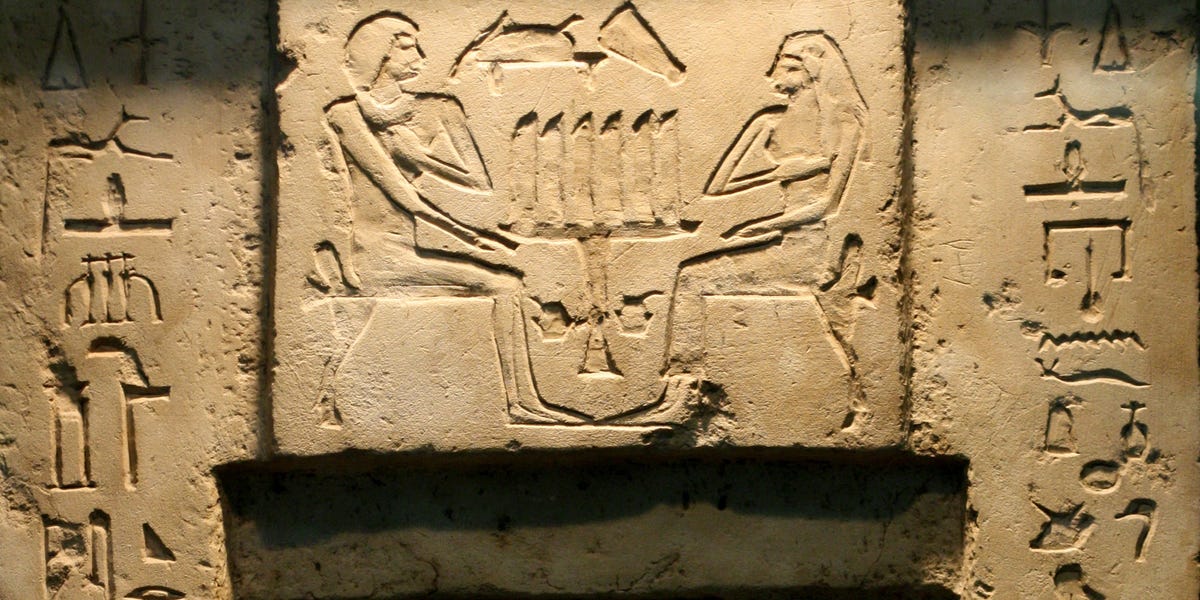
4 min readHere’s what you’ll learn when you read this story:Buried in the necropolis of Saqqara around 4,000 years ago, Sekhentyu-Ptah was an elite of society whose tomb was recently discovered by archaeologists excavating the area.Inscriptions on funerary objects indicate that he had several roles, including priest and supervisor of the king’s works and documents. There was also a false door in the tomb, not to fool potential looters, but instead for the deceased to enter and leave the afterlife at will.Among the sands of the Egyptian desert lies Saqqara, a necropolis where the first pharaohs and elites of the Old Kingdom were buried in tombs known as mastabas that were carved out of limestone. It was in one such tomb that the mummified body of a high-ranking official known as Sekhentyu-Ptah began his journey to the afterlife. While the tomb has long since been looted, it still offers a glimpse into life and death at the dawn of pharaonic rule 4,000 years ago.According to Egypt’s Ministry of Tourism and Antiquities, archaeologists discovered Sekhentyu-Ptah’s tomb while excavating the Bubasteion necropolis at Saqqara. The necropolis takes its name from the Bubasteion, a temple complex dedicated to the cult of Bastet, where worshippers from the Nile Delta city of Bubastis venerated the feline goddess and left offerings. Although the temple itself was built long after Sekhentyu-Ptah’s time, there’s evidence that the cult of Bastet had already formed during the Old Kingdom: vessels depicting the goddess in her cat and lioness forms have been found at the Step Pyramid of Djoser, built around 2650 B.C.E. And while the tomb may not have been directly associated with the cult of Bastet, its surviving artifacts illustrate the life and afterlife of an official who held many senior titles in Egyptian society.When the archaeological team investigated this tomb, they encountered a false door in the remains of a funerary chapel. A common sight in Egyptian tombs, “doors” like this one were once thought to deter and confuse grave robbers, but they were actually intended for the dead instead of the living. Ancient Egyptians believed that the deceased could enter and exit the afterlife at will through a door that no human alive would be able to open. In front of the false door, priests or mourners placed several funerary objects, among them a purification basin, an offering table, and an offering disk. Hieroglyphic inscriptions on these items identified them as belonging to Sekhentyu-Ptah and listed his titles, of which there were many: a royal chamberlain, supervisor of the king’s works, supervisor of the king’s documents, supervisor of scribes, and priest of the goddess of order and justice Ma’at, according to a statement from the ministry.Priests of Ma’at functioned as judges. They sought to resolve disputes by upholding the principles of truth and balance, which every Egyptian was expected to live by (rather than strict legalities), and dishonesty was a severe violation. Serving Ma’at must have helped Sekhentyu-Ptah in the afterlife. Egyptians feared the consequences of the goddess weighing the sins in their hearts against a feather and finding the heart was heavier, in which case the soul would be thrown down to the jaws of Ammit, the crocodile-headed devourer of the dead with the forelegs of a lion and the hindquarters of a hippopotamus. Embalmers sometimes placed a scarab over the heart of the deceased in the process of mummification, so any questionable deeds could be hidden and the heart would appear pure enough not to outweigh the dreaded feather.Saqqara is a UNESCO World Heritage site for good reason. It is an archipelago of tombs that includes relics of the Old Kingdom and burials from later periods. Also revealed near the tomb of Sekhentyu-Ptah was a network of burial shafts that looters also raided in antiquity, but which still contained human remains and funerary objects. Archaeologists also uncovered more than a hundred shabti figures, servant statuettes intended to take on every task in the afterlife while their master luxuriated in the Field of Reeds. Shabtis originated as a humane alternative to sacrificing a pharaoh’s actual servants, and at first they accompanied only royals to the tomb. But after artisans devised a way to mass-produce the figures—crafted from faience, an earthenware coated in blue, green, or turquoise glaze—they eventually became accessible to most Egyptians.This summer, the Egyptian government launched an initiative to upgrade the visitor experience at Saqqara by improving infrastructure such as roads, services, and facilities. The ongoing project is intended to emphasize the historical wonders of this necropolis while making it easier to tour for those who wish to take a journey through the sands of time. Reinforced roads between monuments will facilitate walking from one to the other. As tourism to the site increases, Tourism and Antiquities Minister Sherif Fathy is looking for sustainable ways to preserve and uplift Egypt’s cultural heritage while accommodating an increase in visitors. Meanwhile, excavations at Saqqara go on, and maybe they’re destined to uncover another entrance to the afterlife.“The mission will continue excavations and scientific analysis of the finds,” said a recent statement from Egypt’s Ministry of Tourism and Antiquities, “which are expected to provide further information about burial practices and the development of the Saqqara necropolis across different periods of ancient Egyptian history,”Elizabeth Rayne is a creature who writes. Her work has appeared in Popular Mechanics, Ars Technica, SYFY WIRE, Space.com, Live Science, Den of Geek, Forbidden Futures and Collective Tales. She lurks right outside New York City with her parrot, Lestat. When not writing, she can be found drawing, playing the piano or shapeshifting.
Scientists Found a 4,000-Year-Old Tomb—With a Door No Living Human Could Open
Full Article
Original Source
Read the full article at Popularmechanics →KhanList aggregates and links to publicly available news content. We do not host full articles from third-party sources. Always verify important information with original sources.