
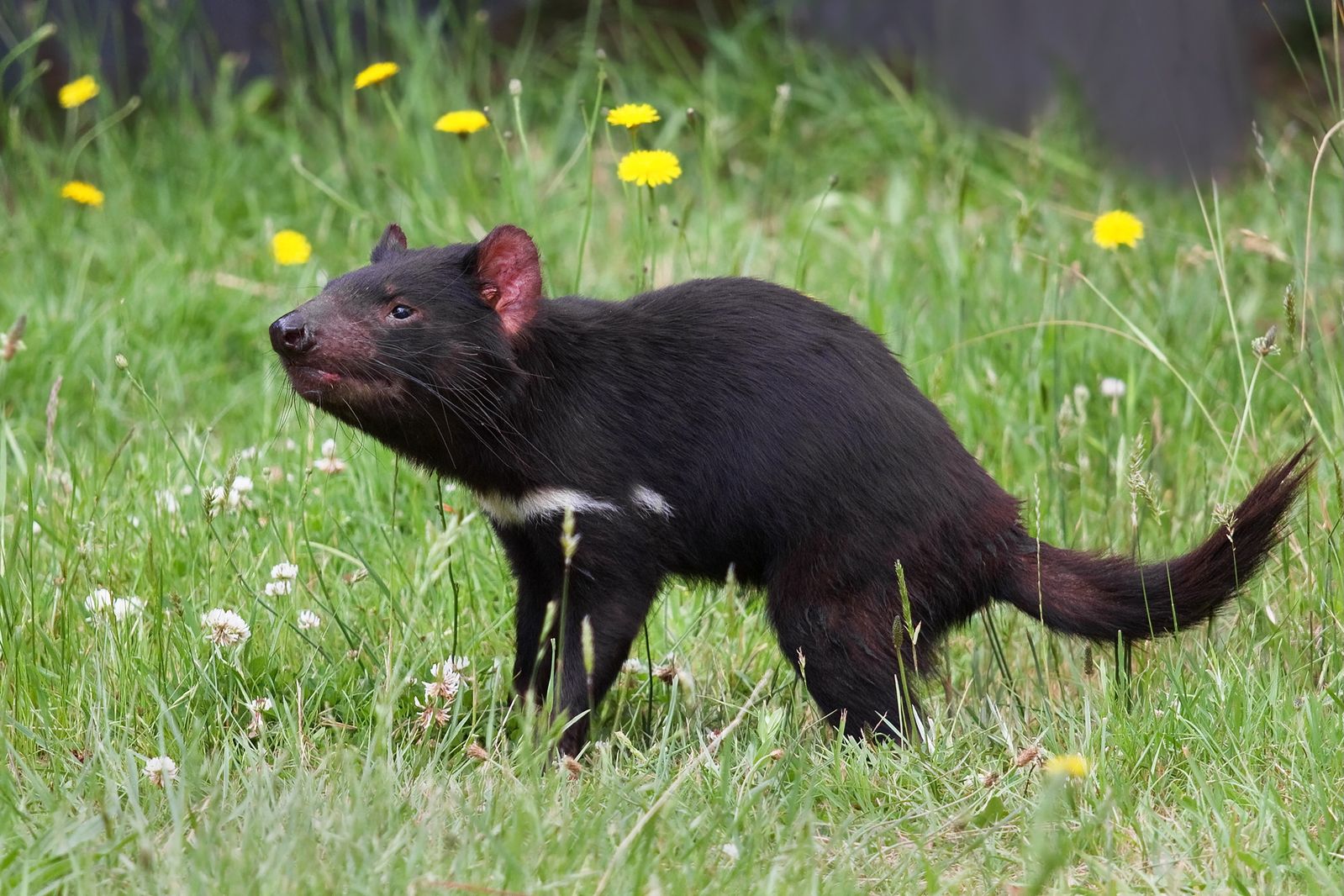
Fossils and marked bones unearthed in a Juukan Gorge cave suggest that the marsupial species not only once lived in the region but may have been a “garbage compactor on four legs” for its human population September 16, 2026 9:15 a.m. Tasmanian devils used to live across mainland Australia, but wild populations now inhabit only the island state of Tasmania. JJ Harrison via Wikimedia Commons under CC BY-SA 3.0 The Tasmanian devil, Earth’s largest meat-eating marsupial, is named for the single island state it inhabits. But thousands of years ago, the species lived all over mainland Australia—including alongside cave-dwelling people of the Ice Age, according to new research. “We picture them today living in the cold, wet forests of Tasmania,” Timothy Churchill, a paleontologist and zooarchaeologist at the University of New South Wales, tells the Guardian’s Petra Stock. “But they’re in fact a highly adaptable species that could be found across the entire mainland continent, including the arid, rocky gorge lands of the Pilbara.” Did you know? The Tasmanian devil’s mainland comeback A 2020 reintroduction project released 26 devils at a wildlife sanctuary in Barrington Tops National Park, about 130 miles north of Sydney, returning the species to mainland Australia for the first time in 3,000 years. Churchill and his colleagues recently unearthed telling fossils at Juukan Gorge in Australia’s northwestern region of Pilbara—the territory of the Puutu Kunti Kurrama and Pinikura peoples. Juukan has been called the setting of the “dawning of humanity”: It boasts rock shelters filled with evidence of human habitation stretching back 46,000 years, some of which were damaged or destroyed by mining operations in 2020. According to a study published in Archaeology in Oceania, the Juukan 2 rock shelter contained a jaw bone and a tooth fragment belonging to Tasmanian devils. Study co-authors Churchill and Gavin Ashburton of the PKKP Aboriginal Corporation, which supervised the excavation, write in the Conversation that the fossilized bone is a fragment of a lower jaw. It retains two molars and is between 6,900 and 7,300 years old. The tooth fragment, meanwhile, belongs to a premolar, and it was found embedded in sediment between 42,500 and 47,100 years old. This map of Australia indicates where Tasmanian devil fossils have been found. Juukan 2 is represented by a green dot, and the black arrow shows the location of some ancient rock art depicting the marsupial. Timothy J. Churchill et al., Archaeology in Oceania, 2026 Tasmanian devils are scavengers. Though they occasionally hunt for prey, such as wallabies and birds, devils mostly feed on carrion. The researchers concluded that the animals must have been using the Juukan caves—dwellings of semi-nomadic hunter-gatherers—as sources of food. The devils were the “local cleanup crew,” Churchill tells the Guardian. They ate rotting meat, reducing disease risk: “Having a garbage compactor on four legs running around would have definitely been an advantage.” The researchers found other evidence that Tasmanian devils had been in Juukan 2. They write in the Conversation that they’ve cataloged and examined more than 8,000 animal bones at the site, 1,000 of which are marked from chewing and gnawing. Most of these bones were scratched by rodent teeth, but at least ten of them have gnaw marks consistent with Tasmanian devil teeth. Those bones were found in deposits spanning the pre-Last Glacial Maximum—roughly 47,000 years ago—to the Holocene, about 11,600 years ago. The fossilized bone is a fragment of a Tasmanian devil's lower jaw, with teeth still attached. Timothy J. Churchill et al., Archaeology in Oceania, 2026 Additionally, the researchers studied 263 digested bone fragments found in Juukan 2. They deemed some of them too big to have been eaten by Pilbara’s smaller carnivores, like quolls and mulgaras. Instead, “they are most compatible with digestion by a large bone-eating dasyurid, such as the Tasmanian devil,” Churchill and Ashburton write in the Conversation. “We found lots of evidence of bones that have been chewed and digested by devils, which suggests that devils were accessing carrion that was accumulated by humans,” Churchill tells Amy Rossbach of the Australian Broadcasting Corporation (ABC). Researchers found the bones in areas also containing shell beads, bone tools and braided human hair. The new research adds a region, Pilbara, to the Tasmanian devil’s ancient territory, which massively shrank when dingoes outcompeted them in mainland Australia. The study also highlights an ancient interspecies relationship—between the Tasmanian devils and the humans who fed them. “What’s particularly interesting about this story is that Tasmanian devils may have had a much closer place in the lives of ancient Australians than we previously recognized,” Churchill tells the ABC. You Might Also Like Get the latest stories in your inbox every weekday. More about: Ancient Civilizations Animals Archaeology Artifacts Australia Bones Caves New Research Zoology
Tasmanian Devils Lived Alongside Humans in Northwestern Australia as Far Back as 45,000 Years Ago, Researchers Find
Full Article
Original Source
Read the full article at Smithsonianmag →KhanList aggregates and links to publicly available news content. We do not host full articles from third-party sources. Always verify important information with original sources.