
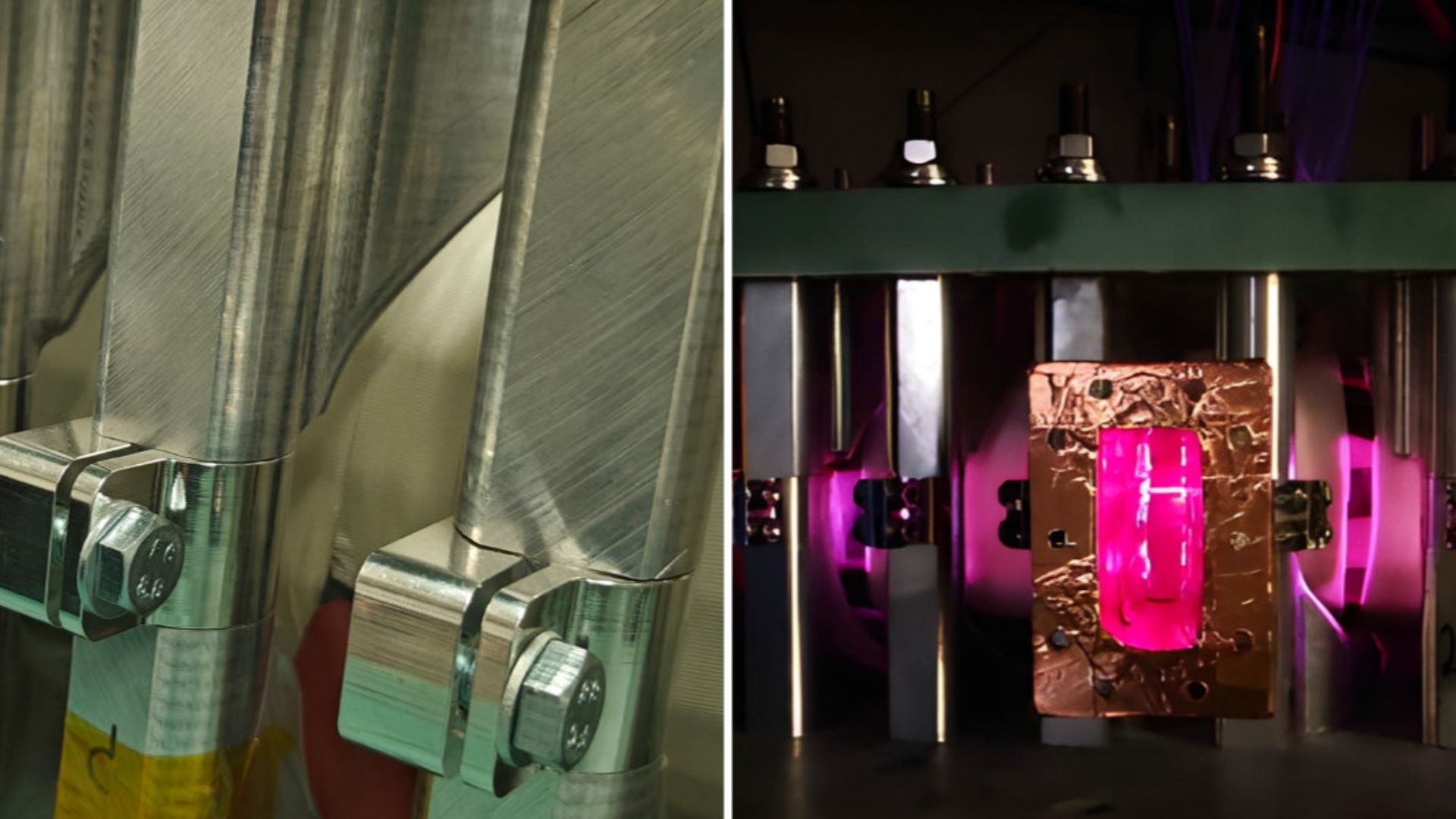
Engineers at compact fusion company nT-Tao have brought a 50-megawatt pulsed-power subsystem into active service. The hardware delivers high-energy bursts to the company’s C3 prototype, a machine designed to test magnetic confinement in dense plasma regimes. This installation marks a critical step toward exceeding 1.5 million degrees Celsius, the highest thermal benchmark recorded on the platform to date. Injecting large bursts of electricity into an ionized gas triggers severe circuit instability. As the plasma heats up during each pulse, its internal electrical properties fluctuate within fractions of a millisecond. These rapid swings alter the electrical impedance of both the plasma and the delivery hardware. “The power must also be controlled precisely as the electrical characteristics of the system and the plasma change rapidly during each pulse,” said the company in a press release. If the supply fails to match these shifts instantly, electrical resonance breaks down and the gas reflects energy back into the driving circuits. To prevent this loss, nT-Tao paired the 50-megawatt unit with a proprietary real-time nonlinear control system. Nonlinear real-time tuning The controller tracks circuit changes during the pulse and updates operating parameters continuously. This active tuning maintains resonance throughout the discharge, ensuring maximal energy transfers into the plasma core under fast-varying conditions. CTO and co-founder Boaz Weinfeld pointed out that generating 50 megawatts is relatively straightforward compared to the task of coordinating 50 separate modules in real time. The primary engineering accomplishment lies in forcing multiple units to function as one synchronized circuit. The physical power supply expands the company’s Modular Energy Generator Architecture, known as MEGA. The setup distributes the power load across 50 compact units called Power Electronic Generators (PEGs), rather than relying on a single, large power source. Each PEG produces approximately 1 megawatt of output. Technicians grouped these generators into ten parallel branches, placing five parallel-wired modules on each branch. The complete network operates across switching frequencies between 50 and 2,000 kilohertz. “It represents a roughly five-fold scale-up from an earlier generation that integrated 12 PEGs into an approximately 10 MW system,” added the company. Hardware scalability and recent milestones Using 1-megawatt modules provides practical manufacturing and operational advantages. Technicians can connect modules in series or parallel arrangements to meet specific circuit requirements. According to Weinfeld, fusion systems that cannot be produced at scale will fail commercially. Standardized, repeatable modules keep the physical footprint compact and allow capacity growth without redesigning core hardware. The 50-megawatt power feed supports a broader strategy to turn plasma physics theory into viable, compact reactor hardware. Assembly took two months, with the machine reaching operational status and firing initial plasma pulses in January. That testbed followed an earlier experimental series with the C2-A machine, which registered plasma temperatures around 100 electronvolts, or about 10^6 degrees Celsius. By combining modular power electronics with high-speed nonlinear controls, the team has established the electrical drive required to push plasma past those early milestones toward commercial reactor temperatures.“Together, the 50 PEGs and the real-time controller form the power architecture subsystem intended to deliver large amounts of energy to the plasma in precisely controlled pulses, moving nT-Tao closer to its next temperature milestone on the path toward a commercially viable compact fusion system,” concluded the company.Get the latest in engineering, tech, space & science - delivered daily to your inbox.An active and versatile journalist and news editor. He has covered regular and breaking news for several leading publications and news media, including The Hindu, Economic Times, Tomorrow Makers, and many more. Aman holds expertise in politics, travel, and tech news, especially in AI, advanced algorithms, and blockchain, with a strong curiosity about all things that fall under science and tech.
Nuclear fusion testbed gets 50-MW pulsed-power upgrade to push core plasma temperatures
Full Article
Original Source
Read the full article at Interestingengineering →KhanList aggregates and links to publicly available news content. We do not host full articles from third-party sources. Always verify important information with original sources.