
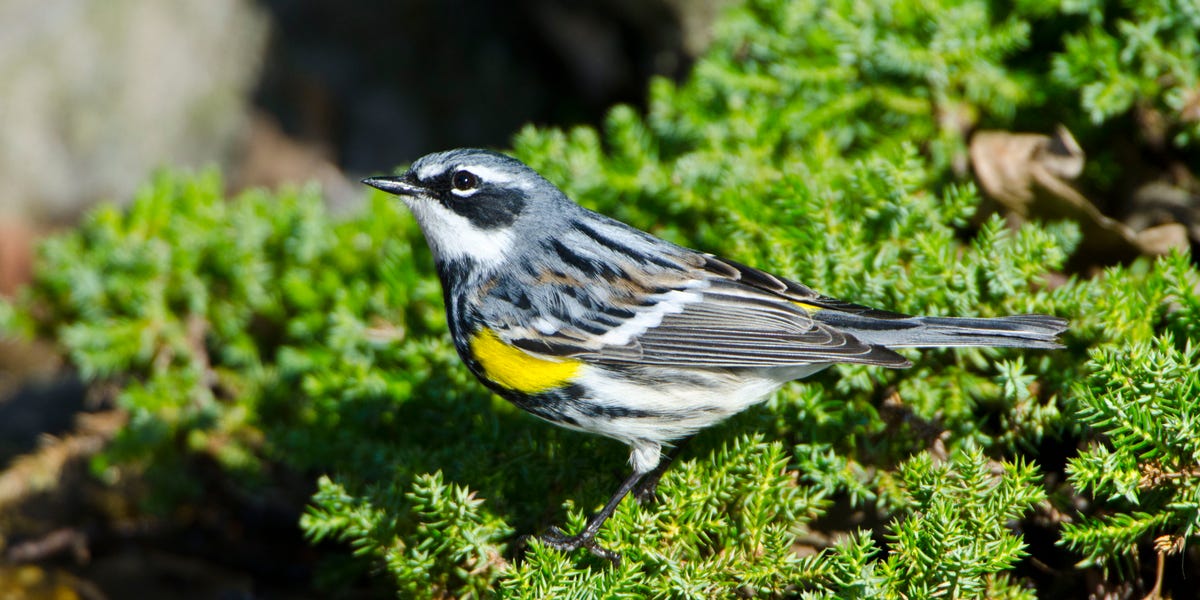
4 min readHere’s what you’ll learn when you read this story:Songbirds used to be difficult to track because GPS tags were too heavy for their small bodies, but much lighter and more compact geolocators have made it easier. By tracking yellow-rumped warblers with pressure-based geolocators, researchers found that their actual migration routes were different from what had been previously assumed.While genes drive birds to migrate to certain locations, the formation and melting of ancient glaciers is also thought to have an influence.When Stephanie Szarmach, a postdoctoral fellow at the Smithsonian Migratory Bird Center, caught a yellow-rumped warbler that had been flitting from branch to branch in a black spruce forest, she knew she had the right bird. She’d identified it by a red band on its leg, which meant it was carrying a tiny backpack that would tell her about its migration routes over the past year.The “backpack” is actually a multisensor geolocator tracking device about the size of a breath mint. Last year, Szarmach and evolutionary biologist David Toews of Penn State University tagged dozens of birds to find out exactly where they flew off to as they migrated over the changing seasons. Yellow-rumped warblers tend to begin migrating earlier in the spring and later in the fall than other warbler species. These tiny songbirds, which are only 5 to 6 inches long from beak to tail, were named for the bright splotches of yellow on one side of their chest and, of course, on the underside of their rump. They communicate with chirps, trills, and whistles. Living mostly in coniferous forests during the spring and summer, they can be found everywhere from gardens and thickets to beaches, depending on where they migrate to in the winter.Szarmach and Toews wanted to find out more about the warblers’ migration routes. So each bird they captured received a geolocator backpack, held in place by harness loops around its legs, with the tag resting comfortably on the lower back. While GPS satellite tags have shown high accuracy in tracking migrating birds, their relative bulkiness makes them unsuitable. Just the battery of a GPS tag is too heavy for a bird the size of a yellow-rumped warbler. Enter light-level geolocators. These devices weigh far less, at just 0.3 grams, making it possible for any bird weighing more than 7 grams to fly while wearing them. The devices employ a light sensor that estimates location based on daylight, which nearly cancels out the need for electricity, so the minuscule batteries they use can last a year or more as the birds undertake their journeys.When birds are recaptured, the “backpack” is unloaded and connected to a computer that downloads the data it collected over the migration period. Analysis of this data reveals where and how far the bird ventured. While these can still glitch and result in minor errors, especially around the autumnal and spring equinox whose days are the same length, a newer type of barometric geolocator tracks migrations by gauging air pressure as birds fly higher and lower. This tells scientists when a bird departed from one stop on its migration route and landed at another. The “backpack” records a drop in air pressure as a bird ascends and an increase in air pressure when it descends, while also keeping track of the elevations where the bird spends most of its time. Yellow-rumped warblers tend to range from middle elevations in the summer to low elevations in winter.Pressure changes recorded by the geolocator can be compared to global weather data with the computer program GeoPressureR, which uses air pressures for the migration journey to narrow down specific locations. How likely a bird is to have been somewhere depends on whether the elevation at ground level matches the pressure picked up by the geolocator. These devices eliminate the problem of inaccuracies based on equinox light and can be nearly three times more accurate than older versions that relied on light. What Szarmach especially wanted to know were the breeding locations and migration routes of yellow-rumped warblers in the Pacific Northwest, a subspecies known as myrtle warblers. It was previously thought that they bred as far north as Alaska and British Columbia and spent the winter on the California coast.When the trackers were analyzed, Szarmach and Toews found that the six warblers they successfully tracked from breeding grounds near Anchorage, Alaska, ended up nowhere near California. Instead, the birds flew east across the boreal forest of northern Canada, then turned south near the Great Lakes and continued to the Gulf Coast. At roughly 6,800 miles (10,900 kilometers) round-trip, the journey was far longer than expected for a bird long considered a short- to medium-distance migrant. While this might still seem inconvenient considering the entire trek through Canada, it might have been ingrained in these birds for millions of years, going back to ice ages when the spread of glaciers blocked their original paths and forced them in another direction. When the glaciers began to recede, birds expanded their breeding range further and further into the forest. This would ultimately lengthen their migrations.It’s also possible that there is a genetic component to bird migration routes, which includes both physiological and morphological traits such as wingspan. Some researchers think that certain species may have genes that control multiple migratory traits in close proximity, and the birds inherit them together. There might also be genetic variants of a given gene which allow it to be in charge of more than one trait. Whatever it is that keeps birds coming back to the same locations season after season, year after year, advances in geolocation such as the backpacks these warblers were equipped with are helping scientists better understand why.“More precise location estimates help researchers identify key stopover and wintering sites in need of protection and better understand the threats birds face throughout their journeys,” Szarmach recently told Smithsonian Magazine.Elizabeth Rayne is a creature who writes. Her work has appeared in Popular Mechanics, Ars Technica, SYFY WIRE, Space.com, Live Science, Den of Geek, Forbidden Futures and Collective Tales. She lurks right outside New York City with her parrot, Lestat. When not writing, she can be found drawing, playing the piano or shapeshifting.
Why Do These Birds Keep Flying in the Wrong Direction? Scientists May Have Found the Answer—in the Last Ice Age
Full Article
Original Source
Read the full article at Popularmechanics →KhanList aggregates and links to publicly available news content. We do not host full articles from third-party sources. Always verify important information with original sources.