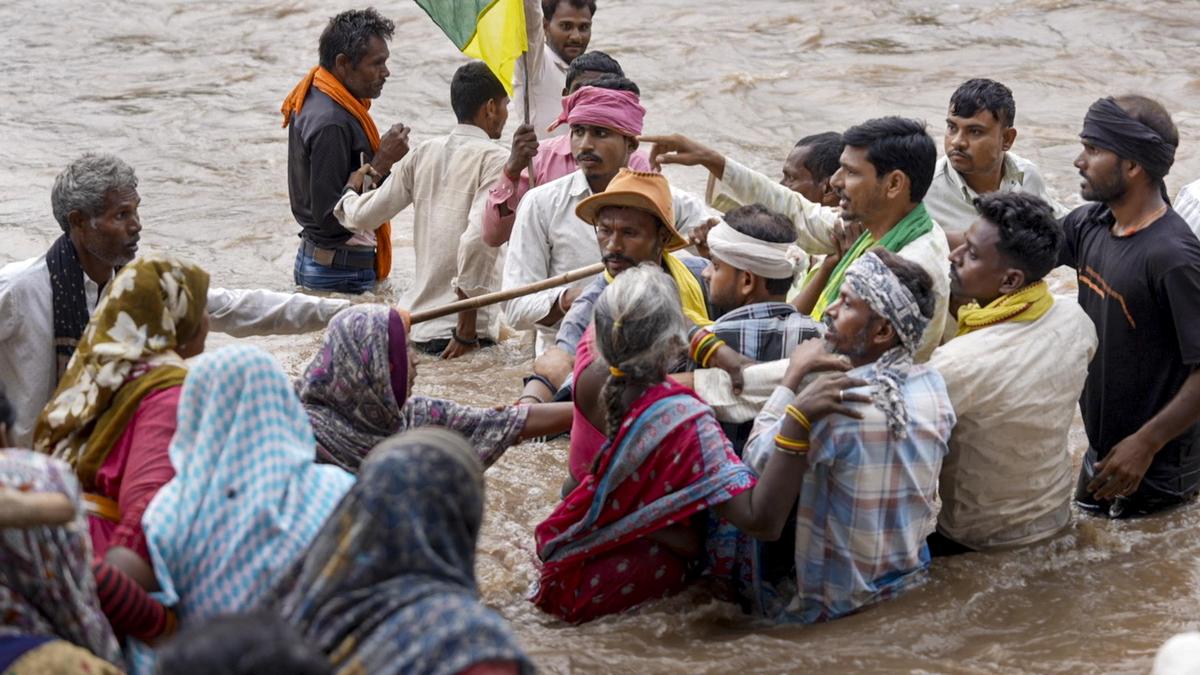
The story so far: Less than 24 hours after the Delhi Police’s forcible removal of activist Sonam Wangchuk from his protest site at Jantar Mantar on the 21st day of his indefinite hunger strike, the Madhya Pradesh Police ended another protest about 650 km from the national capital. Early morning of Sunday (July 19, 2026), M.P. Police personnel arrived on the banks of Barana river stream in Kupi village of Chhatarpur district and cleared a protest site where hundreds of villages, mostly tribals, had been demonstrating for two weeks against the Union Government’s ₹44,000 crore Ken-Betwa Link Project (KBLP), India’s first river linking project, and two irrigation projects of the Madhya Pradesh Government.The police also took local activist Amit Bhatnagar, founder of Jai Kisan Sangathan, who had been on an indefinite hunger strike for 14 days and admitted him to a government hospital, while nearly 150 protestors, most of them from neighbouring Panna district, were taken in buses and dropped in their villages.Videos that emerged from the scene showed a group of protestors standing in the middle of the river and holding onto each other amid heavy water flow, women protestors being dragged away from the shore by the police, and a group of personnel carrying Mr. Bhatnagar into an ambulance.The visuals from the demonstration grabbed national attention on social media where men and women could be seen placing hanging noose around the neck while some lied on symbolic pyres inside the water. They raised the slogan ‘nyaya do ya maar do [either give us justice or kill us]’.The unique protest, that was first held in April, had been relaunched earlier this month after discussions and efforts by the government failed to convince the villagers.The protestors have been demanding improved rehabilitation and compensation package for families facing displacement by a dam while also alleging various irregularities in selection of eligible people for compensation.What is the Ken-Betwa river linking project?Part of the Ken-Betwa river linking project is the first of 30 such link projects under a National Perspective Plan (NPP) for water resources development and interlinking of rivers with ‘surplus water’ to those with ‘deficit water’, formulated in 1980 by the Ministry (then Union Ministry of Irrigation) and the Central Water Commission.The NPP is divided into two components — Himalayan Rivers Development that proposes 14 links and Peninsular Rivers Development that plans 16 links, as identified by the National Water Development Agency (NWDA).The foundation stone for the project was laid by Prime Minister Narendra Modi on December 25, 2024, at an event in Madhya Pradesh’s Khajuraho where he laid the foundation stone for the construction of Daudhan dam.The project plans on transferring the declared surplus water of the Ken river by constructing the Daudhan Dam on it and using a 221-km canal, including a 2-km tunnel, to the Betwa river. Apart from this, the project is also expected to generate 103 MW of hydropower and 27 MW of solar power.It is also aimed at solving the water woes of the drought-prone Bundelkhand region by providing drinking water to 4.4 million people in about 12 districts of Madhya Pradesh and more than two million people in 10 districts of Uttar Pradesh.Spread between the northern parts of Madhya Pradesh and southern Uttar Pradesh, the partly-hilly region covers 13 districts in the two States and has for long suffered droughts and water shortages. The region is also among one of the country’s most socio-economically backward regions. Madhya Pradesh also features in the plans for three more similar river linking projects.Protest against Ken-Betwa river link project turns violent in M.P.; 3 cases lodgedWhat are the key demands of the affected tribal families?As per the Union Government, 7,193 familiies of 14 villages in Chhatarpur and eight villages in Panna district are facing displacement under the project.However, the protests are not only against the Ken-Betwa project but also include at least five Madhya Pradesh Government works such as the Majhgaon and Runjh irrigation projects.The primary demands regarding the Ken-Betwa project are that each adult individual be counted as a single unit for the ₹12.5 rehabilitation package instead of a family, and that the cut-off date for the eligibility be moved from February 16, 2024 to the current date, according to Divya Ahirwar of Jai Kisan Sangathan.As for the other projects, the protestors demand that the rehabilitation provided to them be in line with the Ken-Betwa project.In both cases, however, they also allege serious irregularities in the survey and selection process and claim that several people who have no connection with the villages or have moved years ago have been included in the rehabilitation plan, while many genuine residents have been left out.Speaking from the hospital, Mr. Bhatnagar claimed that the police action came on the day he was planning to “reveal the details of an alleged ₹400-crore corruption scheme” involving the inclusion of fake beneficiaries in the compensation process.The have also alleged irregularities in the proceedings of the gram sabhas of the tribal villages to get the approval for the Ken-Betwa project.The 12-day April protest was suspended following assurances from the government but was relaunched after the protestors alleged that their demands were not met.Days after it was restarted on July 4, the State Government approved to increase the amount of rehabilitation package for Majhgaon and Runjh projects by about ₹300 crore, increasing the compensation from ₹5 lakh to ₹12.5 lakh.Chhatarpur Collector Parth Jaiswal says that about 750 families were also added to the rehabilitation plan for the two projects through a fresh survey. Mr. Jaiswal has termed the rest of the demands as “invalid” and said the villagers are being “misled” by some people.Speaking about the Sunday’s (July 19, 2026) police action, Divya Ahirwar of Jai Kisan Sangathan alleged that many people had received injuries and that several women were yet to reach their homes.“Since Amit ji is continuing his fasting in the hospital, all the protestors observed a ‘Chulha Banda Andolan’ on Monday (July 20, 2026) by not cooking anything at their homes and fasted with him,” she said.The protestors have also accused the authorities of illegal and forcible evictions of several families before they received full compensation, disconnecting electricity and filing false police cases against at least 250 people.While various protests over Ken-Betwa have been reported in the region since early, 2025, a statement by the Union Ministry of Jal Shakti in July, 2025, said, “No protest has been observed as reported by the Project Authority, District Administration and Forest Department, concerned.”What are the environmental concerns surrounding the project?While the Bharatiya Janata Party governments in the Centre and the two States have claimed various benefits of the project, several environmental concerns have also been flagged as the result of the massive project, primarily over its potential impact on the local ecology and wildlife as a large part of the project falls inside the Panna Tiger Reserve.Apart from displacement, the primary concern revolves around proposed felling of trees. As per the Jal Shakti Ministry, approximately 17,101 trees had been identified for felling to facilitate the execution of the Daudhan Dam and allied infrastructure until July, 2025. Of these, 12,404 trees have been felled within the Panna Tiger Reserve Forest.Ms. Ahirwar, however, claims that at least 46 lakh tree, a large number of them inside the Tiger Reserve, are likely to be felled for the entire project.Concerns have also been raised that the project may hurt the tiger reintroduction programme in the Reserve which revived the feline population after it had locally gone extinct in 2009.Apart from tigers, species such as endangered vultures, mahseer fish, and gharials in the Ken Gharial Sanctuary are also feared to be impacted.The Central Government is also yet to release hydrological data of the two basins claiming that they are sensitive by virtue of being subsets of the international Ganga basin.A Central Empowered Committee (CEC) of the Supreme Court had in a 2019 report also flagged various wildlife clearances to the project, claiming that the authorities had not considered its impact on the Gharial Sanctuary and the vulture nesting sites. It had also warned of serious impacts on the riverine flora and fauna of the Ken river as well as the unique ecosystem of the region.Various experts also believe that the data the government has banked on to conclude that the Ken river has surplus water is outdated and have demanded release of the latest figures.Between 2005 and 2008, then Panna Collector Deepali Rastogi had written to various Central and State Government Departments claiming that there was no surplus water in the Ken river.
Ken-Betwa protest: Why are tribals opposing the river-linking project | Explained
Full Article
Original Source
Read the full article at Thehindu →KhanList aggregates and links to publicly available news content. We do not host full articles from third-party sources. Always verify important information with original sources.