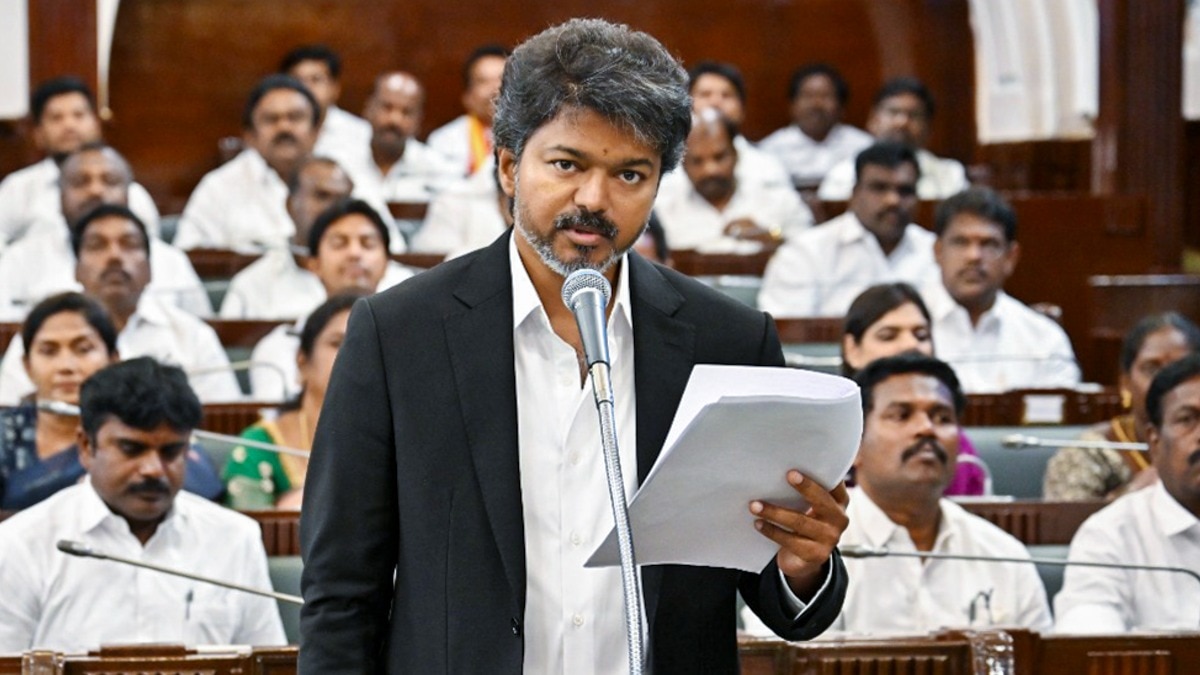
The Niti Aayog's first-ever Investment Friendliness Index ranks Tamil Nadu third in India and praises its strengths. But it also flags areas such as airport capacity, treated sewage water, and port connectivity as key gaps. The challenge now is whether CM Vijay can turn these shortcomings into opportunities and make Tamil Nadu India's most investment-friendly state.Tamil Nadu Chief Minister C Joseph Vijay in his first Niti Aayog meet raised several key issues relating to the state. (Image: PTI)Tamil Nadu Chief Minister C Joseph Vijay is running the state more like a CEO than a career politician. A new Niti Aayog report card reflects that approach. The report has come as both applause and a to-do list for Tamil Nadu and its new TVK government led by Vijay.Tamil Nadu has been ranked the third most investment-friendly state by the Niti Aayog in its first-ever Investment Friendliness Index 2026 report.However, buried within the praise are some reminders about the ageing airport infrastructure, gaps in sewage management and other issues that continue to test Tamil Nadu's investment ambitions. The question now is whether Chief Minister Vijay will turn these identified weaknesses into his next governance mission.The NITI Aayog's Investment Friendliness Index 2026 report was published on July 18. The report cited Tamil Nadu's strong performance as a result of its infrastructure, institutional capacity, and policy stability. Tamil Nadu was ranked first among large states in infrastructure, backed by the country's most efficient industrial corridors, better road connectivity linking Chennai, Coimbatore, and Hosur, a wider rail network serving the automobile, textile, and cement industries, and ports ranked the best in terms of turnaround time. The state's energy sector also emerged as a key strength, recording electricity downtime and transmission losses below the average for large states while drawing significant support from its expanding wind and solar energy capacity.But despite these criteria that have made Tamil Nadu investor-friendly, the report makes it clear that Tamil Nadu's journey towards becoming India's most investment-friendly state is not an unfinished job. Several indicators of Tamil Nadu continue to lag behind the country's best-performing states, with shortcomings in areas such as airport infrastructure, sewage management and other civic and logistics bottlenecks emerging as the next set of governance challenges. It is these gaps that now present CM Vijay with an opportunity to move beyond maintaining Tamil Nadu's position and push the state to the top of the national rankings.HOW TAMIL NADU CAN BECAME THE BEST STATE FOR INVESTMENTThe first half of the Niti Aayog's Investment Friendliness Index 2026 report highlights the success story of Tamil Nadu, but the report also has some suggestions that could be read like a governance mission blueprint by the Tamil Nadu government to improve the state's accreditation as investment-friendly.According to the Niti Aayog report, Tamil Nadu's financial health is a major concern. The report reveals that the state's outstanding liabilities stand at 31% of its Gross State Domestic Product (GSDP).Tamil Nadu's GSDP is close to the national average (the average for large states is 30.3%), but it is high enough to weigh down the financial health score of the state.Interest payments, which account for 3.4% of GSDP, have also been flagged in the report as an area where fiscal discipline could improve the state's investment credentials.The report also identifies critical gaps in logistics despite Tamil Nadu being ranked first in infrastructure among large states. It notes that the state's Container Freight Station (CFS) and Inland Container Depot (ICD) capacity is 33% below the large-state average relative to its manufacturing output, creating a bottleneck in cargo movement.Around Chennai Port, inadequate road infrastructure continues to cause severe congestion, with trucks reportedly waiting for as long as 36 hours to enter or exit the port, increasing logistics costs for businesses in the state.Another area, according to the Niti Aayog report, demanding urgent attention is aviation infrastructure. The report reveals that the Chennai airport needs significant expansion to keep pace with the state's growing industrial economy. It specifically points to limited international connectivity, particularly the lack of direct flights to several European destinations, despite Tamil Nadu hosting many European multinational companies.Water security also emerges as a long-term challenge for investors. The report highlights difficulties in securing industrial water supply in several parts of the state and notes the limited availability of treated sewage water for industrial reuse, especially in rain-shadowed and landlocked regions. Improving wastewater treatment and expanding water recycling infrastructure, it suggests, would make industrial growth more sustainable.FACTORS MAKING TAMIL NADU INVESTOR-FRIENDLYThe Niti Aayog has also credited Tamil Nadu for maintaining one of India's strongest innovation ecosystems, supported by the second-highest number of Atal Tinkering Labs, a near-100% conversion of investment memoranda of understanding into operational projects, and policy consistency that has earned investor confidence over the years.The electric vehicle policy was particularly highlighted in the report as a model for attracting global manufacturers through customised incentive packages. These efforts were complemented by the state's deep pool of skilled talent produced by engineering colleges, ITIs and polytechnics, alongside industrial infrastructure developed by SIDCO and SIPCOT and investor facilitation systems such as Biz Buddy and the Guidance Tamil Nadu Investor Facilitation Portal, which offers time-bound grievance redressal.The state's economic credentials are equally impressive. Tamil Nadu's export-to-GSDP ratio is 36% higher than the average for large states, while it attracted $2.436 billion in foreign direct investment (FDI) during FY24. It also topped the environmental resilience pillar, with air quality 22% better than the category average and strong stakeholder confidence in its disaster preparedness mechanisms.Taken together, the shortcomings form the NITI Aayog's roadmap for Tamil Nadu's next phase of reforms. For Chief Minister C Joseph Vijay, whose governance narrative has centred on efficiency, execution and results, the report offers more than a ranking. It lays out the specific tasks that could transform Tamil Nadu from a top performer into India's most investment-friendly state.- EndsPublished By: Avinash KateelPublished On: Jul 21, 2026 07:14 IST
Will CM Vijay take up airports, sewage challenge thrown by Niti report?
Full Article
Original Source
Read the full article at Indiatoday →KhanList aggregates and links to publicly available news content. We do not host full articles from third-party sources. Always verify important information with original sources.