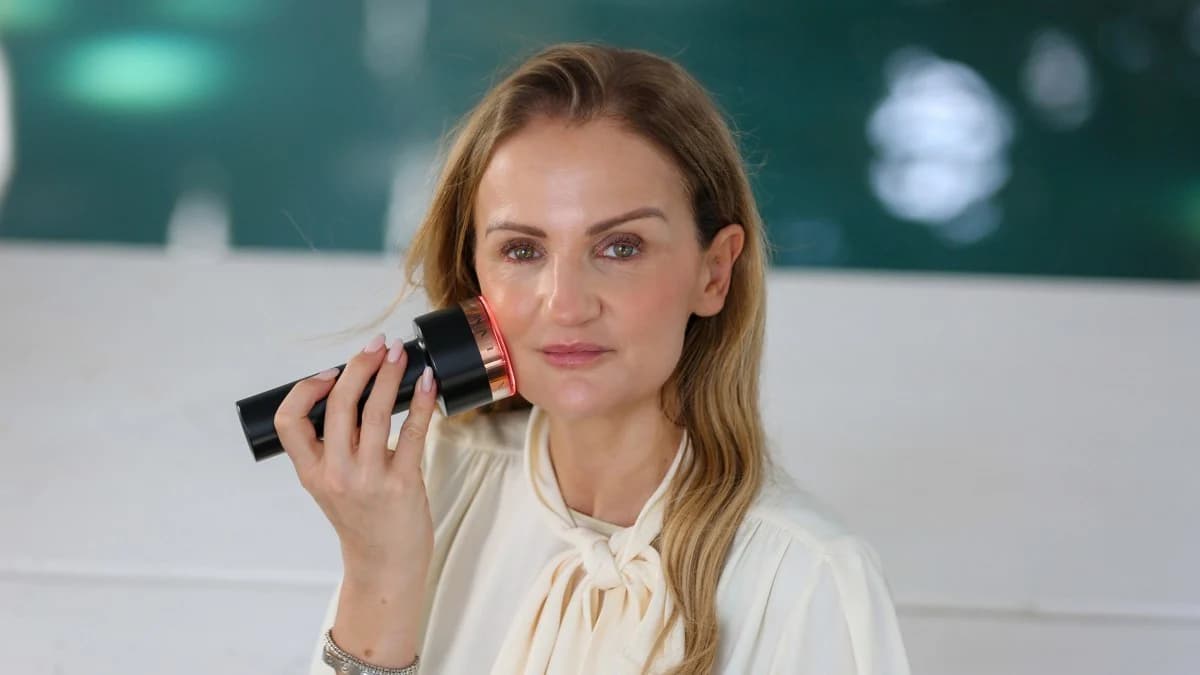
When Lucy Goff’s baby was a few days old, she lay in bed after a terrifying spiral of pre-eclampsia, an emergency C-section, felt “worse than I could ever imagine,” woke up her husband and told him: “I think I'm going to die.”He called an ambulance, where paramedics undressed Goff and drew pen all over her body as parts of her skin had turned black.It was septicaemia, and Goff spent the next six weeks in intensive care. Even when she came home, recovery was gruelling. The woman who had spent a decade running major PR campaigns for Selfridges now lacked the physical strength to lift her newborn daughter. “The doctor said I should ‘give it time,’ but I felt hopeless,” she recalls.Instead, Goff took a desperate trip to a Swiss health clinic - which changed her life in two ways. She fell into a chance conversation with Oxford longevity academic, Professor Paul Clayton, who was at the same hotel for a conference. “He started talking about pharma-equivalent, highly absorbable supplements designed to stop bodily inflammation,” she explains, “and promised to post me some to try. I was pretty sure I’d hear nothing of it.”But a few weeks later, a package arrived containing a supplement regime of 16 tablets a day. Goff recovered “dramatically,” she says - and also had the blueprint for a business. “Working at Selfridges, I’d spent years watching beauty brands launch identical, marketing-led products,” she says. “I knew the industry was ripe for actual, science-backed disruption.”But turning Clayton's complex formulation into a commercial product, which grew into Goff’s luxury supplement brand LYMA, wasn’t easy.“The standard supplement factory all used generic, bulk-bought ingredients from China," Goff explains. “Finding a facility that would agree to use our patented, peer-reviewed ingredients took us over a year.”Securing capital was tough too: Goff sought £2 million - “but every single investment firm turned me down. They refused to believe that anyone would pay premium prices for a scientifically-proven supplement.” Instead, the entrepreneur remortgaged her home to pay for 10,000 units of supplements, which she listed at £150 for a month’s supply. “When we sold out in two weeks, and then the investors came back to me wanting to get involved.. but I wouldn't partner with someone who didn't believe in me from the start.”Goff struck LYMA sales deals with Net-a-Porter, then Harvey Nichols, Harrods, and - in the US - Gwyneth Paltrow’s Goop, and department stores Bergdoff Goodman and Neimann Marcus. She went on to take £2 million investment from Pembroke VCT across 2018 and 2019; the company has been profitable since year two.Its next big leap came after Clayton noticed that a patient's knee, which had been treated with a medical-grade, low-level cold laser for an injury, looked much younger than the other knee. Goff then beamed a handheld laser torch at her own knees every evening. After eight weeks, her younger-looking knees led the entrepreneur to engineer cumbersome medical lasers into a sleek, consumer-friendly device.The LYMA Laser launched in September 2020 - fortuitously when the lockdown-struck wealthy really wanted beauty treatments - at £2,000. “It was a completely unprecedented point in the home beauty tech space, and I was worried,” Goff admits. “But I thought if we sold 100 lasers in a year, we’d have done incredibly well.”She sold 100 in the UK and Europe in the first week. “That was the moment I realized the absolute power of the trust we had built.” It took 18 months to receive regulatory approval to sell the laser in the US - as there was no precedent for home-use cold lasers, LYMA had to wait for a lengthy compliance pathway to form.But once it went on sale, business ballooned: since Goff launched her high-powered LYMA Laser PRO, 70% of turnover comes from the US, where A-list facialists and celebrities have become fans. “I was at an event in New York recently where Martha Stewart was talking about how much she loves the Laser,” Goff reports. "Then Courteney Cox turned around and said, 'I love you guys, I have your lasers at home.'” Other customers include Hannah Waddingham, Carey Mulligan, and Kate Hudson.The numbers reflect the frenzy: turnover hit £36 million last year, with £5 million Ebitda. Now running a team of 55, Goff’s desk still houses a badly-made copper pot - a remnant of an early supply chain mistake that resulted in a warehouse full of “expensive, unusable paperweights,” she grins. “It sits there to mock me… a daily reminder that quality is non-negotiable.”LYMA is now launching a skincare line to capitalise on its anti-aging audience, and considering launching in the UAE and Australia. “We’re just,” Goff adds, “getting started.”
Every VC turned her down. Now she runs a £36M beauty empire
Full Article
Original Source
Read the full article at Standard →KhanList aggregates and links to publicly available news content. We do not host full articles from third-party sources. Always verify important information with original sources.