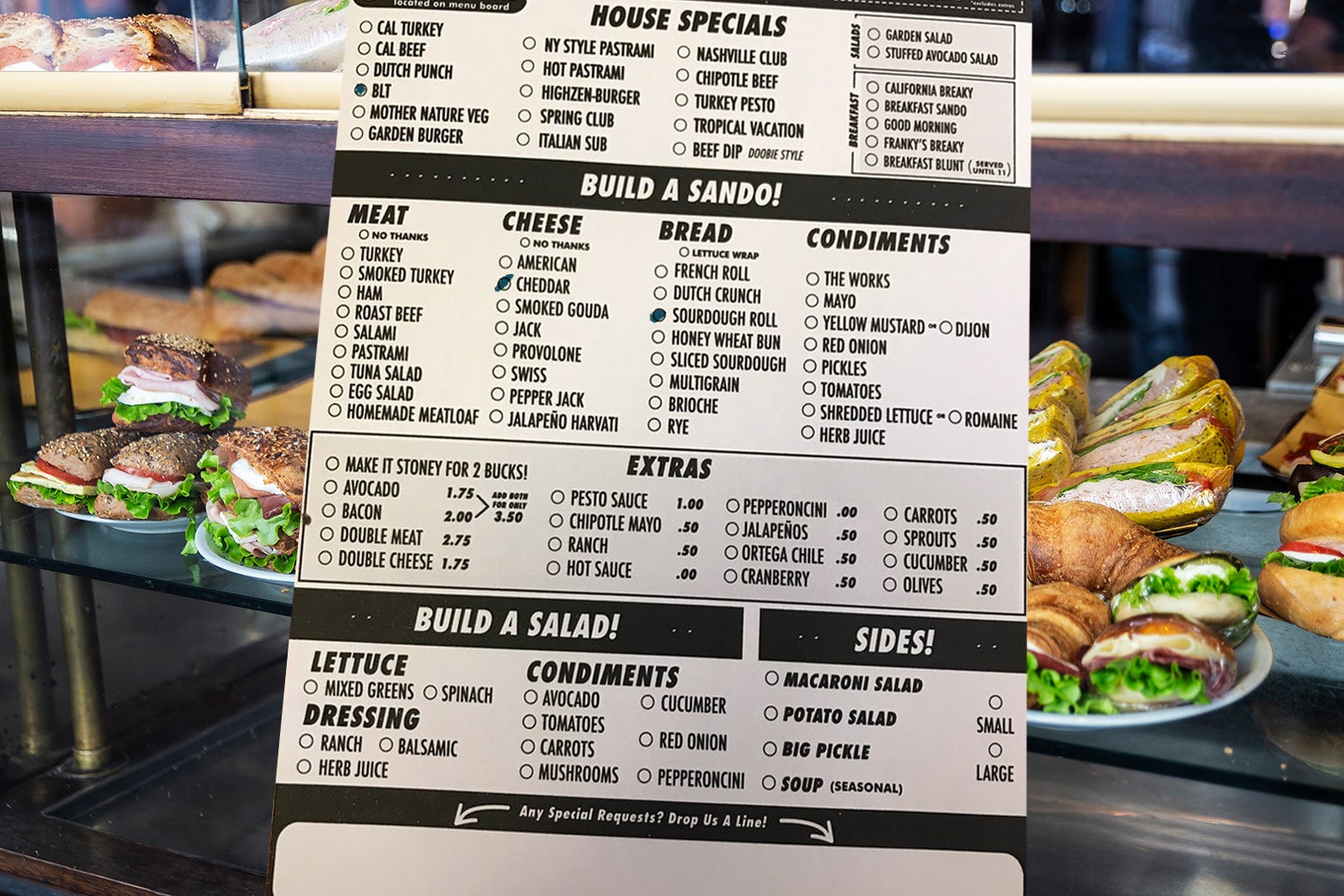
Food The Joys and Tribulations of Multiple-Choice Ordering Checkbox menus like those at Which Wich offer endless sandwich freedom. But can we handle the gift? Photo illustration by Slate. Photos by J2R/Getty Images Plus and High Street Deli. Sign up for the Slatest to get the most insightful analysis, criticism, and advice out there, delivered to your inbox daily. Storytelling began with the oral tradition and found its peak in written form, and so it is with sandwich ordering. Though underutilized, the most advanced ordering system in the food industry is when you’re handed a multiple-choice menu at a sandwich (or burrito, or burger, or pita) joint and get to check among 100 little boxes, selecting sauces, toppings, bread/wrap, cheese, baking method, and every other micro detail. It’s like a delicious version of the SATs. Within that bubble sheet is a world of possibility. The eateries have every filing, topping, and garnish in existence, and it feels like they’ve been waiting since opening just for you to come in and provide the exact combination in order to build the perfect bite. “Gosh, we’ve never known what to do with all these fixings,” they say, handing me the raw ingredient list. “Show us the way.” So I oblige them. And yet sometimes, when I get the sandwich or burrito back, the perfection I thought I’d summoned slips through my fingers (literally, as overfilling forces a structural leak and the sub implodes in my hands). Did it really have a chance to begin with? Probably not with me at the helm. And thus we see the double-edged/stuffed sword of multiple-choice ordering: It may offer a horizon of endless customization, but it comes at a price. I remember when I first encountered this somewhat rare system at a random Which Wich years ago. Seeing my confusion, the clerk pointed me to a stand like you’d find at the DMV, where fields of bag-shaped menus and silos of little Sharpies awaited. Checking the endless boxes with the careless abandon of someone who got the answers ahead of time, I handed the completed sandwich bag to the cashier and watched as they turned my primitive scribblings into delicious art. Best Adapted Screenplay, as far as I was concerned. No longer did I have to order under pressure with passive-aggressive throat clears of impatience behind me. No more did I have to request countless substitutions to prebuilt sandwiches like a neurotic. It was all there, I just had to make my marks. “When I created Which Wich, I wasn’t trying to reinvent the sandwich—I was trying to reinvent the ordering experience,” says Which Wich founder Jeff Sinelli, who opened his first location in Dallas in 2003, replacing, appropriately, a Subway. “Traditional sandwich shops often involve a line where you’re making decisions under pressure while someone waits for your answer. We wanted to give people the freedom to browse, think, and build exactly what they wanted without feeling rushed.” It is true freedom—but are we ready for it? Some customers (me) won’t know what to do with all that possibility, overfilling a pocket of starch with way too many ingredients and subsequently wondering if they shouldn’t have gone with the chef’s recommendations instead. The problem is that freedom of choice tends to lead to an escalation of expectations. I stare at that Enigma machine of sandwich options and imagine that somewhere within those little boxes there’s a perfect sub waiting to be found. No such thing exists, of course, and I needlessly torture myself with thoughts of what could have been. “It’s very hard to avoid having expectations go up as options go up. Why would you settle? Seeing the options is telling you that you may not think you care much about the exact constitution of your sandwich, but you should,” says psychologist Barry Schwartz, author of The Paradox of Choice: Why More Is Less. “I myself don’t spend my time chewing a burrito and imagining that another would have been better, but I think a lot of people do … you’re doing these implicit comparisons with alternatives you rejected, and whatever you’ve got in front of you is bound to lose.” It’s not that we want our sandwiches, burgers, and burritos handed down unalterable from on high by some Big Brother entity. But there’s a limit to how much choosing mere mortals can handle. If you’re ordering a burger, for instance, and they ask if you want cheese or not, that’s fine. But if they’re offering six types of cheeses, seven types of meat, and options to have the onions raw, grilled, caramelized, or pulverized into confetti above the sandwich, the customer might merely ask for a bun to lay his head on and take a nap. Customization-based sandwich chains like Mr. Pickle’s and Which Wich understand this all too well, which is why they also offer signature combinations to guide the hesitant. And if you get a bit trigger-happy at Which Wich and don’t like the sandwich choices you made, they’ll totally refund it and let you try again. “Every now and then someone creates what can only be described as a very ambitious sandwich,” says Sinelli. “Sometimes you discover your new favorite combination. Sometimes you learn that 12 toppings and four sauces might have been one step too far.” I learn that frequently. Which is why endless choices allow me to take part in one of my favorite hobbies: blaming myself. You see, if I order the recommended signature sandwich, and it’s not to my liking, I typically blame the establishment. When I have all the power? It’s on me—the shredduce is always greener, etc. “You just assume that one option you rejected would have been better, without evidence,” says Schwartz. “And nobody was putting a gun to your back. So whose fault is that?” It’s why, when I don’t want to think, I gravitate toward those old-school sandwich shops where the barren menu has fewer letters than the alphabet and there are no substitutions. Ask for a different cheese or esoteric sauce and they’ll just respond with the thousand-yard stare and refer again to the two or three things on the board. I’m reminded of Wilensky’s Light Lunch in Montreal, open since 1932. It’s where you’ll find the grilled salami and bologna sandwich with mustard on a roll, and where they tell you: “It’s always served with mustard and never cut in two. Don’t ask why; just understand that this is nothing new.” Such places can be a haven for those seeking refuge from endless alternative universes of sandwiches. I should probably just stick to them. And yet, like many who’ve grown up in the just-order-it-on-Amazon digital age, I stupidly tend to assume that everything should be possible. So I keep returning to that bubble-sheet parade of veggies and cheeses and meats looking to come on down. Why? Because maybe I recently patronized a restaurant that might as well be called “Fuck Tomatoes,” where they don’t put tomatoes on sandwiches and burgers the way I like, and then where do I go? Right back into the welcoming arms of “We Love Tomatoes and We’ll Make Whatever the Hell You Want, Incorporated.” It’s not just limited to sandwiches. Everything—the news, your health, election results, history, students telling professors what to teach—is now customizable to the preferences of whatever reality bubble you want to live in. More egalitarian? Maybe, but few seem truly happier with all the choice. So sure, I want tomatoes and banana peppers and white cheddar on my sandwich. But part of me is a little disappointed when that one old-school joint opens up the fixings floodgates because a few picky jackasses complained. Now they have it all—except for my respect. Get the best of news and politics Sign up for Slate's evening newsletter. Cooking Fast Food Food Restaurants
There’s a Simple Technology That Could Revolutionize the Restaurant Experience. Are Diners Ready for What It Demands?
Full Article
Original Source
Read the full article at Slate →KhanList aggregates and links to publicly available news content. We do not host full articles from third-party sources. Always verify important information with original sources.