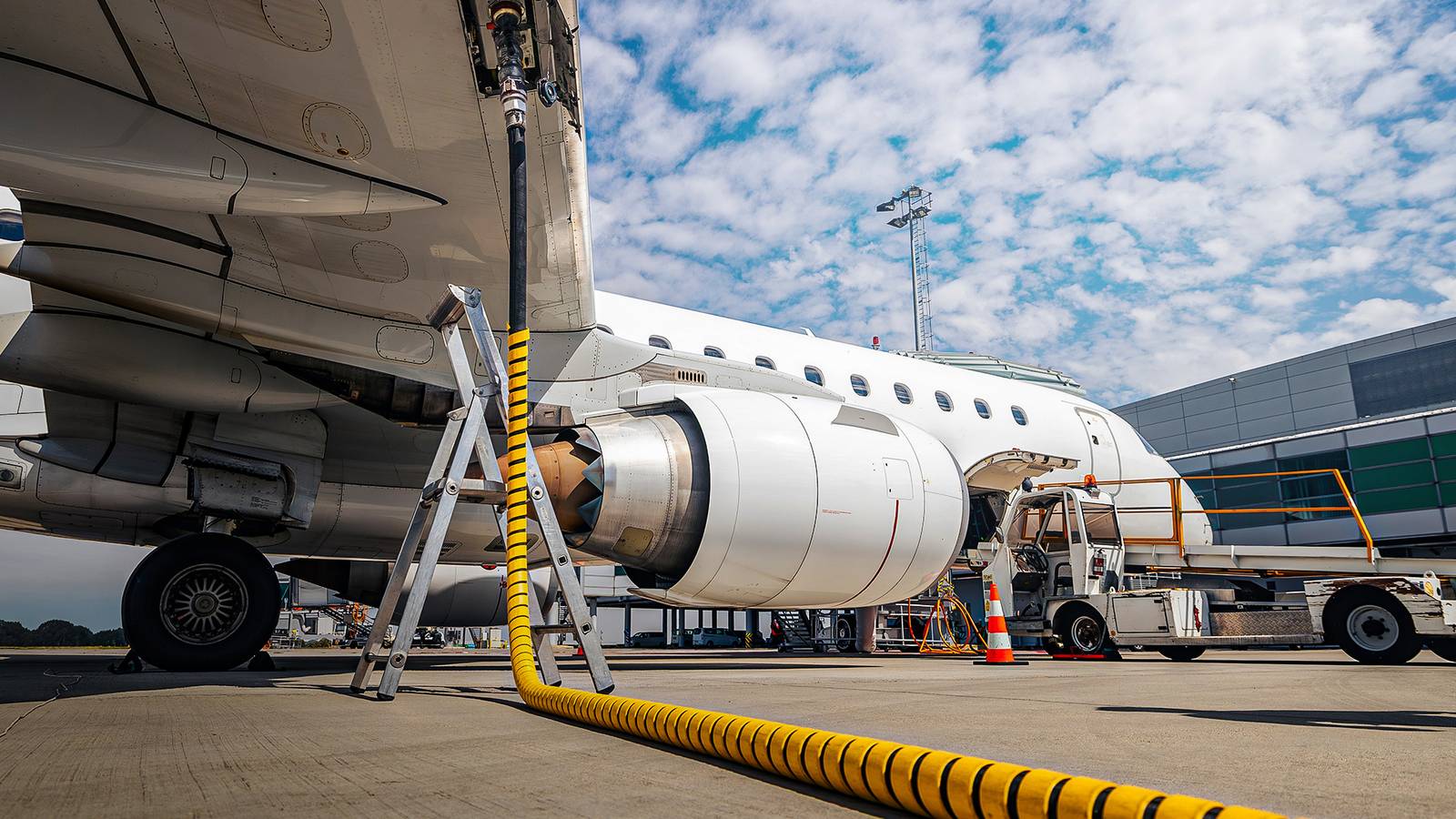
Published Jul 26, 2026, 6:00 AM EDT Airline and Airport Management Graduate, Student Commercial Pilot and Commercial Aviation Writer. Based in London & Nagoya Here's something that plays out at many airports globally: two identical commercial airliners sit parked at adjacent gates at a major international aviation hub. Both ground crews connect fuel hoses to the subterranean hydrant system, pumping thousands of gallons of standard kerosene-type jet fuel into the wing tanks of each aircraft. The fuel itself is identical, drawn from the same storage tanks buried deep beneath the airport tarmac. When the financial invoices are settled, one airline might be paying $2.80 per gallon ($0.74 per liter) while its neighbor is billed $4.10 per gallon ($1.08 per liter) for the same uplift on the same afternoon. Fuel is the single largest variable operating expense for commercial carriers, frequently consuming between 25 and 35% of total airline revenue. The price an airline pays at the nozzle is the final output of a plethora of factors, including long-term off-take agreements, joint-venture infrastructure ownership, local into-plane tolling fees, and paper-market financial derivatives. Buying Fuel In Bulk Credit: Shutterstock At the core of fuel price asymmetry is volume-driven bulk procurement, as airlines rarely purchase fuel on an ad-hoc basis at the airport gate. Instead, large-scale network carriers negotiate massive multi-year off-take agreements with global oil refiners and major fuel distributors to secure predictable supply chains. Today, far more of these agreements are being made for sustainable aviation fuel (SAF) contracts. These agreements establish guaranteed minimum volume commitments across entire domestic or international networks, securing steep bulk discounts that remain completely out of reach for smaller regional operators or low-cost startups. When drafting an agreement, the details are structured around index-linked spot market benchmarks rather than fixed retail prices. In North America, agreements are typically pegged to the US Gulf Coast or New York Harbor spot market indexes, while European and Asian operations look to the Platts index for regional pricing baselines. The final price paid by the airline is calculated as the underlying index price plus a specific basis spread, which covers the logistical costs of moving the kerosene-type jet fuel from the refinery or pipeline terminal to the airport boundary. Legacy carriers with massive hub operations hold significant leverage when negotiating this basis spread, allowing them to extract favorable terms. For instance, a dominant airline purchasing 5,000,000 gallons (18,927,058 liters) of jet fuel per week can negotiate a basis spread as low as $0.03 per gallon ($0.008 per liter) above the baseline index. In contrast, an international operator lifting only 50,000 gallons (189,270 liters) per week for a limited schedule faces zero local leverage, meaning it has to accept a basis spread of $0.22 per gallon ($0.058 per liter) from secondary distributors, resulting in a massive structural cost divergence at the exact same airport. The Cost Of Getting Fuel In The Aircraft Credit: Shutterstock Once the jet fuel crosses the airport property line, it enters a highly regulated distribution network that can heavily penalize outsiders. At major international airports, the fuel farm infrastructure, pipeline connections, and subterranean hydrant system are rarely owned by the airport authority or a single oil company. Instead, they are typically managed by a fuel consortium, which functions as a joint-venture corporation formed by a select group of founding legacy airlines that invested the original capital to build the facility. This infrastructure ownership model creates a massive cost divide, as proprietary consortium members pay minimal internal throughput charges to cover basic maintenance, insurance, and management of the underground network. Non-consortium airlines, including newer low-cost entrants or occasional foreign carriers, face heavily marked-up commercial throughput rates set by the consortium board just to access the storage tanks. On top of these storage and distribution fees, every airline must contract with an into-plane service provider, like Swissport or Menzies, responsible for physically pumping the fuel from the ground valve into the aircraft wing tanks. These tolling fees vary wildly based on contract terms and historical relationships at the station. A dominant airline might negotiate a flat monthly service rate or a volume-tiered fee of two cents ($0.02) per gallon ($0.005 per liter), while a transient carrier without an established local contract pays an ad-hoc rate as high as 15 cents ($0.15) per gallon ($0.040 per liter) for the same delivery service. This discrepancy means that the act of storing and moving fuel through the airport floor adds a significant premium to the non-member airline invoice before the engines ever start. Predicting The Unpredictable Credit: Shutterstock Procurement contracts and infrastructure fees establish the baseline cost at the wing tank, but the most radical distortions in fuel pricing occur far away from the airfield on the financial trading floors. The price of jet fuel is tied intimately to global crude oil volatility, so airlines adopt derivative risk mitigation strategies to protect their balance sheets from sudden, unpredictable oil market spikes. These risk management programs use financial instruments like options hedging, crack-spread swaps, and costless collars to lock in maximum fuel prices months or years in advance. When an airline successfully uses a derivative risk mitigation program, its true cost of fuel decouples entirely from the current spot market price. If an airline locked in a significant portion of its summer fuel requirements using options hedging when crude prices were depressed, its effective net price per gallon drops dramatically. Conversely, if an airline enters into fixed-price swaps right before a market downturn, it remains legally trapped into paying inflated prices for its fuel uplifts, independent of the actual pump price displayed at the gate. Two airlines might purchase fuel from the exact same supplier, using the same subterranean hydrant system, and receive identical delivery invoices at a baseline spot rate of $2.90 per gallon ($0.77 per liter). However, after accounting for financial paper gains or losses, their true corporate fuel costs diverge entirely, directly altering the net effective operating cost per hour and determining which carrier can afford to underprice the other in a fiercely competitive passenger fare war. New Era Of Sustainability Credit: Shutterstock Under the terms of the Chicago Convention of 1944, fuel lifted for international flights is legally exempt from direct national customs duties and excise taxes, a protection designed to foster global connectivity. However, this historic exemption does not apply to domestic operations, leaving airlines highly vulnerable to localized tax regimes. In the United States, commercial operators face a baseline federal excise tax of $0.043 per gallon ($0.011 per liter), but individual state-level taxes fluctuate wildly from zero to over $0.30 per gallon ($0.079 per liter), penalizing airlines with heavy domestic networks concentrated in high-tax states. Regional environmental policies and carbon pricing systems amplify these fiscal disparities, particularly as regulatory bodies accelerate their decarbonization frameworks. In Europe, the regional emissions trading scheme has entered a decisive phase, completely removing free carbon allowances for aviation. Airlines operating flights within the European Economic Area must purchase 100% of their carbon obligations through competitive auctions, adding a substantial carbon premium to every gallon uplifted. Conversely, foreign long-haul carriers operating departing flights out of European hubs are primarily subject to the broader international carbon offsetting scheme, which features vastly lower offset credit prices, shielding them from the brunt of localized carbon compliance costs. European regulations enforce a mandatory 2% sustainable fuel blend at major airports, while individual nations across the Asia-Pacific region are rolling out independent frameworks, such as a 1% blending target supported by centralized procurement levies. Alternative fuels can cost up to four times more than standard kerosene, so a domestic carrier operating exclusively within these mandated boundaries absorbs a severe structural cost penalty. Meanwhile, an international competitor refueling at an unregulated home hub completely avoids these immediate premium outlays, allowing it to maintain a lower net operating expense. Credit: Shutterstock To circumvent these compounding fiscal disparities, localized basis spreads, and inflated infrastructure fees, airlines use an operational strategy known as fuel tankering. Instead of purchasing fuel at a destination outstation where local distribution markups or taxes are elevated, flight dispatchers deliberately over-fuel the aircraft at their primary hub. The aircraft carries enough additional fuel to cover the outbound flight, the ground operations, and the subsequent return leg without ever drawing from the outstation ground valves. This practice turns the aircraft into a flying storage tank, taking advantage of the airline's hub purchasing power to starve high-cost outstations of refueling revenue. Although tankering avoids localized price spikes, it introduces a strict penalty in the form of increased fuel consumption due to deadweight. Transporting thousands of pounds of extra kerosene increases the gross weight of the aircraft, requiring the engines to burn more fuel just to keep the additional weight airborne. For every extra 1,000 pounds (454 kg) of fuel carried, a modern commercial jet burns an additional 30 pounds (14 kg) to 40 pounds (18 kg) of fuel per hour, depending on cruise altitude and atmospheric conditions. Advanced flight planning systems utilize real-time optimization algorithms to evaluate this weight penalty against the outstation price spread, activating the strategy only when the financial savings outpace the cost of the extra burn. The economic stakes of these calculations have risen dramatically following a severe global energy and refinery crisis triggered by the closure of the Strait of Hormuz. With global jet fuel prices skyrocketing to an unprecedented average of $209 per barrel ($1.31 per liter), fuel now accounts for over 31% of total airline operating expenses, compressing net profit margins across the industry to a razor-thin 2%. In this highly volatile environment, where unexpected geopolitical detours can force widebody aircraft to burn an additional 2,000 gallons (7,571 liters) to 4,000 gallons (15,142 liters) of fuel per flight, network carriers with sophisticated algorithmic tankering capabilities hold a massive advantage. They can dynamically shift their fuel procurement across global stations, leaving smaller regional airlines or unhedged operators exposed to catastrophic financial strain. Who Will Survive The Fuel Crisis? Credit: Shutterstock The baseline retail price posted at the airport boundary fence is a financial illusion that bears little resemblance to the real corporate cost of keeping an aircraft airborne. The convergence of multi-year bulk procurement leverage, proprietary infrastructure ownership within tight airport fuel consortiums, and sophisticated paper derivative hedging dictates the financial reality of each flight. Ten separate airlines can stand side by side on the same concrete ramp, drawing identical kerosene from the same fuel system, but operate under completely different economic rules. This persistent asymmetric advantage massively reshapes the competitive landscape of the global airline industry, acting as a sorting mechanism between highly capitalized mega-carriers and vulnerable independent operators. The current era of aviation is being defined by extreme market volatility and mandatory environmental compliance, and so, the ability to orchestrate network-wide fuel arbitrage is just as critical as aerodynamic efficiency or passenger load factors. Fuel efficiency has now shifted from a minor operational KPI into a core pillar of macroeconomic survival, dictating which airlines can afford to maintain their networks and which will be forced into consolidation. Winning the passenger fare wars is no longer a task executed entirely in the sky through customer service or cabin layouts. The true battle is won on the balance sheets and within the long-term logistics contracts.
The Reason Airlines At The Same Airport Pay Completely Different Prices For The Same Fuel On The Same Day
Full Article
Original Source
Read the full article at Simpleflying →KhanList aggregates and links to publicly available news content. We do not host full articles from third-party sources. Always verify important information with original sources.