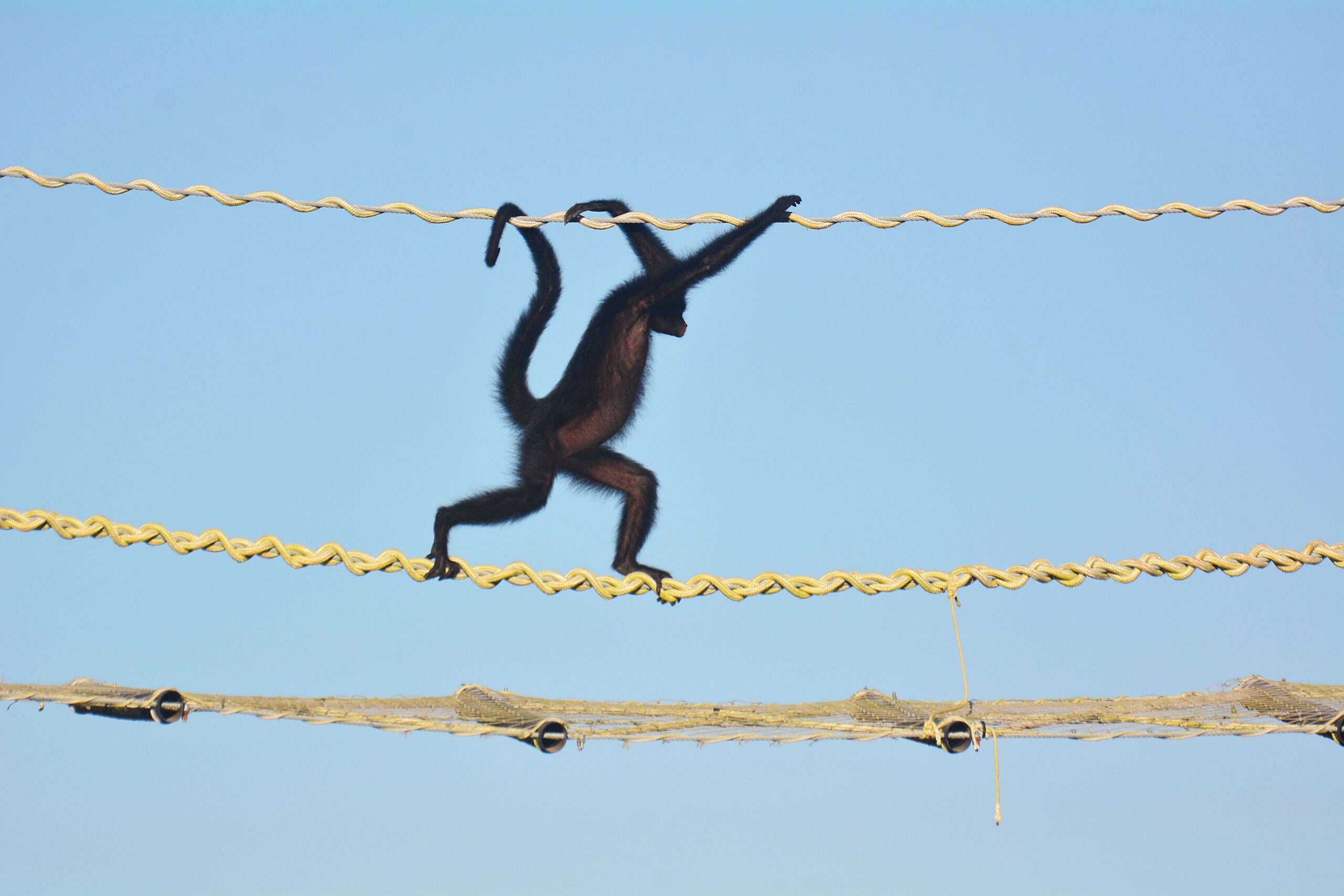
Project Reconecta installed eight rope bridges in a municipality in Brazil, and a 15-month study used camera traps to document thousands of arboreal wildlife adapting to new aerial crossings.Safe road passages enable seed dispersal and gene diversity, reversing the “domino effect” of biodiversity loss that begins when highways split habitats.Reconecta’s creator, biologist Fernanda Abra, a National Geographic Explorer and winner of the Whitley Award, is now expanding these low-cost conservation tools to other Brazilian biomes and neighboring Suriname.Brazil’s federal transport department has officially designated the rope bridge design as the recommended national standard for highways to curb the millions of wildlife deaths recorded on roads annually. Around 7 a.m., with dense fog blanketing the landscape, biologist Gabriel Falquetto had already come across several road-killed animals along ES-164 highway in Brazil’s Espírito Santo state. He was on his way to Kaetés Private Natural Heritage Reserve (RPPN), in the Atlantic Forest, where he monitors wildlife and roadkill in the region. Suddenly, he spotted the lifeless body of a primate on the pavement. It was a buffy-headed marmoset (Callithrix flaviceps), a species listed as critically endangered on the International Union for Conservation of Nature (IUCN) Red List. An estimated 2,500 individuals remain in the wild, making it one of the world’s most threatened primates. “It was extremely painful and discouraging,” Falquetto told Mongabay. “We travel through this region every day monitoring wildlife, and we celebrate every encounter with groups of buffy-headed marmosets in the forest.” “Finding an individual in those conditions brings a feeling of sadness and helplessness. Beyond the loss of that animal, the incident reminds us of the impacts our activities have on biodiversity.” About 2,900 kilometers (1,800 miles) away, on the road that leads to Alta Floresta, a small Amazon town in the far north of Mato Grosso state, cases like the buffy-headed marmoset’s roadkill have not been recorded since 2024. That year, eight canopy bridges were installed, connecting fragmented forest patches. Camera trap footage revealed that, over 15 months, the aerial wildlife crossings enabled 15,000 safe crossings by arboreal animals — and not a single roadkill. Installation of the first canopy bridges in Alta Floresta, in 2024. Image courtesy of Programa Alta Floresta Não Atropela. The bridges are part of a program involving Projeto Reconecta and the municipal government, along with local organizations and business owners who are eager to conserve the unique biodiversity of their town and promote ecotourism, but were alarmed by the growing number of wildlife-vehicle collisions. Biologist Fernanda Abra, an associate researcher at the Smithsonian National Zoo and Conservation Biology Institute in the U.S., and the founder of Reconecta, recalled that just hours before installing the first bridges in Alta Floresta, she found two Schneider’s marmosets (Mico schneideri) dead. The species is endemic to the Brazilian Amazon and is threatened with extinction. “A canopy bridge serves two purposes,” Abra said. “The first is to improve connectivity for wildlife, allowing animals to move from one side to the other in these fragmented forest areas. As a result, we also reduce roadkill.” All bridges have two camera traps, one facing the crossing to record which animals are using it and another facing the forest to observe which animals arrive there but decide not to use it. Among the primate species recorded using the bridges during the first months of the program were the black-faced black spider monkey (Ateles chamek), the Purus red howler monkey (Alouatta puruensis), the northern night monkey (Aotus infulatus), the tufted capuchin (Sapajus apella), Schneider’s marmoset and the Alta Floresta titi monkey (Plecturocebus grovesi). Described only in 2019 and soon after classified as critically endangered, the Alta Floresta titi monkey has become the symbol of the initiative, which is now entering a new phase thanks to its positive results. “In August, we will install eight more bridges in the city’s urban area,” Abra said. “The only difference is that the electric utility will first need to lower the power lines and insulate them so that if animals jump from the bridge onto the wires, they won’t be electrocuted.” A schneider’s marmosets (Mico schneideri), a threatened species from the Amazon, crossing one of the bridges in Alta Floresta. Image courtesy of Maelle Lima de Freitas. Bridge use increases over time The project underway in Alta Floresta is not Reconecta’s first. In 2021, working alongside the Waimiri-Atroari Indigenous people, the team installed 32 canopy bridges over BR-174, the highway that crosses both their territory and the Amazon between the Brazilian states of Amazonas and Roraima. The Waimiri-Atroari helped Abra identify the best locations for the artificial bridges. Over the past five years, cameras mounted on the bridge poles have documented about 1,250 primate crossings, including the golden-handed tamarin (Saguinus midas), a species that is not strictly arboreal and often descends to the ground in search of food, making it particularly vulnerable to roadkill. “The outcomes of the BR-174 project have been incredible. We were able to test different bridge designs to find out which ones the animals prefer,” Abra said. After years of working along Brazilian highways, the biologist had always sought a solution that was simple, low-cost and durable. The current bridge features a multilayer design that accommodates primates with different modes of locomotion — from species that rely on their prehensile tails to move through the canopy to brachiating species such as spider monkeys, which swing using their arms, both of which are common in the Amazon, as well as species that simply walk across the network of crossed ropes. It is worth noting that other small terrestrial mammals, including opossums, sloths and mouse opossums, have also been recorded using the bridges. Abra said it is important to keep in mind that this is a long-term project, and results are not always immediate. BR-174 was built in the 1970s, and animals take time to adapt to a new crossing alternative. Reconecta’s monitoring has shown that use of the structures increases over time. “Very often, our sense of urgency in conservation doesn’t take into account the timing of the impact,” she said. In Alta Floresta, tufted capuchins took seven months before using one of the bridges for the first time, which may indicate that each species has its own pace of adaptation. The Alta Floresta titi monkey is the symbol of the Alta Floresta bridges program. Image courtesy of Smithsonian’s National Zoo and Conservation Biology Institute and Projeto Reconecta. Species disappear, forests decline Home to the world’s greatest diversity of primates, Brazil also has the world’s fourth-largest road network — a deadly combination for animals living along forest edges that have been split apart to make way for highways. “From our human perspective, roads mean connection and development. But for wildlife, they represent disconnection, barriers and a threat to survival,” Abra said. Nearly 9 million mammals are killed on Brazil’s roads every year, a 2022 study found. A data compilation published in the journal Nature in 2025 also found that the country ranks among those with the highest mortality rates of terrestrial vertebrates killed in roadkills. “Habitat loss is one of the main drivers of population declines, especially among threatened species, but the impact of roadkill is still greatly underestimated,” primatologist Fabiano Rodrigues de Melo, a professor at the Federal University of Viçosa in Minas Gerais, told Mongabay. Beyond roadkills, highways bring confinement to fauna. “When populations become isolated, they grow smaller and more vulnerable to threats,” said Amely Branquinho Martins, an environmental analyst at the ICMBio, Brazil’s federal agency for conservation units, and coordinator of the Brazilian Biodiversity Genomics (GBB) project. One of those threats is inbreeding, which occurs when closely related individuals reproduce. “Habitat loss and degradation can prevent an individual from one population from migrating to another — what we call gene flow. Without it, the species’ genetic diversity declines.” The consequences continue to multiply in a domino effect, Melo said. The loss of primates, especially fruit-eating species, can alter forest composition, because they play a key role in seed dispersal and even contribute to pollination. “A whole network of ecological interactions is ultimately lost with the disappearance of these species,” Melo said. Biologist Fernanda Abra, founder of Reconecta. Image courtesy of Projeto Reconecta. Reconecta expands One of the hopes for reducing wildlife roadkill is the passage of a bill currently under consideration in Brazil’s Congress that would establish the National Road Safety Plan for Wildlife, which calls, among other measures, for the placement of wildlife warning signs, speed-reduction devices and the construction of overpasses, aerial crossings and underpasses along highways. The bill has already been approved by the Chamber of Deputies and is now awaiting a vote in the Senate. If approved, the canopy bridge model developed by Reconecta could be implemented nationwide. In 2026, Brazil’s National Department of Transport Infrastructure designated the design as the recommended standard for highways. In addition to Reconecta expansion results, Abra’s efforts to protect primates have earned international recognition. In 2019, she received the Future For Nature Award, followed by the Whitley Award in 2024, often referred to as the Oscars of environmental conservation. In June, she was also named one of the recipients of the 2026 Wayfinder Award, joining the select group of National Geographic Explorers, who receive funding from the organization for their projects. The support comes at the right time, as Abra plans to expand Reconecta, including new chapters in Suriname and Lucas do Rio Verde, a municipality in Brazil, which will install 10 canopy bridges. Aerial image shows one of the bridges installed in Alta Floresta. Image courtesy of Programa Alta Floresta Não Atropela. Abra also hopes to bring her canopy bridges to other biomes, including the Pantanal and the Atlantic Forest, helping prevent the deaths of monkeys such as the buffy-headed marmoset. Expectations are especially high for bridges over BR-262, one of Brazil’s longest highways, which cuts across the Pantanal and is known as the “highway of death.” The road kills approximately 2,000 animals every year. “I envision a future with Reconecta Biomes. We already have Reconecta Amazon, and we’ll soon launch Reconecta Pantanal. I also see canopy bridges in the Atlantic Forest for the primates that live there, including muriquis and howler monkeys, which are both highly threatened,” she said. She stressed that for this vision to succeed, the continued engagement of government agencies, private companies and local communities will be essential, just as it was in Alta Floresta and the Waimiri-Atroari Indigenous Territory. “When everyone is involved, everyone values the initiative and works harder to make it succeed.” Banner image: A black-faced black spider monkey (Ateles chamek) crossing one of the multilayered bridges. Image courtesy of Sergio Leal. How effective are canopy bridges really? FEEDBACK: Use this form to send a message to the author of this post. If you want to post a public comment, you can do that at the bottom of the page. Credits Topics
Zero roadkill as Amazon canopy bridges secure 15,000 crossings
Full Article
Original Source
Read the full article at News →KhanList aggregates and links to publicly available news content. We do not host full articles from third-party sources. Always verify important information with original sources.