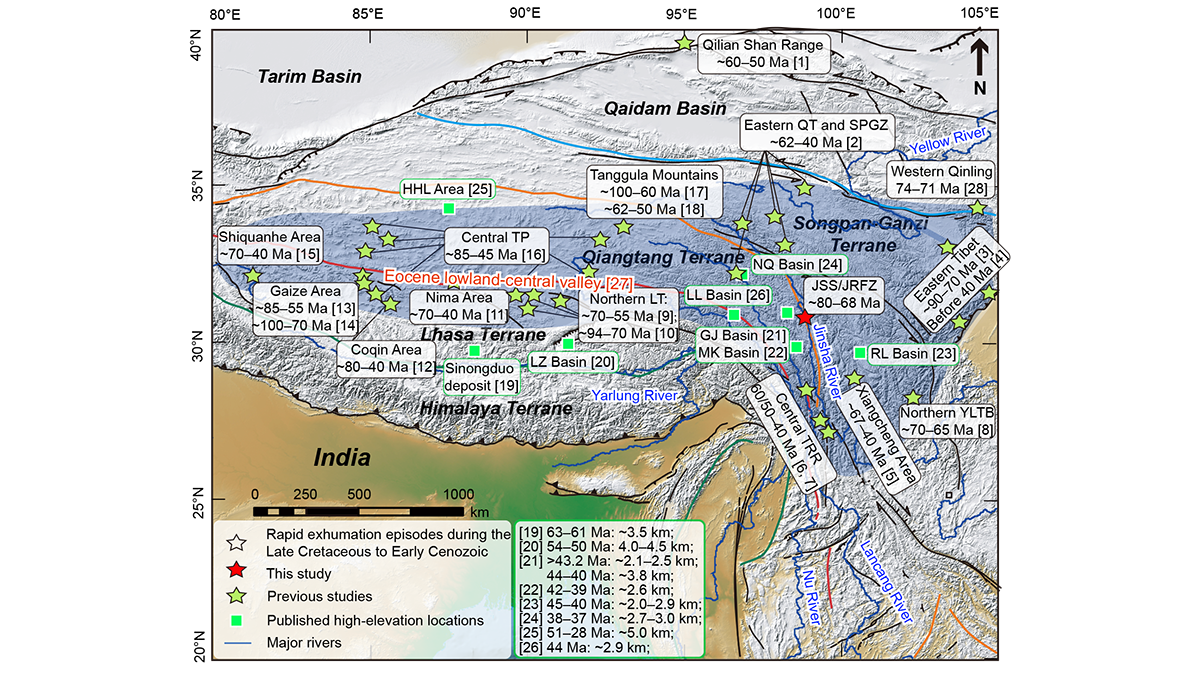
This figure shows the regional synthesis that places the new results from the Jinsha region within the wider pattern of Late Cretaceous–Early Cenozoic erosion and elevation across Tibet. It also conveys one of the paper’s broadest implications—substantial topography existed well before the commonly emphasized late Miocene phase of plateau growth. Credit: Shen et al. [2026], Figure 9 (modified) Editors’ Highlights are summaries of recent papers by AGU’s journal editors. Source: Tectonics The gently sloping southeastern margin of the Tibetan Plateau preserves an important record of when and how the plateau expanded, yet its growth history remains contentious. By dating the cooling histories of minerals from the northern Jinsha River fold-and-thrust belt (a region where rock layers were compressed, folded, and thrust over one another), Shen et al. [2026] identify three episodes of accelerated exhumation, when tectonic uplift and surface erosion brought deeply buried rocks toward the surface: approximately 80–68 million years ago, 38–34 million years ago, and from about 19 million years ago to the present. The oldest episode coincided with sediment accumulation in the adjacent Gonjo Basin, linking early mountain building to sedimentary basin development. The second episode records renewed compression along the Jinsha suture, a former tectonic plate boundary, and forms part of a broader southeastward propagation of crustal shortening across northern Southeast Tibet. The youngest episode primarily reflects incision by the Jinsha River, although continued fault activity may also have contributed to exhumation. Together, these results indicate that Southeast Tibet grew through multiple tectonic pulses over the past ~80 million years, rather than predominantly during a single phase driven by the southeastward flow of weak lower-crustal rock and consequent surface uplift. Citation: Shen, X., Liu-Zeng, J., Shen, X., van der Beek, P., Cao, K., Xing, Y., & Zeng, X. (2026). Multi-stage tectonic growth of Southeast Tibet since the late cretaceous: Insights from the Jinsha suture zone in the three rivers region. Tectonics, 45, e2025TC009246. https://doi.org/10.1029/2025TC009246 —Djordje Grujic, Editor, Tectonics Text © 2026. The authors. CC BY-NC-ND 3.0Except where otherwise noted, images are subject to copyright. Any reuse without express permission from the copyright owner is prohibited.
Southeast Tibet Grew in Pulses, Not All at Once
Full Article
Original Source
Read the full article at Eos →KhanList aggregates and links to publicly available news content. We do not host full articles from third-party sources. Always verify important information with original sources.