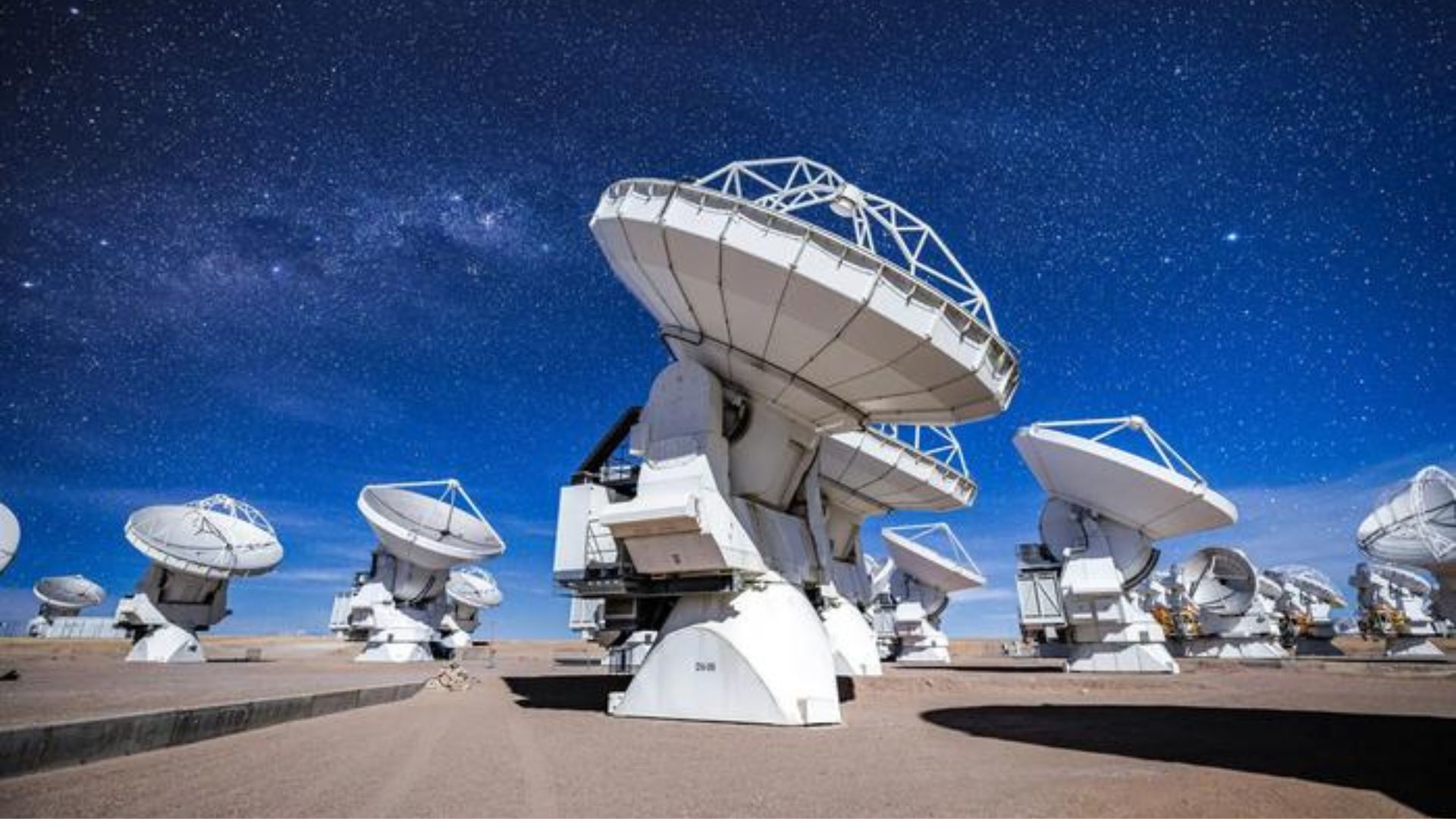
Astronomers might be hunting for alien signals in all the wrong places. A new study by PhD researcher Louisa Mason (University of Manchester) suggests astronomers may be missing potential extraterrestrial signals by focusing too narrowly on radio frequencies. The research explores untapped higher-frequency radio bands and proposes a new method to dramatically increase the number of stars analyzed in existing data. Expanding the search spectrum Humanity’s search for alien life has long been fixated on a single, cozy corner of the radio spectrum. We assumed extraterrestrials would act like us. Hence, the search for alien intelligence was mostly concentrated on a narrow band of the radio spectrum known as the “water hole.“ It is a quiet frequency range between 1.42 and 1.66 GHz bracketed by the natural emissions of hydrogen and hydroxyl. Scientists reasoned that because these two molecules combine to form water, an advanced extraterrestrial civilization would recognize their universal importance and choose this specific band as a logical channel for interstellar communication. What if the rest of the galaxy left that frequency behind long ago, leaving us listening to dead air while a bustling galactic conversation hums away on higher bands? That question is driving a quiet revolution in the Search for Extraterrestrial Intelligence (SETI). At the Royal Astronomical Society’s National Astronomy Meeting in Birmingham, Mason presented the first-ever SETI survey powered by the Atacama Large Millimeter/submillimeter Array (ALMA), which is a massive high-altitude observatory nestled in Chile’s Atacama Desert. Instead of booking expensive, dedicated telescope time to hunt for alien technosignatures, Mason raided ALMA’s vast digital archives. She sifted through raw data collected for entirely different astronomical missions, searching for sharp, narrow radio spikes that nature cannot produce. Her primary focus? Higher radio frequencies, specifically millimeter and submillimeter wavelengths. These bands remain nearly untouched by alien hunters. “For decades, SETI searches have concentrated on a relatively small part of the radio spectrum. We wanted to ask what might happen if we looked somewhere very different,” Mason said. “The millimetre and submillimetre radio bands remain almost completely unexplored for SETI, so this is really about opening up a new area of parameter space to search,” the researcher added. Unlocking stellar bycatch While Mason’s initial search across two small frequency windows turned up no signs of extraterrestrial technology, the real breakthrough lies in how she searched. Telescopes don’t just see their primary target, but also capture a vast, unintentional background of surrounding stars. This phenomenon is known as “stellar bycatch”. Mostly, astronomers estimated this background using basic sky catalogs like Gaia, which often miss faint or deeply buried stars. Mason took a different path. She applied the Besançon Galactic Model, which is a complex computer simulation of the Milky Way’s population. It helped to account for every hidden star tucked inside the telescope’s field of view. When applied to a past survey of 1,327 telescope pointings, the model revealed that astronomers hadn’t searched 288,000 stars as initially calculated. They had actually swept past more than 6.1 million stars. It turns out we’ve been auditing our own search area all wrong. The universe is incomprehensibly vast, but high-frequency observations and galactic modeling could give us a vastly sharper lens, and maybe help find some fruitful alien signals in the future. She stresses that these initial negative results should motivate future SETI searches to explore broader radio spectra and maximize the potential of existing astronomical data. Recommended ArticlesGet the latest in engineering, tech, space & science - delivered daily to your inbox.Mrigakshi is a science journalist who enjoys writing about space exploration, biology, and technological innovations. Her work has been featured in well-known publications including Nature India, Supercluster, The Weather Channel and Astronomy magazine. If you have pitches in mind, please do not hesitate to email her.
Wrong frequency? Astronomers rethink where to hunt for alien signals
Full Article
Original Source
Read the full article at Interestingengineering →KhanList aggregates and links to publicly available news content. We do not host full articles from third-party sources. Always verify important information with original sources.