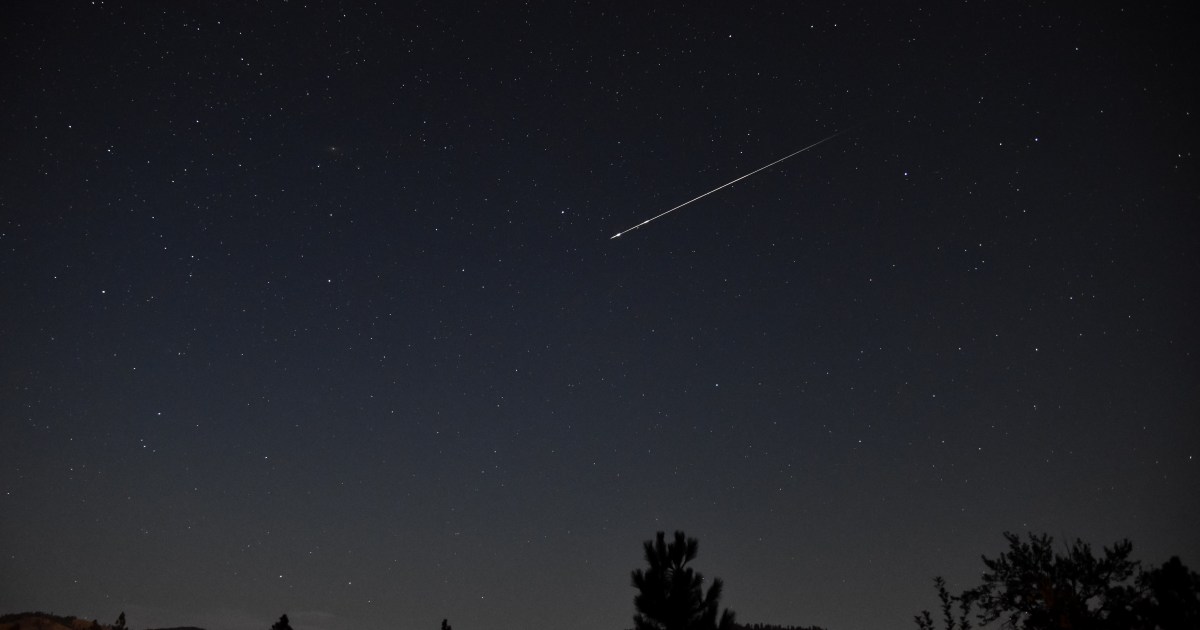
Friday, July 24The Moon passes 0.6° south of the bright red star Antares in Scorpius at 6 P.M. EDT. This evening, the two remain nestled close, a lovely sight in the southern sky after sunset. You’ll find the pair in the south early this evening, slowly arcing down toward the west throughout the evening. At their highest — around 9:30 P.M. local daylight time, as twilight is still fading, they are just over 20° high in the south, as the bright waxing Moon stands to the lower left of 1st-magnitude Antares. You can follow them long after sunset — the Moon doesn’t set until after midnight. Over in the north, look for the Big Dipper asterism late this evening, its cup diving down toward the horizon and handle in the air. This star pattern — and the constellation that contains it, Ursa Major — is part of a gaggle of some 60 stars all physically moving in the same direction through the sky, aptly named the Ursa Major moving group. Included in this family are five of the Big Dipper’s stars: Merak, Phecda, Megrez, Alioth, Mizar, and Alcor. These are also cataloged as Beta (β), Gamma (γ), Delta (δ), Epsilon (ε), Zeta (ζ), and 80 Ursae Majoris, respectively. While this moving group is not considered a cluster of stars, it likely once was. Astronomers think moving groups may be the intermediate step that occurs when more tightly bound open clusters of stars start to move apart after their birth. Related: Inside the Ursa Major moving group Sunrise: 5:51 A.M.Sunset: 8:21 P.M.Moonrise: 5:04 P.M.Moonset: 1:13 A.M.Moon Phase: Waxing gibbous (82%)*Times for sunrise, sunset, moonrise, and moonset are given in local time from 40° N 90° W. The Moon’s illumination is given at 10 P.M. local time from the same location. Saturday, July 25The Moon reaches apogee, the farthest point from Earth in its orbit, at 12:45 P.M. EDT today. At that time, our satellite will stand 251,996 miles (405,548 kilometers) away. By evening, the Moon has moved into Ophiuchus and stands highest around 10:30 local daylight time, just off the spout of the Sagittarius Teapot (whose stars may be a bit difficult to see in the bright moonlight). Rising in the east around this time is the Great Square of Pegasus, made up of four stars: Algenib, Markab, Scheat, and Alpheratz. But of these four, only the first three on the list are technically in the constellation Pegasus, cataloged as Gamma (γ), Alpha (α), and Beta (β) Pegasi. Alpheratz is cataloged as Alpha Andromedae, part of Andromeda the Princess. Despite its location on modern charts, the late stellar expert Jim Kaler suggests Alpheratz was once part of Pegasus proper, as its ancient name can be translated to “the horse’s shoulder.” The constellations have undergone many changes throughout the millennia, and it is only in recent decades that we have come to use an established, universally accepted system of 88 constellations and their boundaries, created in 1928 by the International Astronomical Union. Related: Who made the present-day constellations and why do they look the way they do? Sunrise: 5:52 A.M.Sunset: 8:20 P.M.Moonrise: 5:59 P.M.Moonset: 1:54 A.M.Moon Phase: Waxing gibbous (89%) Juno (red crosshairs) is located in Aquila, near the waxing Moon on the evening of July 26 — but you can give spotting the main-belt world a try with a telescope. Credit: Stellarium/USGS/Celestia/Clementine Sunday, July 26Asteroid 3 Juno reaches opposition at 1 P.M. EDT. Already above the horizon at sunset and visible all night, Juno glows at 9th magnitude in the constellation Aquila the Eagle. The Moon is nearby, now contained within the lid of Sagittarius’ Teapot. But let’s give Juno a try, one constellation to the northeast and near the tip of Aquila’s eastern wing. A telescope may be best for the effort, as it will capture more light from fainter objects, even in the light of the Moon. The brightest star in Aquila is magnitude 0.8 Altair, in the constellation’s northern region. Early this evening, with Aquila still rising in the southeast, all you need to do is drop down toward the horizon about 11° from this star and you’ll land on 3rd-magnitude Theta (θ) Aquilae. Juno is just over 4° south of this star, passing very close to a slightly brighter (magnitude 8.7) field star, cataloged as HIP 99225 or HD 191147. Of the two similarly bright lights in your eyepiece, Juno is the northern one, moving subtly toward the southwest as the hours pass. Sunrise: 5:53 A.M.Sunset: 8:19 P.M.Moonrise: 6:49 P.M.Moonset: 2:43 A.M.Moon Phase: Waxing gibbous (94%) On early mornings this week, Saturn dominates the southeastern sky as the brightest point of light there. Credit: Stellarium Monday, July 27Pluto is now at opposition, reaching this point at 3 A.M. EDT in the constellation Capricornus. However, the Moon is nearby and even once our satellite sets, the region housing the distant dwarf planet will be too close to the horizon for a clear view. Pluto is always a challenge, and conditions must be just right to spot it. Much closer and brighter, the ringed planet Saturn reaches a stationary point tonight at 7 P.M. EDT. Located in the constellation Pisces, it rises late at night (just before midnight) and is highest around sunrise, so the best time to spot it is a few hours before dawn, with the sky still dark and the gas giant well above the horizon. Around 3 A.M. local daylight time, Saturn is roughly 40° high in the southeast, the brightest point of light here. It stands in southern Pisces, just above the lumbering constellation Cetus the Whale. Through a telescope, the planet’s disk stretches 18” across, while its rings are more than twice that: 41” across. Saturn is currently tilted by nearly 7°, showing off its south polar region and the underside of its rings. While several 10th-magnitude moons cluster near the planet, its largest — and brightest — moon, Titan, is a bit farther away. On the morning of the 27th, it lies about 1.7’ southwest of Saturn and is moving east. It should be easy to spot; Titan will pull closer in to the planet’s southwest tomorrow morning, then sit southeast of Saturn the morning of the 29th. If you’re an early riser, try to catch it over the next few days to see orbital mechanics in motion! Today’s halt brings Saturn’s prograde, or eastward, motion to an end. After this evening, the ringed planet will about-face and begin moving westward, or retrograde, relative to the background stars. Sunrise: 5:54 A.M.Sunset: 8:18 P.M.Moonrise: 7:31 P.M.Moonset: 3:39 A.M.Moon Phase: Waxing gibbous (98%) Tuesday, July 28Asteroid 342 Bamberga reaches opposition at 5 A.M. EDT. Located in the constellation Capricornus, it is unfortunately too close to the nearly Full Moon to easily observe, even at magnitude 9.4. Wait a few days for the Moon to begin waning, then come back to southwestern Capricornus to try catching sight of this main-belt world. Although its number is quite high, Bamberga is one of the largest bodies in the main belt, roughly 140 miles (227 km) across. More easily visible will be Mercury, which has reached magnitude 1.0 in the early-morning sky. Rising a little over an hour before the Sun, it reaches some 6° above the horizon 40 minutes ahead of sunrise. You’ll find it low on the eastern horizon, left of the fading stars of Orion the Hunter and far below and to the left of Mars in Taurus. The Red Planet, which shines a tad fainter at magnitude 1.3, will fade out of view first and may be harder to find in a broader swath of sky, while Mercury’s location just above the horizon will help in your search. If you use binoculars or a telescope to view the small planet, make sure you put them away well ahead of sunrise from your specific location, which may differ from the time given below. Sunrise: 5:55 A.M.Sunset: 8:17 P.M.Moonrise: 8:06 P.M.Moonset: 4:40 A.M.Moon Phase: Full Wednesday, July 29Jupiter reaches conjunction with the Sun at 8 A.M. EDT, rendering the solar system’s largest and most massive planet invisible to us for now. We only have to wait about a month for it to reappear, when it will begin rising in the early-morning sky shortly before the Sun and slowly gain visibility as the second half of 2026 progresses, heading for its December equinox. Full Moon occurs this morning at 10:36 A.M. EDT. Also called the Buck Moon, the July Full Moon will rise this evening within 20 minutes of sunset. Dominating the constellation Capricornus, the Buck Moon’s bright light will make it difficult to see fainter objects — including many stars — in the sky. Many people think Full Moon is a great time to observe our satellite, but it can actually be quite challenging, as the brightly lit face shows few shadows with the Sun high overhead from the lunar surface’s point of view — it is now noon on the Moon. But while it’s difficult to pick out detail, it’s still a great time to study the lunar face simply with your eyes, tracing out the large dark regions (called maria, or seas) that signal where old lava flows have long since cooled into flatter terrain. In the south, more rugged features make this portion of our satellite appear brighter, but the large crater Tycho still stands out. See if you can trace the long, bright rays of material (called ejecta) that were thrown outward during the impact that created it. These rays are more difficult to spot during the Full phase, but sharp-eyed observers may still see them. If you do opt for a telescope to view the Moon tonight, try using a Moon filter or even wearing sunglasses to help cut down the glare and make viewing more comfortable. Sunrise: 5:56 A.M.Sunset: 8:16 P.M.Moonrise: 8:36 P.M.Moonset: 5:44 A.M.Moon Phase: Full The Moon will hide nearly all Southern Delta Aquariid meteors this year, but you can try to spot a few overnight from July 30 into early July 31. Credit: Astronomy: Roen Kelly Thursday, July 30Today marks the convergence of two meteor showers, as both the Alpha Capricornids and the Southern Delta Aquariids peak. But despite the enticing sound of that setup, both showers are quite light, with expected hourly rates of some 5 and 25 meteors per hour, respectively, even at their very best. Plus, there’s the bright, just-past-Full Moon to contend with, and it’s right in the thick of things, hanging near the border of Capricornus and Aquarius. Despite the unfortunate setup, you can still test your luck overnight and into the early morning of July 31. The Southern Delta Aquariids’ radiant rises in the east around 9:30 P.M. local daylight time and stands highest in the south a few hours after midnight. You’ll want to look in the regions of sky some 40° to 60° on either side of the Full Moon for meteors — this is where the longest trains will appear, and also offers a better chance of a sighting with the Moon out of direct view. It will be a challenge, but any shooting stars you do see should feel doubly rewarding! Sunrise: 5:57 A.M.Sunset: 8:15 P.M.Moonrise: 9:02 P.M.Moonset: 6:49 A.M.Moon Phase: Waning gibbous (98%) Mercury has now brightened to magnitude 0.5 and should be relatively easy to spot in the east before sunrise. You might even catch it standing in line with two fainter stars in Gemini if you look early enough. Credit: Stellarium Friday, July 31Mercury has now brightened to magnitude 0.5 in the early-morning sky and should be even easier to see than it was earlier in the week. It is now just a few days from greatest western elongation. If you’re already up trying to catch the brightest Southern Delta Aquariid meteors, turn your gaze eastward about an hour before sunrise (roughly 5 A.M. local daylight time) to look for Mercury, now roughly 4° above the eastern horizon. The small planet should be bright enough to spot easily if your horizon is clear. You may even notice that it stands directly in line with two faint stars, Delta (δ) and Lambda (λ) Geminorum, although these two pinpricks of light will quickly disappear in the encroaching twilight. If you’re able, try to take a closer peek at the planet with a telescope, as long as you’re mindful of the time and put your instrument away well before sunrise. Under magnification, Mercury’s disk spans 8” on the sky and shows off a slim crescent with 33% of its surface illuminated. Because Mercury has no significant atmosphere, you’re seeing all the way down directly to its cratered surface when you look at it. Sunrise: 5:58 A.M.Sunset: 8:14 P.M.Moonrise: 9:25 P.M.Moonset: 7:54 A.M.Moon Phase: Waning gibbous (94%) Alison Klesman is senior editor of Astronomy magazine. She holds a Ph.D. in astronomy and has studied a variety of topics, from minor planets to supermassive black holes.
The Sky This Week from July 24 to 31: The Southern Delta Aquariids peak
Full Article
Original Source
Read the full article at Astronomy →KhanList aggregates and links to publicly available news content. We do not host full articles from third-party sources. Always verify important information with original sources.