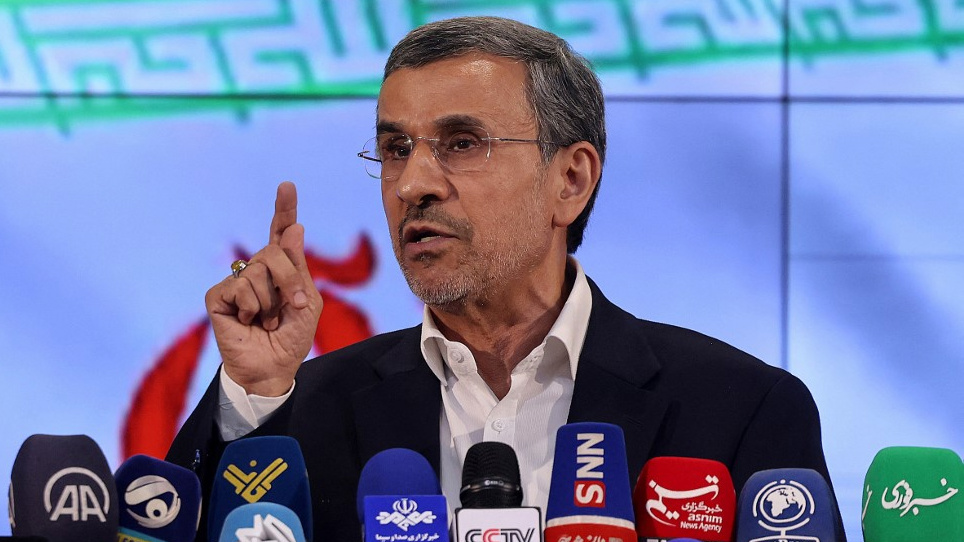
The New York Times published an extraordinary investigation this month, asserting that Israel’s Mossad spent years cultivating former Iranian President Mahmoud Ahmadinejad as an intelligence asset, with the aim of installing him as leader of a post-Islamic-Republic Iran. The report, authored by a team of veteran investigative journalists, describes secret meetings in Budapest, encounters with then-Mossad chief David Barnea, covert payments, and a dramatic wartime extraction of Ahmadinejad from his bombed Tehran compound on 28 February. From this moment, the story becomes confused. Ahmadinejad was allegedly led to a Mossad safe house inside Iran, but swiftly lost his trust in the Israelis and left. Whether he escaped or was allowed to exit remains unclear; either way, the tale tarnishes Mossad’s image, to say the least. Yet no matter how gripping the story might sound, upon closer examination, it is riddled with implausibilities, and deserving of far more scrutiny than the breathless coverage it has generated. Those who know Iran’s complex power structure know perfectly well that the president is not the top decision maker. The supreme leader and Islamic Revolutionary Guard Corps (IRGC) hold all the major cards, possessing the country’s most delicate secrets and deep knowledge of its operations abroad. New MEE newsletter: Jerusalem Dispatch Sign up to get the latest insights and analysis on Israel-Palestine, alongside Turkey Unpacked and other MEE newsletters If Israel’s real intention was to recruit a major Iranian asset, its efforts should have been directed towards an aide to the supreme leader, a member of the Supreme National Security Council, or a top IRGC official. The most immediately suspicious element of the story is its account of how the “recruitment” allegedly began: a Hungarian government official reportedly asked the rector of a Budapest university to invite Ahmadinejad to a climate change conference as cover for a meeting with Israeli intelligence operatives. Former Israeli intelligence professionals have themselves publicly balked at this description. Brigadier General (res) Hanan Geffen, a former commander of the Israeli army’s elite Unit 8200, called the sequence of events into question; for a sitting Mossad chief to personally travel to meet a target would be an extraordinary breach of standard operational practice, he noted. Career intelligence officers do not typically expose their director to a meeting with an unproven, high-risk target. That is precisely the kind of exposure agencies spend decades training to avoid. Curiously thin veil A climate conference as cover for a meeting with a globally recognised former head of state, still trailed by intelligence services and journalists worldwide, is also a curiously thin veil for an operation supposedly running since 2024. Furthermore, sharing part of this operation with another government would be highly risky - no matter how friendly the Orban government was with Israel. Such a move would only have increased the potential for security breaches in an extremely delicate operation. Even setting aside tradecraft objections, the very choice of Ahmadinejad as a candidate to lead Iran after a regime-change operation is bizarre. The former Iranian president spent eight years loudly denying the Holocaust, calling for Israel’s destruction, and hinting at nuclear ambitions. He is, by any measure, one of the most internationally toxic Iranian political figures of the last quarter-century: easily recognisable, reviled in much of the West, and permanently associated with the regime’s most extreme rhetoric. From 'Baby Shah' to Bond villains, Iran war coverage has reached new heights of absurdity Read More » If Israeli intelligence planners were seeking a figure who could plausibly unify Iranians after a regime collapse, attract international legitimacy, and normalise relations with Israel, Ahmadinejad is close to the least credible choice imaginable. A former president later disqualified multiple times from running again for office by his own regime - one distrusted by reformists for his populist authoritarianism, and by hardliners for his later criticisms of former Supreme Leader Ali Khamenei - Ahmadinejad had no natural political base to inherit power. Installing him would not have been the best recipe to promote national reconciliation, ostensibly the outcome that any rational intelligence service would be seeking. According to parallel reporting from Haaretz, senior officers within Israel’s military intelligence reportedly viewed the plan as unrealistic, warning that predicting the outcome of a chaotic post-collapse political scramble was fundamentally unworkable. Their doubts centred specifically on the final stage of the plan: installing Ahmadinejad as leader. Military intelligence officials reportedly modelled scenarios in which attempting the plan would leave Israel worse off, amid concerns that toppling the Khamenei regime without an established civilian counterweight could hand power to the Revolutionary Guards, rather than any western-aligned successor. If Israel’s own military intelligence apparatus regarded the endgame as implausible, even while the operation was allegedly underway, that is a significant signal that outside observers should treat the whole scheme’s supposed strategic logic with considerable caution. Watching Iran today - including the concealment of the supreme leader and the country’s shadow power architecture - it is impossible to exclude the possibility that the IRGC could ultimately get the upper hand in the ongoing power struggle, even without the installation of Ahmadinejad. Long-simmering rivalries There is also a domestic Israeli political dimension worth noting. Analysts have pointed to long-simmering institutional rivalries between Israel’s military intelligence and Mossad, alongside the tense run-up to the country’s October elections, as factors that may be shaping how, and by whom, this story is being told. Leaks that flatter one agency’s boldness while implicitly criticising another’s caution are a familiar feature of intelligence bureaucracies everywhere, and Israel is no exception. Ahmadinejad’s office has dismissed the entire account, describing the allegations as “Hollywood-style claims” not even worth formally denying, and accused the New York Times of publishing fabricated material. Dismissals from implicated parties are, of course, unsurprising and cannot be taken at face value either - but they add another layer of contestation to a story that is already built almost entirely on anonymous sourcing. The Times report relies on unnamed American and Iranian officials, while Mossad did not respond to the newspaper’s requests for comment. No documentary evidence, recordings, or named intelligence officials have been produced. For a story of this magnitude - alleging that a foreign intelligence agency ran a years-long campaign to install a former head of state as the leader of a regional adversary with nuclear capabilities - the evidentiary base remains remarkably thin, resting on characterisations rather than verifiable primary material. There is also a broader coherence problem. The story conveniently ties together nearly every notable thread of the recent US-Israel-Iran war into a single, dramatic arc: the killing of Khamenei, a targeted strike on Ahmadinejad’s compound, a covert extraction, a failed Kurdish uprising, and Ahmadinejad’s mysterious reappearance at the slain supreme leader’s funeral before he vanished into alleged house arrest. Real intelligence operations are rarely so narratively tidy. Genuine covert programmes tend to be messy, compartmentalised, and only partially reconstructible even years after the fact. A fully arced story - recruitment, wartime climax, betrayal and comeuppance - delivered within months of the events it describes, sourced entirely to anonymous officials on both sides of an active conflict, should raise any analyst’s eyebrow. Case for caution None of this proves the story is false. Anonymously-sourced intelligence journalism has, on past occasions, proven to be accurate well before official confirmation has emerged. But the specific claims here - the amateurish tradecraft implied by the cover-story meeting, the strategic incoherence of choosing Ahmadinejad as a figurehead, the explicit scepticism voiced by Israel’s own military intelligence establishment, and the absence of any verifiable documentary evidence - together constitute a case for considerable caution. One element seems certain, considering the practice of the IRGC’s intelligence apparatus, which calls the shots in Iran: if there was some evidence that Ahmadinejad had compromised himself with Israel, he would have been executed already. Readers, and particularly policy analysts, would do well to treat the Ahmadinejad story as an intriguing but heavily contested account, rather than an established fact Instead - contrary to his predecessor, Mohammad Khatami, and his successor, Hassan Rouhani - he was allowed, albeit heavily escorted, to attend Khamenei’s unprecedented funeral. This decision seems to confirm that the Iranian regime does not consider Ahmadinejad to be particularly dangerous. Readers, and particularly policy analysts, would do well to treat the Ahmadinejad story as an intriguing but heavily contested account, rather than an established fact of the recent war - at least until independent corroboration emerges, beyond the current circle of anonymous officials. If the story should then turn credible, I would bet that Ahmadinejad’s recruitment started far before he became president - and that all the stunts he pulled during his mandate were deliberate acts to conceal his recruitment, with his puppet master’s full agreement. After all, no Iranian political figure has publicly supported better than Ahmadinejad the well-worn Israeli narrative about Iran posing an existential threat to Israel and to regional Arab states. Ahmadinejad’s policies in that regard offered stronger cover for his recruitment. For those who might be intrigued by this odd theory, but struggle to follow its logic, the best advice to make sense of it would be to read John Le Carre’s masterpiece, The Little Drummer Girl. The views expressed in this article belong to the author and do not necessarily reflect the editorial policy of Middle East Eye.
Why the New York Times story on Mossad recruiting Ahmadinejad doesn't add up
Full Article
Original Source
Read the full article at Middleeasteye →KhanList aggregates and links to publicly available news content. We do not host full articles from third-party sources. Always verify important information with original sources.