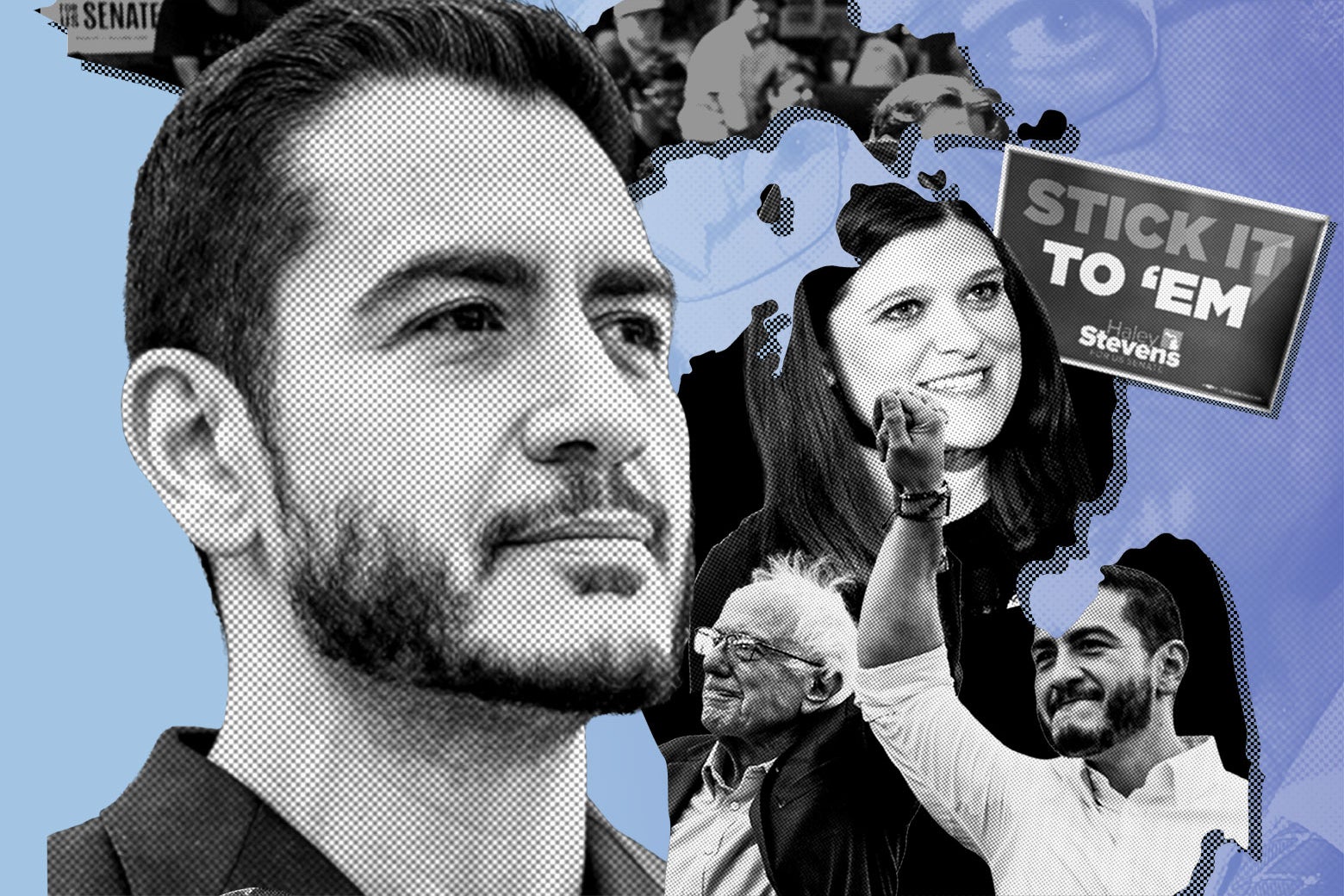
Photo illustration by Slate. Photos by Evan Cobb for the Washington Post via Getty Images, Win McNamee/Getty Images, Michael Brochstein/SOPA Images/LightRocket via Getty Images, Sarah Rice/Getty Images, Emily Elconin/Getty Images, and Getty Images Plus. On a hot and smoky mid-July Saturday night at the Detroit Opera House, the front-running campaign in Michigan’s Senate Democratic primary had little to say about the Republican Party. But it offered no mercy for the Democratic establishment. It was the kickoff event for Abdul El-Sayed’s biggest swing of rallies to date in what has become the country’s most-watched primary. The left-wing populist has come a long way. When he launched his campaign last year, he was speaking to small groups, and he would now be speaking to crowds in the thousands alongside the two most famous leftists in the country: Rep. Alexandria Ocasio-Cortez and the godfather of progressive insurgent campaigns, Sen. Bernie Sanders. Sanders, 10 years out from his campaign that opened the breach between the Democratic establishment and a progressive movement that seeks to bury it, laid out the grand stakes in the Aug. 4 primary. It was no longer, he said, a race just between El-Sayed, a public health official who has never held elected office, and Rep. Haley Stevens, a moderate four-term congresswoman. “It has now become an election of national significance,” Sanders said, and “an election of historical significance.” The outcome of the primary would “show the nation whether AIPAC and other billionaire-funded super PACs can spend tens and tens and tens of millions of dollars to buy a U.S. Senate seat.” Over the course of the night, speaker after speaker would excoriate the Democratic establishment as beholden to corporate dollars, cynical, and out of gas. Mentions of the American Israel Public Affairs Committee or Israel would automatically provoke stray screams from attendees, who trended younger and whiter than the median Michigan Democrat. Mentions of Donald Trump would promote jeers and chuckles. But this nearly 2,000-person crowd wasn’t here to talk about Republicans. Their badness was a given. They were here to roast the rot within their own party. As the labor leader Shawn Fain, whose United Auto Workers has endorsed El-Sayed, said to the largest cheers of the night, “the only reason we’re in the position we’re in in America right now is because too many Democrats can’t decide who the fuck they want to stand with.” Since a third candidate, state Sen. Mallory McMorrow, dropped out early in July, the Michigan Senate race has become a true instance of what so many other primaries are oversimplified as: a moderate Democrat backed by the establishment versus a progressive insurgent preaching to enthusiastic crowds. It has gotten vicious to the point there’s concern about repairing the bridges burned along the way once whoever wins takes on the Republican in November. Well-funded super PACs—with AIPAC’s chief among them—have been doing Stevens’ dirty work of trying to take down El-Sayed, while the El-Sayed campaign is portraying the Stevens camp as corrupted by powerful interests. The raw emotions of the Israel–Palestine conflict undergird it all. Attending events from the two candidates, as I did a couple of weekends ago in Michigan, revealed two distinct factions of the Democratic Party with little in common—one trying to preserve its loosening grasp on power, the other trying to finally seize it. I’d seen this movie before. At one point during the Detroit rally, Sanders began to make a point by saying “in all due respect to Haley Stevens,” and the very mention of her name prompted an ocean of boos. It was when Sanders waved his hand to stifle the reaction to Stevens’ name that I knew where I was—or rather, when. More than a few times a decade ago, I witnessed Sanders deploy the same gesture after offering all due respect to “Secretary Clinton.” And, sure, Democrats had had furious battles between leading candidates before, such as Clinton and Barack Obama’s 2008 duel, but they all largely operated within the same center-left tradition. Sanders’ 2016 challenge to Hillary Clinton was different. That primary never really ended—it only mutated—and now it has arrived in Senate swing races. With polls showing El-Sayed ahead in the primary, the movement that spawned Bernie may soon have its chance to prove its theory that left populism can perform better in tight elections than the moderation offered by D.C. Democrats. After 10 years of “Bernie would’ve won” debates, we may get to test the case in Michigan. Toward the end of her speech in Detroit, Ocasio-Cortez said that El-Sayed’s campaign “represents the politics of the future.” In the present, though, can those politics win Democrats a Senate seat they can’t afford to lose? On the same Saturday of Abdul El-Sayed’s rally in Detroit, I met Haley Stevens at a campaign event in a small, Black-owned flower shop. I joined Stevens, the shop owner, and one other national reporter at a round table and we interviewed the congresswoman for about 20 minutes. We touched on everything from her no vote on a recent amendment to cut off military aid to Israel (“that one was way too far”) to why she considers herself more electable than El-Sayed (she’s won close races before; his only political experience is in a failed run for governor in 2018). Stevens speaks energetically in a thick regional accent. She throws every tangentially relevant piece of information she can—talking points, asides about old campaigns, recommendations for where to spend time in Detroit, references to bills she’s worked on—into each response. Occasionally, these responses address the question. Stevens had just spent a week enduring more hostility than she usually receives from her detractors in the online left. A pep talk of hers, in which she said, “You better believe I’m going to bring it with a little bit of enthusiasm, a little bit of energy, and a little bit of stick-it-to-’em,” like an old-timey football coach, went viral and was roundly mocked online. It earned enough derision that El-Sayed put out a statement to his followers about how such comments were “unkind and unhelpful” and that if you supported him, “please stop.” (Bernie Sanders used to put out these statements when he ran against Hillary Clinton, too.) In another familiar move, the Stevens campaign was in the process of leaning into it, with Stevens staffers showing me the box of freshly printed “STICK IT TO ‘EM” signs her team had just produced. A friend had even made it her ringtone, she told me. “But hey, whatever’s resonating, whatever brings a little bit of joy. Whatever brings a little bit of that stick it to ’em,” she said, doing the thing. Something felt disorienting about the event. On this valuable Saturday-morning time slot a couple of weeks before the primary, we were in a small flower shop in a pedestrian-unfriendly area with few, if any, walk-in customers to meet and greet. There were several campaign aides, though, as well as various campaign camerapeople taking photos behind us. Hours later, when I looked at Stevens’ X feed, I was surprised to see a photo of our interview, appearing as though we reporters were part of a bustling roundtable Stevens had held with voters.Absent the voters, and for the purposes of the photo op, we would have to do. Haley Stevens/X Prior to this cycle, Stevens may not have had trouble getting through a primary. Michigan Democrats haven’t had a genuinely competitive Senate primary since 1994. (That was also the last year Democrats lost a Senate race in Michigan—which, move along, nothing to see here.) She’s a loyal House Democrat, a pragmatist more focused on legislation than spectacle. That’s usually enough to clear the primary field. Democratic voters in competitive states, always on edge about electability, have tended to follow the cues from Washington. Senate Minority Leader Chuck Schumer, who supports Stevens, doesn’t dictate each race, and some of his preferences are made more overt than others. But for all the grief Schumer gets about this top-down approach (“treating politicians like trading cards,” as El-Sayed put it in a rally in Grand Rapids), it’s worked pretty well for Democrats. In three separate cycles since I’ve been covering elections—2010, 2012, and 2022—Republicans have blown good chances at the Senate majority by nominating fatally flawed candidates. Democrats, who have less margin for error given their structural disadvantage in the chamber, haven’t. What Democrats have blown, though, is two out of three races against Donald Trump. That has created a trust gap between the party establishment and many Democratic voters. And it’s opened up the market to new types of candidates—candidates who will fight, and candidates who will champion progressive causes that the Democratic Party as a whole has never jumped on board with, like Medicare for all. At Stevens’ next event that Saturday, a summer picnic put on by Democrats in her Oakland County congressional district, I asked her why she thinks a progressive has been able to give someone like her a run for her money. “I’ll just say this: I signed up for this election knowing it was going to be a primary, right?” she said. “I knew it was going to be a race, and I decided to run because it was not the time to be comfortable.” This was the most I would get, but it was enough. She was telling me that she wasn’t so naive as to believe that after 2024, with withering rage directed at the Democratic establishment, and a large Arab American community in Michigan that had protest-voted against the Biden administration’s Gaza policy, that she—a card-carrying member of the Democratic establishment and close ally of AIPAC—would get a free primary ride. Maybe she didn’t get the best crowds. Maybe she was suffering an inordinate amount of vitriol online about her accent, her looks, her mannerisms, and her vast financial support from corporate PACs, wealthy donors, and the Israel lobby. But the immense national pressure of carrying a Democratic establishment to victory in a must-win state did not in any outward way appear to be breaking her spirits. Even though she was, by all accounts, struggling to do so. Before she gave a small speech at the picnic, Stevens took a few questions from reporters. As her team worked to assess which direction she should face for the best shot, she stood next to an unlit public charcoal grill and joked, “I’m hot, I’m hot!” Then, turning to me, she muttered, “Not according to the internet this week. I’m joking!” Sarah Rice/Getty Images “She has events?” Abdul El-Sayed asked sarcastically the following day, in Grand Rapids, when I said I had attended some of Haley Stevens’ stops on the trail. I offered that they were certainly of a different nature from the rallies he was hosting. “She can’t have rallies of her own,” he said. “You have to have supporters to have rallies.” Stevens has supporters, though their idea of Saturday night may not involve going to campaign rallies. El-Sayed argues that the way she’s earning those votes, though, will never bring about real change. That’s because, stripped to their essence, modern Senate campaigns tend to be large cash transfers from wealthy donors to the owners of local television affiliates. The events on the ground are helpful for forming certain narratives in the press and earning coverage where you can. But campaigns rely on the tens of millions of dollars in advertisements to achieve the actual work of shifting poll numbers. As Stevens and I had been speaking at the flower shop, or the picnic, the real effort to get Haley Stevens into the general election was taking place on the small screen, through a constellation of super PACs. Chief among them is the United Democracy Project, AIPAC’s super PAC. Per the most recent Federal Election Commission filings, UDP has spent about $25 million in advertisements and direct mail. The second-largest super PAC, A Stronger Michigan, came into existence on June 1 and has plunked down nearly $17 million already. Per its mid-July filing, its funding had come almost entirely from a single nonprofit—making it “dark money” that doesn’t need to disclose its donors. A third, Unite to Win, has spent nearly $3 million. There are some smaller super PACs supporting El-Sayed. But all told, the pro-Stevens PACs were outspending their competition 12 to 1 as the race ramped up in mid-July. UDP’s ads don’t talk about Israel. One of its most-discussed spots features former President Barack Obama praising Stevens’ work on the auto industry rescue, but the clip is from a 2018 rally—Obama has not endorsed in the current race. The Stevens campaign, though, is banking heavily on turning out Black voters, among whom she enjoys a significant advantage, in metro Detroit. El-Sayed told me that before this race, he didn’t “understand just how craven big money could get.” He knew that there would be big money at play in the race, particularly AIPAC money, as he’s a vocal critic of Israel’s war in Gaza. But since seeing that Obama ad? “You know, when you have AIPAC running ads pretending like President Obama endorsed their candidate, even though they spent the end of his presidency opposing his principal foreign policy goal”—the Iran nuclear deal—“It’s just craven. It’s cynical. I think a lot of the establishment is just showing just how cynical they are about democracy itself.” This isn’t the first time AIPAC has come to Stevens’ rescue. In 2022, the year in which AIPAC formed UDP and began intervening in primaries, the super PAC helped carry her across the line in a member-on-member primary against Rep. Andy Levin. But its massive intervention in this race is as much about stopping El-Sayed as it is supporting Stevens. A swing-state Senate seat would be a groundbreaking development for those Democrats hoping to upend American policy toward Israel. And so, as El-Sayed put it to me, “they spend all this money to put my head on a pike.” But given Democrats’ turn against Israel over the past few years and AIPAC itself becoming such a lightning rod, El-Sayed has worked to use their heavy-handed involvement as his principal argument against Stevens. It’s hardly a new technique for a less funded candidate to complain that their opponent is bought and paid for by special interests. Usually the complainer loses, and life goes on. This time, given the bright spotlight on the race, AIPAC’s new villain status among many in the Democratic base, and El-Sayed’s gifts as a communicator, progressives hope this race can chart a new course for defeating big money in campaigns by weaponizing it in return. “For many years,” Alexandria Ocasio-Cortez told reporters after the Detroit rally, “we’ve been chipping away at how to figure out how we actually break up the system of big money in politics.” She listed some recent races where the progressive candidates had been outspent but won their primaries. “People are starting, and communities are starting, I think, to associate a lot of this large spending with the big money that requires it to be.” Sarah Rice/Getty Images In 2020, four years after losing to Hillary Clinton, the presidential nomination was Bernie Sanders’ to lose. But South Carolina primary voters fled to the safety of Joe Biden, someone they, then the rest of the field and the party establishment, decided was “electable.” It was effectively over by Super Tuesday the following week. “Electability,” interpreted as risk aversion, has governed Democratic voting strategy in the high-stakes era of Donald Trump, standing as a bulwark against the inroads Sanders and his descendants have made into the party. Polls show Haley Stevens and Abdul El-Sayed performing about equally in hypothetical matchups against Mike Rogers, a non-crazy former House Republican who’s running again after he lost by only 19,000 votes to Sen. Elissa Slotkin two years ago. But Stevens more aptly fits the conventional understanding of electable, a point that her campaign is hammering home as its closing message. She’s not particularly ideological, and stays on message about affordability and stopping Trump’s corruption. “All I can speak to is my record that I have won tough primaries, and I’ve won tough general elections, and I have done so based on my passion, my commitment, my Michigan way of campaigning, fighting, and delivering for people,” she told me when I asked what makes her more electable. The subtext of her argument, though, is that El-Sayed specifically isn’t electable. El-Sayed has a history, which UDP has been eager to point out, of calling to defund the police, for example. He also supports abolishing Immigration and Customs Enforcement, a position that still gives many Democrats the willies even with all of ICE’s recent abuses. Republicans agree with the Stevens camp’s view that El-Sayed is the easier opponent. That’s why Senate Republicans ran a web ad in late June warning that El-Sayed was “too radical for Michigan”—a meddling tactic designed to boost his name recognition and make him seem especially cool to Democratic primary voters. And as CNN reported in late July, Rogers told supporters in a June phone call about El-Sayed that “if he wins, I think we’re in good shape.” El-Sayed isn’t really having it. “It’s funny watching folks make an argument about electability when electable candidates don’t need $50 million crutches,” he told me. “Just think about what this race would be if there was no outside spending at all. We wouldn’t be talking about any opposition. This would be such a lopsided race. Y’all wouldn’t be covering it.” But there’s another dimension around the “electability” conversation. El-Sayed is a Muslim and Arab American, and no such person has ever been elected to the U.S. Senate. El-Sayed and his surrogates insinuated that ultimately, this is what the “electability” talk is all about—a coded way to worry that his race and religion will prevent him from winning. “I want to tell you what they’re whispering about Michiganders out in Washington, because I’ve heard it myself,” Ocasio-Cortez told the crowd at the Detroit rally. “They’re saying a state like yours, and people like you, can’t elect an American like Abdul.” “They’ve taken to calling me ‘dangerous,’ ” El-Sayed said in his speech, before laying into some sarcasm. “Now, I don’t know why you would call somebody who looks like me, with a name like mine, ‘dangerous.’ It’s an interesting adjective to use. Nobody’s ever called somebody who looks like me ‘dangerous.’ ” I asked El-Sayed if, when people argue he’s unelectable, he felt they were talking about his ethnicity or his politics. He was clear that it’s the former. “When you call somebody dangerous, and then your whole ad campaign is about how you’re disrespectful to women, let’s ask what they’re playing to,” he said. “Part of me is just like, I’d respect you more if you just came right out and said it.” El-Sayed had just finished his two biggest rallies of his campaign and was about to start his third. He seemed boggled at how a candidate with thousands of people screaming for him could be deemed the less electable one. “I just think it’s really important to be asking, like, how do you win when you haven’t built a movement?” He said of Stevens. “You know, people are talking about electability as if it’s this thing on paper. Movements are electability.” But senators win without movements all the time. Just about all of them do, really. Elissa Slotkin won the same state, against the same Republican, in a worse environment, without a “movement” just two years ago. For every Democratic voter who might attend an El-Sayed mega-rally, there are many who vote regularly but don’t insist upon, or want, radical change. They don’t need electoral politics to thrill them. They just need to win. Sarah Rice/Getty Images The warm-up band at Abdul El-Sayed’s Grand Rapids rally with Bernie Sanders and Alexandria Ocasio-Cortez was electric. It was a Latin-infused seven-piece ensemble that could (and did) range from “Oye Como Va” to “Don’t Stop Believin’.” It was enough to get El-Sayed himself to emerge and sing a few bars of “Bohemian Rhapsody” hours before he was set to speak. Shortly after this, I was led backstage to his greenroom for my interview. I expected to see him in similarly jovial spirits. Instead, he was hunched over in a single foldout plastic chair in an otherwise empty room, looking spent. The primary has been exhausting, especially given the pressure being applied by national political factions. (Both candidates said they didn’t feel the pressure. I didn’t believe either of them.) But if the candidates feel exhausted now, just wait until the day after the primary. Not only will they have just three months to pivot to the general election and Mike Rogers, they’ll have to work just as hard, and just as quickly, to repair the wreckage from this primary. Just as it would be a triumph to win the primary, so too would it be an embarrassment to go on to lose a Michigan Senate seat, in a good Democratic year, for the first time since the Clinton administration. The credibility of whichever Democratic faction wins this proxy primary is on the line. If Haley Stevens wins, a lot of progressive Democrats will, rightly or wrongly, feel disgusted, as if big money and AIPAC stole the election from the candidate who’d run the better race. The El-Sayed campaign’s rhetoric against Stevens would not make a post-primary reconciliation any easier, either. I asked attendees at El-Sayed’s Detroit rally if they would vote for Stevens in a general election if it came to that. One, a 19-year-old student at Michigan State, told me he might, “but it’s just really hard because I feel like when I talk about Stevens, I’m talking about another Republican.” If El-Sayed wins, moderate Democrats in Michigan—who’ve never been in the position of having to hold their nose and vote for a progressive Senate nominee—will have to find some way to get comfortable with him. A lot of the reconciliation would be up to the candidates themselves. The last time I saw Stevens on the trail was at a Black church in Ann Arbor, where she spoke to a welcoming congregation about the “complex challenges before us that aren’t going to be met with simple solutions or simple slogans.” Addressing her target audience, she emphasized her role working with the Obama administration on the auto rescue and her support from the Congressional Black Caucus. She hung around the service for a bit after giving remarks, keeping her hand raised in praise—as best I could tell, she was the only congregant doing this—with her head bowed as the gospel choir got going. I asked her afterward if she would endorse and campaign for El-Sayed if she lost the primary. “Absolutely, I am on the team, I am so proud to be on the team,” she said. “You know, Mike Rogers wants to rubber-stamp Donald Trump. I’m going to do everything I can, that’s why I’ve been a part of this process right now. I’d be excited and honored to earn the nomination, but we’re going to finish this election and we’re going to win.” When Bernie Sanders lost the Democratic nomination in 2016, he got a lot of grief for taking his sweet time to endorse Hillary Clinton. At least part of Sanders’ thinking, though, was that his campaign had portrayed Clinton as a model of corrupt, corporate, and establishment nefariousness, and it would take his supporters some time to come back for air. So he negotiated with the Clinton campaign on the party platform to show his supporters that he at least got something. Still, on the first day of the Democratic National Convention in Philadelphia that year, when Sanders convened his delegates to break the news that we “have got to elect Hillary Clinton,” he was roundly booed. So I asked El-Sayed the same question later that night: Would he endorse and campaign for Stevens if she lost? “I’m committed to beating Mike Rogers, I’ve said that so many times,” he said. I noted that that wasn’t precisely a yes. “As I’ve said, I am going to do everything I need to do to defeat Mike Rogers.” We may never learn what he meant by sticking to such a precise response. The polling has largely shown El-Sayed ahead of Stevens. That’s in line, frankly, with the developments in the race. Top state Democrats like Sen. Gary Peters and Gov. Gretchen Whitmer, who had no interest in getting involved in this primary, have come off the sidelines in the final few weeks to endorse Stevens. The super PACs are not easing their spending. The Stevens camp, and the Democratic establishment generally, are unloading their arsenal. If Stevens loses, then El-Sayed will have done something unprecedented for progressives since Sanders offered the first draft a decade ago. He’ll have a chance to test-drive the progressive theory of electability in a prime swing election. We’ll finally get an answer. The only risk for Democrats is that the answer is no. Democrats Elections Politics Senate Michigan
I Went to Watch the Most Important Senate Primary of 2026 Unfold in Its Final Days. It Sure Reminded Me of Something Else.
Full Article
Original Source
Read the full article at Slate →KhanList aggregates and links to publicly available news content. We do not host full articles from third-party sources. Always verify important information with original sources.