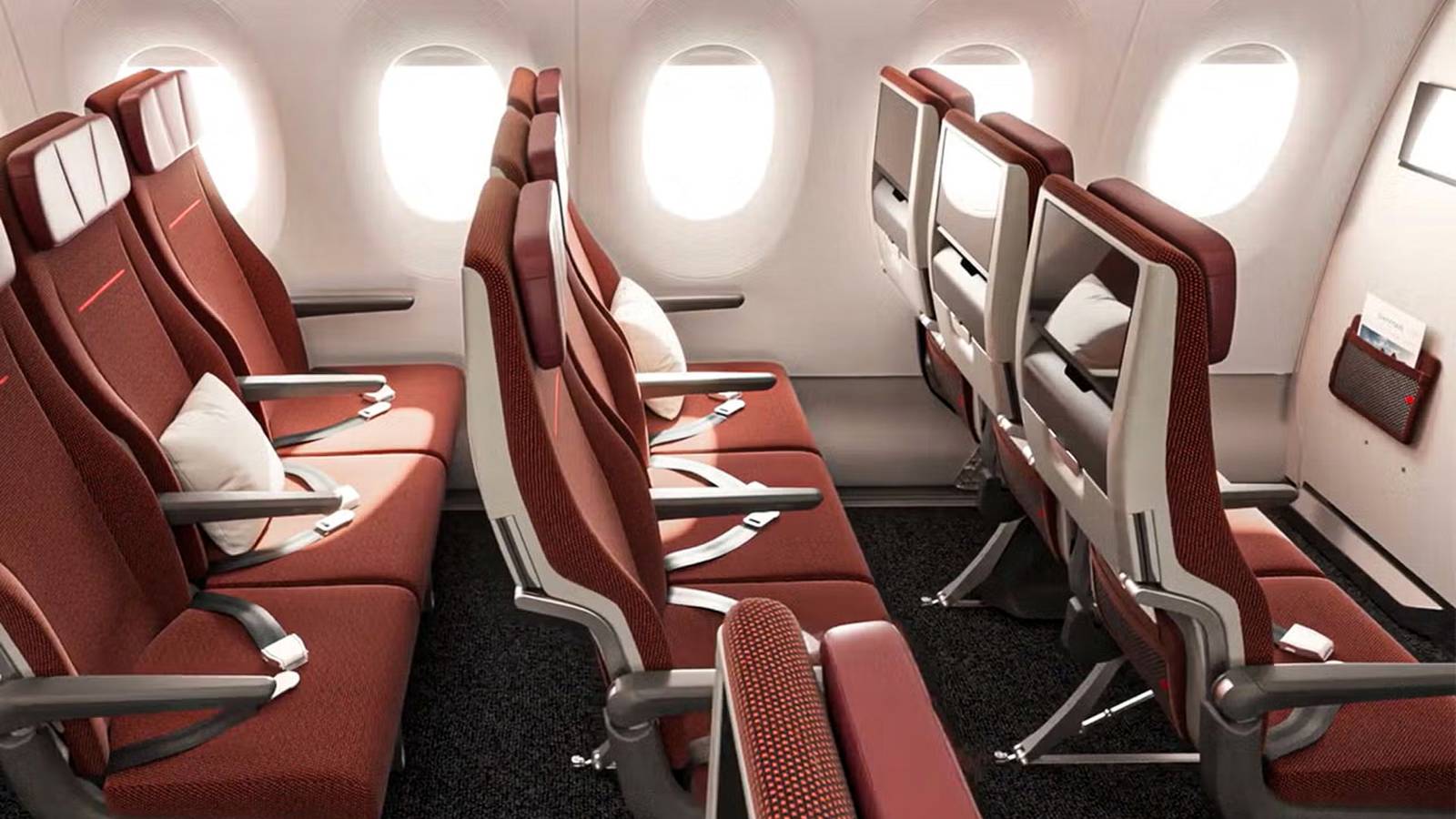
Published Jul 30, 2026, 4:00 AM EDT Brandon's passion for aviation started at a young age. Growing up, he was involved in the flight simulator and VATSIM communities, and he went on to earn his private pilot license while in college. Brandon holds a BSE in computer science and currently works as a software engineer. Outside of work, he continues to build flight hours and explore new airports around the country. In October 2027, Qantas will begin flying nonstop from Sydney to London on a specially modified Airbus A350-1000ULR, covering approximately 10,000 nautical miles (18,520 km) in up to 22 hours. The aircraft carries 238 passengers in four classes, roughly 162 fewer than a standard A350-1000. In their place: a 5,283 gallon (20,000 liters) rear center fuel tank, a purpose-built Wellbeing Zone, and a cabin where 41% of the seats are in premium cabins. Qantas expects to charge approximately 20% more for the nonstop service than passengers currently pay for one-stop alternatives on carriers like Emirates, Singapore Airlines, and Qatar Airways. That premium has to cover the cost of carrying fewer passengers, burning more fuel, and dedicating cabin floor space to a wellness area rather than revenue seats. Here is how the aircraft was modified, what the cabin contains, and why the economics depend on passengers valuing the nonstop flight enough to pay for it. 238 Seats Where 400 Would Normally Fit Credit: Qantas A standard Airbus A350-1000 in a typical three-class configuration carries approximately 350-400 passengers depending on the airline. Qantas's A350-1000ULR carries 238. The difference of roughly 162 seats is not a comfort decision. It is driven by the fuel load required to fly 10,000 nautical miles (18,520 km) nonstop and the weight constraints that fuel load creates. The cabin is divided into four classes. Six first class suites occupy the forward section, followed by 52 business class seats, 40 premium economy seats, and 140 economy seats. Of the 238 total seats, 98 are in premium cabins, representing 41% of the aircraft's capacity. That premium ratio is significantly higher than what most airlines configure on their A350-1000s. Cathay Pacific carries 334 passengers with 46 business class seats, representing approximately 14% of the total. Singapore Airlines carries 253 passengers with 67 business class seats, approximately 26%. Qantas, at 41% premium, is in a different category. The reduced seat count is a direct consequence of the range requirement. The additional fuel the ULR variant carries to reach 10,000 nautical miles adds significant weight, which must be offset elsewhere in the aircraft's payload budget. Fewer seats means fewer passengers, less catering, less baggage, and less cargo, all of which reduce payload weight to compensate for the fuel. Qantas cannot carry 400 passengers and 5,283 gallons (20,000 liters) of additional fuel on the same airframe within the A350-1000's maximum takeoff weight. The 238-seat configuration is the balance point where the aircraft can carry enough fuel to reach London or New York nonstop while still carrying enough passengers to generate revenue. The Engineering That Gets An A350 To 10,000 Nautical Miles Credit: Airbus The standard A350-1000 has a range of approximately 9,000 nautical miles (16,670 km). The ULR variant extends that to approximately 9,700 nautical miles (18,000 km), an additional 1,000 nautical miles achieved without stretching the fuselage or changing the engines. From the outside, the two aircraft are identical. The fuselage remains 241 feet, 11 inches (73.7 meters), the wingspan stays at 211 feet, 11 inches (64.6 meters), and both are powered by the same Rolls-Royce Trent XWB-97 engines producing 97,000 pounds (430 kN) of thrust. Every modification that produces the additional range is internal. The most significant change is a 5,283 gallon (20,000 liters) rear center fuel tank integrated into the aircraft's structure, bringing total fuel capacity to 288,142 lb (130,700 kg), approximately 13,228 lb (6,000 kg) more than the standard A350-1000. The tank is built into the fuselage rather than installed as a removable unit, following the same structural integration approach Airbus used on the A321XLR. Airbus has also increased the maximum takeoff weight and reinforced the landing gear to handle the aircraft at the higher gross weight the additional fuel produces. Taller wingtips reduce drag and improve fuel efficiency at cruise, contributing additional range without adding fuel. The galley cooling system was redesigned specifically for flights lasting up to 22 hours. A standard galley cooling system is not built to maintain food storage temperatures for that duration, and running it continuously for nearly a full day would add weight through additional power consumption and cooling infrastructure. Airbus developed a lighter, more efficient refrigeration architecture for the ULR that reduces the weight penalty of keeping catering fresh across a flight that is roughly twice as long as the sectors the standard A350-1000 was designed for. The first A350-1000ULR, carrying flight test registration F-WULR, completed its maiden flight on June 2, 2026, flying for 3 hours 43 minutes over France and the Atlantic coast. A two-month certification campaign focused on the fuel system, galley cooling, and aircraft performance is underway, with the second airframe expected to be delivered to Qantas in April 2027. The Wellbeing Zone And What It Contains Credit: Qantas The Wellbeing Zone sits between the premium economy and economy cabins and is accessible to passengers in all four cabin classes. Designed by Caon Design Office in collaboration with researchers from the University of Sydney's Charles Perkins Center, the space is the first purpose-built inflight area on any airline dedicated to passenger physical wellbeing rather than socializing, dining, or bar service. The zone features sculpted wall panels with integrated stretch handles, screens displaying a guided movement program, a hydration station, and a self-serve selection of premium refreshments and snacks. The research behind the zone came from a series of Project Sunrise test flights that Qantas conducted before committing to the aircraft configuration. The airline worked with the Charles Perkins Center to study how lighting, movement, hydration, and meal timing affected passenger fatigue and jet lag on flights exceeding 19 hours. The findings informed the Wellbeing Zone's design and also shaped the aircraft's 12 programmable lighting scenes, which include settings labeled Sunrise, Sunset, and Awake, grounded in circadian rhythm science and timed to help passengers adjust to the destination time zone during the flight rather than after landing. Qantas has not disclosed how large the Wellbeing Zone is or how many passengers can use it simultaneously. What is clear is that the space occupies floor area that would otherwise hold seats. On an aircraft where the seat count has already been reduced from 400 to 238 to accommodate fuel, dedicating additional cabin floor space to a non-revenue area is a deliberate trade-off. Why The 20% Fare Premium Has To Work Credit: Simple Flying Qantas expects to charge approximately 20% more for its nonstop Project Sunrise services than passengers currently pay for one-stop alternatives on the same city pairs. Sydney to London is the flagship route, and the one-stop market is well served. Emirates operates via Dubai. Singapore Airlines operates via Singapore. Qatar Airways operates via Doha. Cathay Pacific operates via Hong Kong. Each of those carriers offers lie-flat business class and lounge access at the connecting hub. The Qantas nonstop flight covers the same distance in approximately 20-22 hours with no connection, no second takeoff and landing, and no time spent in a transit terminal. The 20% premium must cover the economic penalty of the reduced seat count. A standard A350-1000 carrying 350-400 passengers on a shorter route generates more revenue per departure than 238 passengers on a 22-hour sector, unless the fare per passenger is high enough to compensate. The additional fuel load increases the cost of each departure. Cargo capacity is limited because payload weight has been traded for fuel. The 20% figure is the threshold at which the nonstop service generates comparable or better returns per departure than the one-stop alternatives that passengers currently use. If Qantas can sustain that premium across both business and economy cabins at load factors that reflect the reduced seat count, Project Sunrise works financially. If passengers decide the time savings of a nonstop flight do not justify paying 20% more than a Singapore Airlines or Emirates connection, the route economics become difficult. Sydney To London And New York: The Launch Routes Credit: Airbus Qantas will launch daily nonstop service from Sydney to London in October 2027, with tickets going on sale in February 2027. The first aircraft, named Vega, is expected to be delivered in April 2027 following the completion of the two-month EASA certification campaign currently underway in Toulouse. Sydney to New York will follow as the second Project Sunrise route, though Qantas has not confirmed a specific launch date for that service. Both routes will operate from Sydney's Kingsford Smith Airport (SYD), with flight times of approximately 20 hours to New York and up to 22 hours to London depending on seasonal wind conditions. Qantas has ordered 12 A350-1000ULRs. Two airframes are currently in the production and testing phase in Toulouse, with the remainder expected to be delivered progressively from 2027 through 2029. Twelve aircraft are enough to support daily frequencies on two routes with spares for maintenance rotations, but it does not leave significant capacity for expanding the ULR network to additional city pairs without reducing frequency on Sydney to London or New York. Qantas has separately ordered 12 A350-1000LRs under a program called Project Fysh, with deliveries beginning from fiscal year 2028. The LR variant does not carry the rear center fuel tank and is configured for long-haul rather than ultra-long-haul operations, giving Qantas a broader A350 fleet for routes that do not require the ULR's range. Melbourne to London and Melbourne to New York are the most frequently discussed candidates for future ULR expansion beyond the initial Sydney routes. Both city pairs generate premium demand from Australia's second-largest city, and both require similar range to Sydney's services. Whether Qantas adds those routes depends on how quickly the ULR fleet grows and whether the 20% fare premium holds well enough on the Sydney routes to justify committing additional aircraft to the same operating model.
Why Qantas Gave Up 162 Seats On Its Airbus A350-1000ULR To Charge 20% More To London
Full Article
Original Source
Read the full article at Simpleflying →KhanList aggregates and links to publicly available news content. We do not host full articles from third-party sources. Always verify important information with original sources.