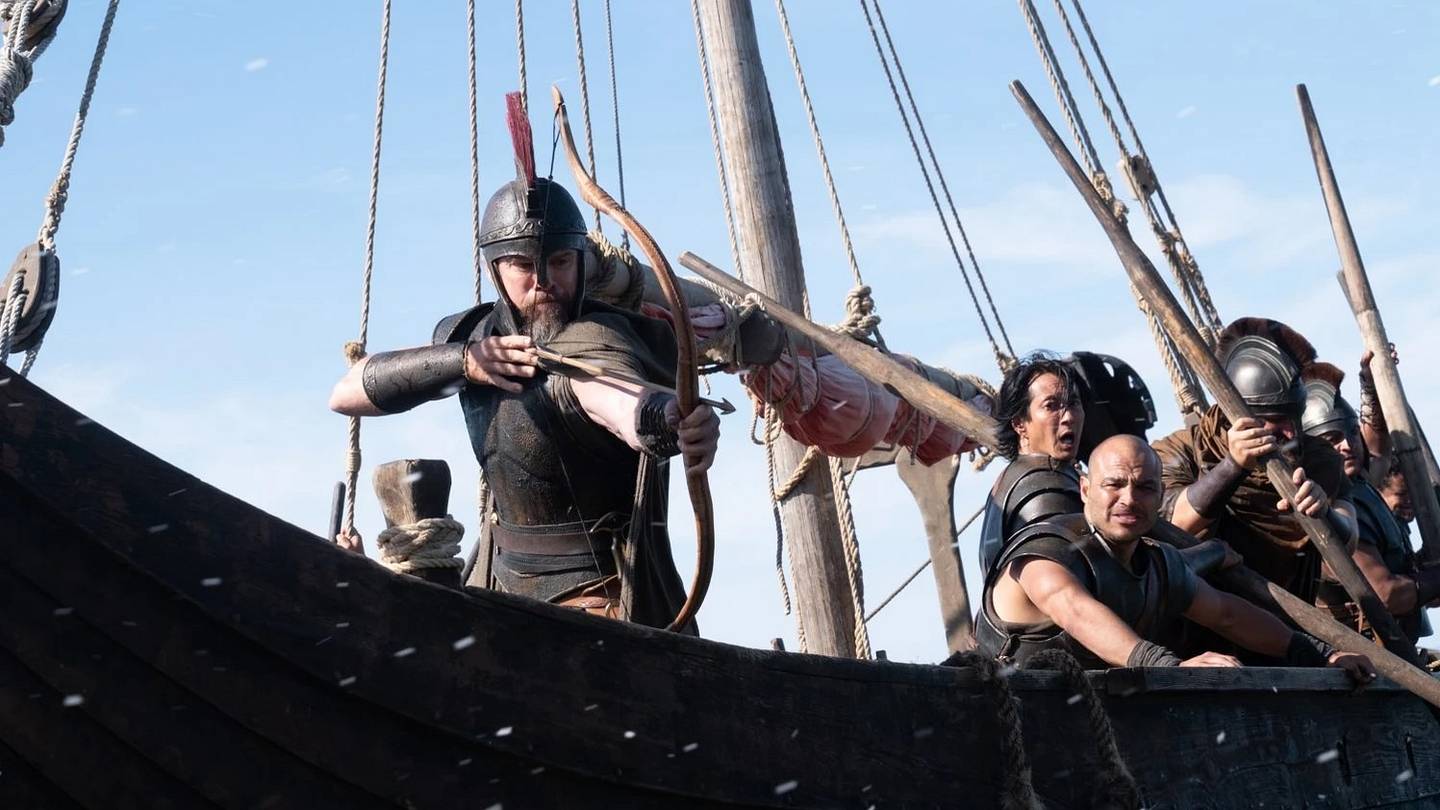
As much as it might horrify Homer, Batman walked so Agamemnon could run. At least, that seems to be the consensus among critics of Christopher Nolan's The Odyssey, who quickly pointed out that the Greek king's matte-black helmet looked less like a Bronze Age artifact and more like the Dark Knight's sleek cowl.Agamemnon’s helmet and American accents are just a few of the details that history buffs and internet haters alike have picked apart since the film’s release. But when it comes to a movie based on a myth, historical accuracy isn't always smooth sailing.After years of movie misconceptions, we now know that medieval peasants weren't always caked in filth, Greek temples were far more colorful than they're often depicted, and cowboys didn't spend all their time robbing banks. So if accurate accounts of much of human history are readily available, why have generations of filmmakers favored dramatized versions of the past?That’s a question you’d have to ask not just Nolan, but Homer himself. The Odyssey began as an oral tradition, passed down from generation to generation before it was ever written down. It was told and retold to preserve the hero’s journey at its heart, not to serve as a history textbook. And when a story relies on word of mouth over pen and paper, exaggerations, misinformation, and modern updates are bound to creep in.Anachronism is just one more consequence of human nature that the Odyssey has to contend with. Homer composed the poem centuries after the Trojan War, mixing Bronze Age lore with Iron Age weapons. Even the ancient Greeks colored their retellings of the Odyssey with the trends of their own times. One might even say that Nolan isn't breaking tradition: he's keeping an ancient one alive. From "Zeus's Law" to misplaced Viking ships, here's how Nolan's epic compares to actual Bronze Age archaeology.Helmets & ArmorBronze plate armor with greaves, from Dendra | DEA / A. DAGLI ORTI/GettyImagesAgamemnon’s suspiciously synthetic-looking helmet drew instant comparisons to Batman's iconic mask. The remaining Trojan War heroes—outfitted in the typical leather gladiator getup and wielding steel swords—snuck past the period-piece fashion police a bit more easily. But if you traveled back to Mycenaean Greece in 1200 BCE, you'd find a drastically different aesthetic.Late Bronze Age soldiers went to war in heavy Dendra-style bronze plate armor and leather caps lined with rows of carved boar tusks. While those boar-tusk caps were explicitly described in the Iliad (and required dozens of wild boars to craft), steel swords and leather battle gear were still centuries away.Interestingly, anachronistic armor isn't just a Hollywood habit; it started with Homer himself. As historians point out, Homer’s poems contain a mix of real Bronze Age relics and newer Iron Age gear from the era in which he lived. Hostility & HospitalityTrojans hauling the wooden horse ashore in Christopher Nolan's 'The Odyssey.' | Melinda Sue Gordon/Universal PicturesWho needs Southern hospitality when you have "Zeus’s Law"? Unlike xenia—the real-world ancient Greek custom of "guest-friendship"—Zeus's Law is more a creation of Nolan than of Zeus himself.The sacred code of xenia was more straightforward. Hosts offered food and shelter to travelers, no questions or compensation asked, to ensure basic survival in a world without hotels. Nolan’s version, however, more closely resembles Jesus’s "Golden Rule": treat others as you wish to be treated.This Hollywood-born hospitality philosophy is peppered throughout the film, explaining both why Telemachus can't evict the suitors and why Odysseus tells his crew to get cozy in the Cyclops’ cave. The most glaring evidence of the law's abstract meaning occurs when Odysseus blames his own Trojan Horse trick for "breaking Zeus’s law forever,” framing the sneaky gift as the sin that shattered the social contract of the ancient world.ShipsOdysseus (Ulysses) tied to the mast of his ship to save him from the Sirens. Roman mosaic, 3rd century AD, Tunis. | Universal History Archive/Getty ImagesOdysseus’s fleet features long, wooden vessels that, to the untrained eye, look like they could be ancient Greek. However, the sturdy ships are actually Viking longships that are just a few millennia early for a Bronze Age story.The ships Odysseus and his crew would’ve actually used are penteconters, which were around 90 feet long and propelled by 50 rowers, who sat in two rows along either side of the ship as it sailed across the Mediterranean. But Nolan had a real reason for the 2,000-year time jump. Prioritizing practical effects over CGI, Nolan borrowed a working Viking longship—the Draken Harald Hårfagre, complete with its own crew. That meant he needed something that could actually withstand the open-water swells that almost seemed like they would spill out from the screen, even if it meant leaving historical accuracy at the docks.Language & AccentsL to R: Anne Hathaway is Penelope and Tom Holland is Telemachus in 'The Odyssey.' | Melinda Sue Gordon/Universal PicturesTom Holland’s Telemachus declaring "My dad is coming home" was like a Bat-Signal for armchair linguists. But while ancient Greeks obviously didn't speak English, they did have their own monikers like "mom" and "dad." Alongside the formal patēr (father), Greeks used diminutives like pappa and táta (daddy). Nolan’s defense of Dadgate? The line may not have been ancient Greek, but its emotional meaning was timeless.More Like This:
What 'The Odyssey' Gets Right (And Wrong) About the Ancient World
Full Article
Original Source
Read the full article at Mentalfloss →KhanList aggregates and links to publicly available news content. We do not host full articles from third-party sources. Always verify important information with original sources.