
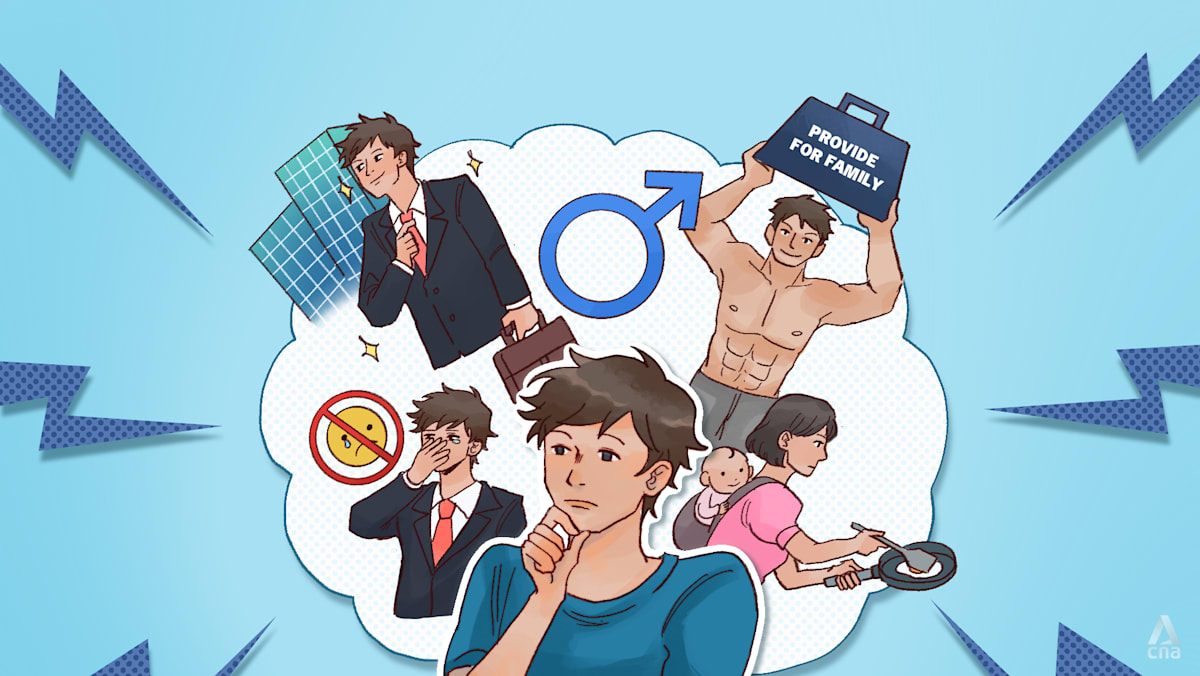
A man’s worth, in 19-year-old Jonathan’s eyes, is defined by his value as provider and protector."Women want someone they can lean on … That's what a man should be … commanding respect and being a leader," said the tertiary student, who declined to give his real name to “avoid being cancelled for being honest”.While he is aware that his views may be controversial in this day and age, Jonathan, who is single, said many of his friends and online peers share them. And to him, these sentiments are a natural result of his upbringing. His father, who works in engineering and is the sole breadwinner, handles major household decisions, while his mother has always focused on raising Jonathan and his younger sister at home. "(My father) would always say that I need to be the man of the house if anything happens to him, that I shouldn't be weak and need to be strong," the young man recalled.Over the years, influencers and online streamers such as American Adin Ross, who is in his mid-20s, have also reinforced Jonathan's beliefs about what an "ideal man" should be like."I knew about Andrew Tate but didn't really care until he appeared on (Ross') streams," he said. "But as I watched him tell Adin to man up, I started realising that I needed to as well." Tate, who is a dual British-US citizen, is a self-described misogynist and social media influencer with millions of followers, mostly young men who believe they have been wronged by modern feminism.On the flip side, there's 44-year-old IT manager Chris Lim, who also grew up in a household of traditional gender roles, but now hopes to show his two teenage sons a different way to express masculinity.The way Mr Lim and his wife split household and caregiving responsibilities is a far cry from his parents’ division of labour in the 1980s and 1990s, when his father, a businessman, was the sole breadwinner and his mother was in charge of all things related to the home and parenting."We knew that my dad was always busy. He will try to engage with us, but he'll leave the education of the children to my mum. Whenever anything goes wrong, if the kids mess up, he will always say (to Mr Lim’s mother): 'You see, your children'.''Before he became a father, Mr Lim found himself adopting elements of the older man’s model of masculinity, which meant "sucking it up” during difficult times to project strength.But Mr Lim’s thinking shifted over the years."There's this (societal) conversation that actually, taking care of the kids is not just a mum's role ... I see it as a good thing, because as a guy I (have learnt) to identify with my feelings a bit more, and ask myself: 'What is masculinity?'" For Mr Lim, this looks like being responsible and resilient, as well as being caring, emotionally vulnerable and present with one's loved ones. Global studies have found that more Gen Zs are subscribing to traditional masculinity beliefs, such as suppressing their emotions, and traditional gender norms. (Photo: CNA/Lim Li Ting) "I don't think those things make someone less masculine. Rather, they broaden what being a man is in this day and age."The two Singaporeans’ contrasting views and experiences highlight a broader trend, with studies indicating that younger men may hold more traditional views of masculinity and gender roles.A new survey by the Association of Women for Action and Research (AWARE) is the latest to have found that younger men are more likely than older men to repress their emotions and to believe that household responsibilities such as caregiving are a woman's duty. The findings were released on Saturday (Aug 22), following a survey of 1,084 male Singaporeans and permanent residents aged 18 and above on masculinity, emotional norms, household responsibilities and sexual entitlement.Similarly, preliminary findings released in July from a study on gender norms by SG Her Empowerment (SHE) found that the gender gap between men and women was widest among Gen Zs in Singapore.The trend is not unique to Singapore. A 2026 study by market research group Ipsos and the Global Institute for Women’s Leadership at King’s Business School, King’s College London, surveyed 23,000 people across 29 countries, including Singapore.It found that 31 per cent of Gen Z men agreed that a wife should always obey her husband, compared with 18 per cent of Gen Z women. A third of Gen Z men also believed a husband should have the final say on important decisions. In response to CNA TODAY's queries, AWARE said that the most concerning finding from its study is that men across all age groups professed to believe in equality, but stopped short when it comes to bodily autonomy, with more than a third believing men cannot control themselves when aroused."These are not fringe positions held by a small minority, they are majority or near-majority views sitting inside the same population," said the organisation.And such views hurt men too, it added."The cost of patriarchal norms is not borne by women alone; they actively tax men’s relationships with themselves … The norms that excuse harm are the same norms that leave men suffering in silence (about their emotions)."With no older data on the changing face of masculinity, sociologists such as Dr Tan Ern Ser of the Institute of Policy Studies (IPS) said that it is difficult to quantify if the gap is widening.But if more younger men are shifting their views towards traditional masculinity, National University of Singapore's (NUS) Assistant Professor Michelle Ho said the trend would be troubling. She is part of Campus Sexual Misconduct in a Digital Age, an independent research project investigating how digital technologies like social media shape, and are shaped, by sexual misconduct in Singapore."We say this not to vilify men, but because we understand that the dominant practices that presently position men within society are damaging, although in varying degrees and forms, for all members of that society," said Asst Prof Ho.WHAT DOES IT MEAN TO "BE A MAN"? Overall, the AWARE study found that most men (72 per cent) across age groups believe their worth is tied to their ability to earn and provide.More than half (55 per cent) of all respondents also said they prefer not to talk about their feelings because it makes them feel weak.However, the study found the highest agreement with such views among younger men aged 18 to 24, at about 65 per cent, while the lowest was among those aged 55 and above at around 49 per cent.Across the board, roughly 63 per cent of men feel pressured to meet masculine ideals. Those aged 18 to 24 were most likely to say that they felt pressure to meet these ideals (70 per cent), compared with their older counterparts aged 55 and up (54 per cent). Having grown up attending a boys' school, Mr Ahmad Amsyar Mohd Adom is not surprised by the findings, as he recalled boys being called names for being more in touch with their emotions. "When boys are getting caned, they will laugh and joke around because they don't even want to acknowledge their emotions. I understood where they were coming from, they're just protecting themselves," said the 25-year-old partnerships and communications executive for a charity."I didn't know that saying 'I'm upset' or being vulnerable was an option until the age of 23."Meeting his now-wife and having female friends in university helped Mr Amsyar reflect more on how traditional expectations of masculinity such as being "rough around the edges", impacted the relationships he was able to form. For many men, he noted, masculinity still has less to do with embracing how one really feels and is more about striving for achievements or a physical ideal."For Singaporeans, a lot of our yardsticks for manhood come from looking at men who do well at Hyrox (a fitness competition), who have very nice bodies, who go to the gym, drive nice cars, run tuition centres, or are financial advisers," he said. Similarly, 30-year-old lawyer Wen Xianda grew up feeling pressured to conform to society's ideals of a man, from expectations of what colours are acceptable for men to wear to how men should be stoic regardless of what happens in their lives."I've always had a pretty strong handle on my own feelings and emotions … but now it's about getting more in touch with them, understanding them. To be honest, I've only really had conversations about this with my wife, but would love to talk with more people, like friends," said Mr Wen.In recent years, Mr Wen has tried, with varying degrees of success, to move past "superficial" symbols of masculinity and is trying to embrace his own definition of it that feels truer to his beliefs. "Right now, I think masculinity for me lies somewhere between the dominant social image of what a man is or should be, and what we make of it ourselves."NUS’ Asst Prof Ho said that young men transitioning from adolescence to adulthood might also look to traditions and norms, including those surrounding gender, for guidance and stability.She noted that these formative years of early adulthood often coincide with National Service, which may inculcate values of Singaporean masculinity characterised by self-sacrifice, ruggedness and self-discipline among other things."Men who are in the midst of or recently completed their enlistment may feel more consequential pressure to embody these traits than those who completed their service long ago, though these older men have likewise been shaped by these expectations."IS CAREGIVING WOMAN'S WORK? When it comes to childcare and housework responsibilities, a majority of respondents in the AWARE survey believe that they should be shared equally by both partners, but there are notable differences between age groups.Among 18- to 24-year-olds and 25- to 34-year-olds, around 29 per cent and 26 per cent respectively said these duties should be more the responsibility of the woman or wife – considerably higher than the roughly 10 per cent among respondents aged 45 to 54 and those aged 55 and above. For Jonathan, the 19-year-old tertiary student, his upbringing may have forged these views, but social media influencers, like Andrew Tate and his brother Tristan, solidified them."Family responsibilities should be on the woman. I mean, they give birth to the kids, so they biologically have the instinct to do so," he argued, echoing views expressed by the Tate brothers. "Modern-day feminism is trying to reject this."There is no scientific consensus that women are biologically predisposed to bear greater family responsibilities because they give birth.Some men said that their views towards how household responsibilities have evolved as they grew up and witnessed the lived experiences of the women around them.Growing up in a dual-income household where his mother went back to work soon after giving birth, Mr Dev Bahl, 28, said he has always been comfortable with the notion of a "woman in the driver's seat" at home and work.But he has observed that women tend to sacrifice more than men post-marriage especially in Asian societies, bearing family and social pressures to have a child and handle caregiving. His family background, discussions with his wife and watching his sister go through the recovery from a Caesarean section shaped his views on how he would prioritise his wife's autonomy on whether she would like to have children."As I was navigating this, I understood that as a man, there's a very core difference between wanting kids and actually having to birth a child," said Mr Bahl, a director of a tech studio utilising augmented and virtual reality, and applied games for education."It's something that I think if men are not exposed to enough, they lose a lot of sensitivity around it because they don't understand how difficult of a procedure (giving birth) is and how risky it is," said Mr Bahl.Conversations with older men also show that when the economic and practical realities of running a household in Singapore hit home, equality may be the pragmatic choice.Mr Shamir Osman, a 45-year-old media industry professional, also grew up in a traditional household."The male roles were very clearly defined. Get outside, get the work done to bring home enough to support your family," he recalled of his childhood. "The wife would do everything from raising the children to the managing of the house, which includes the cooking and the cleaning and everything else."But in his household now, where he and his partner both work and have no children, chores and responsibilities are split between them as they have limited time. Mr Ray Han, too, grew up in a household where responsibilities were split along gender lines – his mother would manage tasks like cooking and chores and his father would be in charge of the finances.But the 31-year-old researcher in a laboratory said he wants a more even partnership in his future home, where both parties are capable of managing any aspect of their household. While he does not know of peers who expect their wives to be homemakers, he does know of some men who do want their romantic partners to "doll up and look pretty", especially during family gatherings."Those friends are generally more generous financially to their female partners, so it's sort of a balance. They have high expectations for a female partner, but they have higher expectations of themselves as a male partner as well,” Mr Han said. Indeed, the AWARE study found that high-income men were more likely than middle-income men of endorsing wife-heavy housework and childcare."These findings … echo feminist theory that once men begin to inhabit patriarchal ideals such as wealth and power, they start exhibiting those patriarchal views as well," said AWARE.Dr Mathew Mathews, the head of IPS Social Lab, noted, however, that while the findings may suggest that younger men are becoming more traditional in their views about gender roles, this does not gel with other data."When we look at survey data that has been done in Singapore over time, younger Singaporeans including younger men have generally become much less traditional on a range of gender issues. "They are less likely than earlier cohorts to say that men should have priority when jobs are scarce, that boys' education should be prioritised, or that mothers working will harm their children."He said that the older men's views on childcare and housework may stem from lived experiences."Many men in their fifties and slightly older have gone through decades of marriage, raised children, probably lived in dual-income households and seen first-hand what it takes to sustain family life," he said."A younger man who has not yet married may be answering based on what he anticipates might happen due to existing gender views. An older man may be answering based on what he has learnt actually works in a marriage."He added: "Given that this current finding is one-off and seems to go against the grain, we have to be cautious and need to consider whether there are other methodological features which have resulted in those results, such as the sample who responded to the study."He also noted that views on gender equality are not necessarily the same as views on responsibilities organised in a family, as some may believe that both men and women have equal opportunities at work while also carrying traditional assumptions about housework and childcare responsibilities.AWARE itself acknowledged that the issue deserves further study: "Our survey is the jumping-off point; more in-depth research, especially qualitative, is urgently needed to make sense of this dissonance and break the cycle of harm."SEX, CONSENT AND HARASSMENT The AWARE survey also looked into men's views towards sexual entitlement, consent and harassment.About 34 per cent of respondents said that a man cannot control himself when sexually aroused, while about 37 per cent said that after a woman consents to a sexual activity with a man, he cannot be expected to stop if she changes her mind. And when it comes to sexual entitlement, 55 per cent of men said that a man is entitled to sex from his partner in a committed relationship. When asked specifically about marriage, about 72 per cent agreed that a man is entitled to sex from his spouse. Younger respondents aged 18 to 24 were less likely to agree (60 per cent) than those aged 55 and above (74 per cent).As for harassment, roughly 67 per cent agreed that if a woman flirts with a man, she is partly to blame if she is harassed. Younger respondents aged 18 to 24, too, were less likely to agree (54 per cent) compared with those aged 55 and above (76 per cent).Mr Amsyar, the charity executive, is aware of these sentiments all too well. As a teenager in a boys' school, "locker room talk" – a phrase for conversations in male-dominated spaces that often lean into objectifying women or sexually explicit topics – was commonplace. “Some boys said things about female teachers – it was gross. I would call it out sometimes, like: 'Guys, no need to say that'." Some boys said things about female teachers – it was gross. I would call it out sometimes, like: 'Guys, no need to say that'. Among his peers now, victim-blaming language, such as berating women for the way they dress in sexual assault incidents, is considered unacceptable. But he noted that such comments are still common on social media when sexual crimes make headlines. "Whenever I see such comments, I'll always look at their profile. Most of the time, it's older people, or those 40 years old and above. I do also think this sentiment is fading away for the younger generation, though with younger people, you wouldn't be able to tell because they are using a burner account," said Mr Amsyar.Asst Prof Ho described the AWARE findings as "disheartening", noting that they show how normalised gender-based violence and acceptance of rape myths – such as men being unable to control themselves – to justify sexual violence. "More research is needed to understand how these beliefs are constructed and disseminated within Singapore."IS THE "MANOSPHERE" TO BLAME?Taken altogether, the survey findings, which align with those from other published studies globally, such as the Ipsos and King's College London study, point to a concerning trend, AWARE said."The comfortable assumption that each generation simply arrives more equal than the last does not hold here," it said."Our concern is less about young men as individuals and more about what is forming them, such as our schools, National Service, early working life, and an online environment where the 'manosphere' offers a very clear and very confident account of what a man is supposed to be."The term "manosphere" refers to a loosely connected network of online communities whose members perceive men as victims of modern feminism and promote aggressive definitions of masculinity. Internet personalities like Andrew Tate, who promote misogynistic views, are part of the "manosphere" that is gaining traction online. (Photo: CNA/Lim Li Ting) UN Women, a United Nations organisation, has raised concerns about the manosphere's growing traction among men and its growing links to radicalisation and extremism. For Richard (not his real name), a university student in his early 20s, content in the manosphere validated the anger he felt towards women after being rejected by a woman he was interested in. Richard, who spoke to CNA TODAY on condition of anonymity because he feared being "cancelled by the woke", felt that the woman had strung him along, making him pay for several dates before eventually rejecting his advances."It pissed me off; I felt very disrespected and thought it was only me who was wronged … Then I saw on social media stories about all these 'gold diggers' and realised it wasn't just me," he said.Mr Clive Velasquez, 21, a content creator who is serving his National Service, said social media has become increasingly divided, especially around gender norms and expectations. Women also fuel this divide, he said, pointing for example to phrases such as "if he wanted to he would" (a common refrain among social media users who believe women should not date men who do not put in effort to woo them) and "not all men, but always a man", a comment often left on posts about sexual crimes committed by men. "I speak to my female friends, whom I call my sisters, and when I see things from their perspective, I understand why they say these things and how men have hurt them," Mr Velasquez said.But he added that some men resented being grouped with those who have behaved badly or committed sexual crimes."I feel we all need to have a conversation," he said. "Everyone needs to chill out, talk it out over coffee or a podcast instead of throwing around all these assumptions and prejudices against one another online."Nanyang Technological University (NTU) lecturer Jeremy Sng said anger, outrage and grievance generate engagement on social media, giving platforms an incentive to amplify such content from the manosphere. Online communities could ultimately deepen isolation if they are built around resentment rather than genuine vulnerability, hindering the social skills and emotional openness needed to form healthy relationships offline, warned one expert. (Photo: CNA/Lim Li Ting) But algorithms are only part of the picture. Loneliness could also draw young men towards online communities that offer connection and validation, he said."The desire for connection, validation, and a sense of belonging – or 'brotherhood' – in digital spaces like Discord, Telegram, or Instagram is not inherently toxic," Dr Sng said, a lecturer in NTU's Interdisciplinary Collaborative Core office. But when a group frames a young man's personal struggles around a shared target such as women, modern dating, or societal unfairness, it can provide immediate validation while reinforcing his existing views.Such communities could ultimately deepen isolation if they are built around resentment rather than genuine vulnerability, hindering the social skills and emotional openness needed to form healthy relationships offline, Dr Sng said.Dr Mathew of IPS added: "We cannot deny that even now there still is fairly strong expectation for men to fulfil the provider role."He said that for younger men contemplating marriage and parenthood, there are still subtle expectations for the husband to concentrate on providing for the family financially while the wife takes greater responsibility for caregiving.He also noted that the most recent data from the World Values Survey, conducted in April 2025, shows that movement towards greater gender equality among younger men has slowed, particularly around male leadership.On this note, AWARE noted that young men are inundated with people offering supposed answers about masculinity."However, they are short of good ones. If we do not offer something better in the places where they actually spend their time, something or someone else already has," said the organisation.WHAT HEALTHY MASCULINITY LOOKS LIKEThe thing is, it is not just women but men themselves – their mental health and relationships – that suffer from regressive views of masculinity, experts said.Asst Prof Ho said: "Put plainly, the standards we currently use to measure men hurt us all. These standards justify violence of all sorts, but especially gender-based violence of women and girls, which is a foundational human rights concern."These standards also harm men, as evidenced by AWARE’s research which found emotional suppression predicts psychological distress. We all deserve to achieve well-being. If our current gendered attitudes and practices are holding us back from that, then it is our duty to ourselves and others to disentangle and restructure those attitudes and practices."But how? AWARE made several recommendations, including integrating emotional literacy and mental well-being support into schools and National Service to encourage men to seek help rather than repress their emotions.It also called for a review of sexuality and gender education in schools and measures to reduce pressure on men in the workplace, such as normalising paternity leave.In his work as a volunteer with the YouthTech Institute under YouthTechSG, a platform to equip youths in Singapore with digital resilience, Mr Bahl has seen "manosphere" content appeal to younger males because of underlying issues such as loneliness, or difficulties conversing and making friends with girls."Maybe they're not able to come to terms with the fact they have different ideas, and they've never been given a platform to be like: 'Hey, let's discuss it openly.' So they are very drawn to echo chambers that provide them justification."In this regard, Mr Bahl said that he hopes there will be more spaces for boys and young men to talk about what it means to be a man with positive role models."These tend to be like those men clubs, replacing the locker room chat with something that's a little bit more positive," said Mr Bahl.Men's support groups told CNA TODAY that men also need healthier models of masculinity."A lot of people think about traditional masculine qualities like strength, courage, being a provider and protector – there's nothing wrong with that. But what we men need to ask ourselves is: what do we do with that strength," said Mr Ismail Didih Ibrahim, 41, the co-founder of Fellowship of Men Singapore, a support group for men to build emotional resilience. "Can we be strong without being violent? Honest with our struggles without being ashamed? Can we take responsibility when something goes wrong?"Mr Didih said the support group had grown from 17 to 80 members in the last six months, reflecting a demand for communities where men could discuss their struggles and encounter healthier models of masculinity. Co-founders of Fellowship of Men Singapore, Mr Ben Ang and Mr Ismail Didih Ibrahim on Aug 20, 2026. (Photo: CNA/Lim Li Ting) He also called for more social media influencers who promote healthy masculinity to younger men.Mr Ghazali Muzakir, 40, founder of Singapore Male Allyship Network (sgMAN), similarly hopes to reach boys and men directly through classes promoting a form of masculinity centred on socioemotional abilities, among other initiatives. Mr Ghazali recalled one teenager telling him that "the man of the house has to be a man" and that the boy had to lead the household and take care of his mother while his father was in prison. Other teens have also told him that men "must be strong", "boys don't cry" and "women are emotional" – words that they have heard from their own parents."As the older generation, we also have to ensure we aren't passing down these traditional messages of masculinity, of emotional suppression, to our children," Mr Ghazali said.However, he noted that it can be hard to reach out to men who are not aware of how traditional values of masculinity can affect them and the people around them. On an individual level, AWARE said that everyone can play a role in shaping healthy masculinity."In conversation, be willing to interrupt and hold the person accountable. When someone makes a comment (in reference to a sexual crime) that 'she was asking for it', a question does more work than a lecture and costs less than what most men expect," said the organisation."Older men have particular room to move here … Having a father, officer, or manager who can say that he is frightened or out of his depth, as well as able to hold someone accountable resets what is possible for the other men watching."For Mr Lim, the IT manager, this is a daily endeavour as he strives to teach his two teenage sons that masculinity can encompass space to be vulnerable, learn to care and put things down when they need to.Mr Lim's approach is to start open conversations with his sons about what it means to be a man, including watching and discussing the Netflix show Adolescence, which was released last year and touches on the rise of incel culture, masculinity and online bullying.Incels, short for "involuntary celibates", refers to a subculture of men who are misogynistic because they can't find a romantic or sexual partner."I watch it with them, because I want them to be more aware of such content. My boy, he knows Andrew Tate these days, so he asked: 'What did he do?' I broke it down with him. But at the end of the day, as a father, I tell him he has to make his own decision for himself, but this is my take,” Mr Lim said.When Mr Lim’s eldest son gets into conflicts with his younger brother and wants to get into a physical fight, he prompts his sons to reflect if it is really "boyish" or "manly" to hurt someone, and to explore better ways of dealing with feelings of annoyance."I am not perfect. I am highly flawed as a human, and I do my best to try to be a role model for the boys. And it also comes down to role-playing what I feel masculinity should be in this day and age, such that they can learn to be better."
What does it mean to be 'man enough'? Evolving social norms have made the answer less clear-cut
Full Article
Original Source
Read the full article at Channelnewsasia →KhanList aggregates and links to publicly available news content. We do not host full articles from third-party sources. Always verify important information with original sources.