
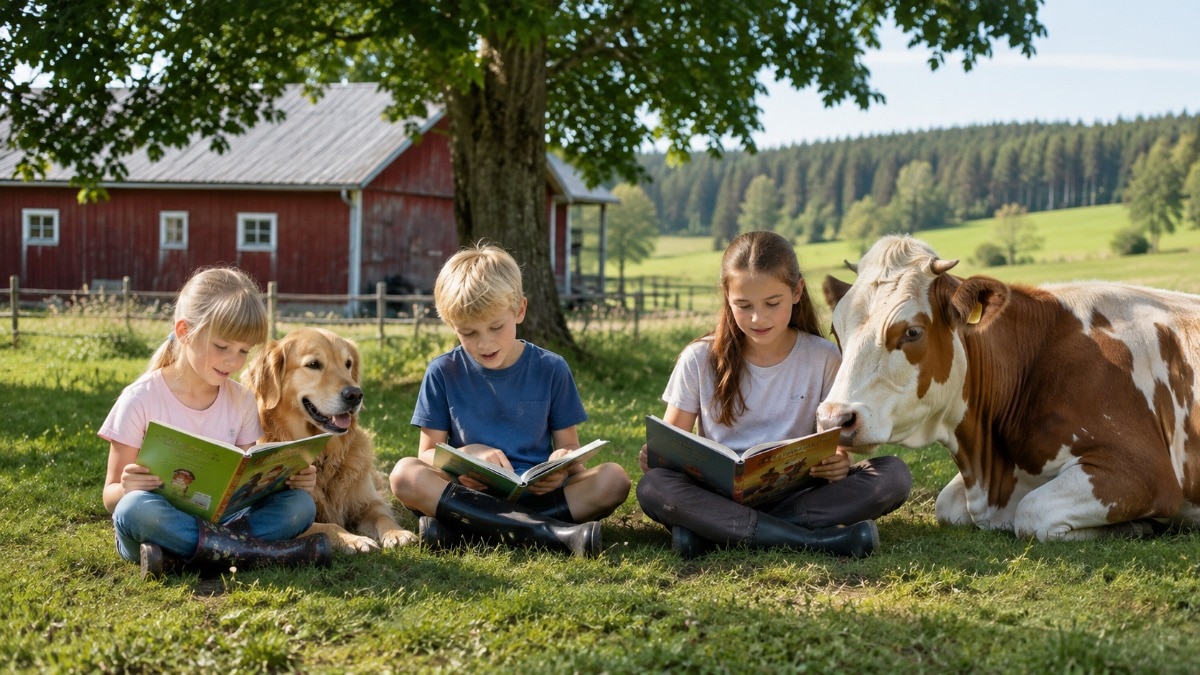
In Finland, children read aloud to trained dogs and, in some local initiatives, cows. The unusual approach aims to make reading less stressful and more enjoyable. Research suggests animals may reduce anxiety and improve motivation, although scientists say stronger evidence is still needed to prove they directly improve children's reading skills.In Finland, children read aloud to trained dogs and, in some local initiatives, cows. The unusual approach aims to make reading less stressful and more enjoyable. (AI-generated image)Imagine being asked to read aloud in front of your class. You stumble over a word, someone giggles and the teacher corrects you. Suddenly, the story becomes less important than worrying about making the next mistake.Now imagine reading the same book to a dog.The dog does not correct your pronunciation, tell you that you are too slow or compare you with another child. It simply listens.That is the idea behind Finland's reading dog programmes, where children read aloud to trained dogs in libraries and other settings. In some smaller Finnish initiatives, children have even been encouraged to read to cows on farms. The idea sounds playful, but it is based on a serious question: could removing the fear of making mistakes make children more willing to practise reading?WHY ARE FINNISH CHILDREN READING TO DOGS?During a typical session, a child sits beside a trained dog and reads from a book while its handler remains nearby. The dog listens quietly while the child can pause, repeat a sentence or struggle with a word without being interrupted. The Finnish Kennel Club says reading dogs are intended to create a relaxed environment and help reduce anxiety around reading. Finland's formal reading dog programme began in 2017 through cooperation between the Finnish Kennel Club and the City Library of Mikkeli. The programme grew out of earlier library initiatives to develop reading dog activities.These are not simply friendly pets brought into libraries. Reading dogs must meet requirements including being at least two years old, healthy, comfortable around people and calm around strangers. Their handlers are also trained.FINLAND DIDN'T INVENT THE IDEAReading to animals is part of a much larger international movement.One of the best-known structured programmes, Reading Education Assistance Dogs (R.E.A.D.), was launched in Utah, US, in 1999 by Intermountain Therapy Animals. It used trained therapy dogs as reading companions and became a model for similar programmes elsewhere.Australia has its own major initiative, Story Dogs, which began in 2009 and places accredited dog-and-volunteer teams in primary schools. Children receive regular opportunities to read to the dogs in individual sessions.So Finland's reading dogs are not an isolated experiment. The country has instead developed its own established version of an approach now used in several countries.WHAT ABOUT THE COWS?Dogs are the more established reading companions. Cows are the unusual part.Some Finnish rural initiatives have children visit farms and read aloud to cows in barns. The idea is similar: the animals provide a quiet, non-judgmental audience, while the rural setting can make reading feel different from a conventional classroom.However, reading-to-cows initiatives are much smaller than reading dog programmes, and there is far less scientific research specifically examining their impact on literacy.The cow angle is therefore best seen as an interesting extension of the idea rather than a proven educational intervention.WHAT DOES SCIENCE ACTUALLY SAY?The evidence for reading dogs is promising, but it is important not to oversell it.A 2016 systematic review published in PLOS ONE examined 48 papers on children reading to dogs. It found encouraging evidence around reading confidence, motivation, attention, anxiety and the overall reading environment.But the researchers also found that much of the existing research was of low quality, with small samples and methodological limitations. They called for larger, better-controlled studies before strong claims could be made about the effect on reading ability.In other words, the strongest evidence is not that dogs make children better readers, but that they may make children more comfortable and motivated to practise.A CANADIAN STUDY FOUND AN INTERESTING RESULTOne of the more useful studies involved 24 children aged seven and eight who needed additional reading support.The children experienced both canine-assisted and adult-assisted reading sessions, allowing researchers to compare the two settings. The study found evidence of improvements in reading performance, particularly following the dog-assisted sessions, along with some positive changes in social and emotional measures.But the sample was small, so the findings cannot establish that reading to dogs improves literacy for children generally.Another US study of a five-week R.E.A.D. programme also found no statistically significant differences in measured reading outcomes between children who read to dogs and those in the control group. However, the control group showed a decline in academic attitudes towards reading that was not seen in the dog group.That distinction matters. The potential benefit may not be an instant jump in reading scores, but helping children stay interested and willing to practise.WHY MIGHT A DOG HELP?Reading aloud is not only a test of whether a child knows the words. For some children, it is also a social performance.They may worry about sounding foolish, being slower than classmates or being corrected after every mistake. A dog removes much of that pressure.A 2022 systematic review of 18 experimental studies involving dogs and children with special educational needs found mixed results for academic outcomes, including reading. However, the strongest evidence was around areas such as motivation and physiological stress, with some studies reporting lower cortisol levels when dogs were present.This suggests that the animal may not be acting as a teacher at all. It may be changing the environment in which the child learns.SO, DO DOGS REALLY IMPROVE READING?The honest answer is: we don't know yet.Research suggests that dogs can help create a calmer environment, reduce anxiety and increase motivation to participate. Some individual studies have also reported improvements in reading performance. But larger, better-designed studies are still needed to establish whether these programmes produce lasting improvements in literacy.That means reading dogs should not be presented as a replacement for teachers, reading specialists or structured literacy instruction. Their role may be much simpler.They give children an audience that makes it safe to practise. And for a child who is nervous about reading, sometimes a patient audience that never laughs, interrupts or judges may be enough to make them turn the page and try one more sentence.That may be the most useful lesson from Finland's four-legged reading companions: learning does not always require more pressure. Sometimes children need a space where making a mistake does not feel like failure.- EndsPublished On: Aug 22, 2026 09:00 IST
In Finland, children read to dogs and cows. The science behind it is fascinating
Full Article
Original Source
Read the full article at Indiatoday →KhanList aggregates and links to publicly available news content. We do not host full articles from third-party sources. Always verify important information with original sources.