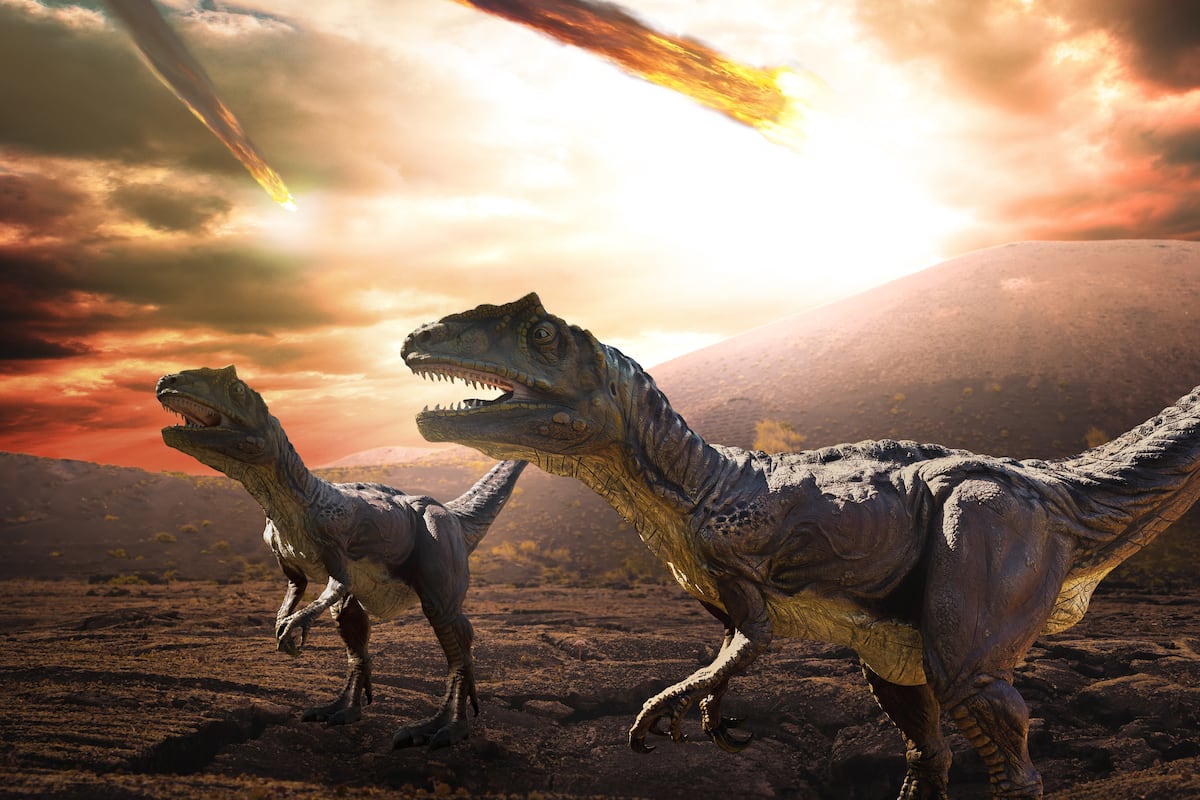
Dinosaurs, which dominated the planet for tens of millions of years, may have perished in a matter of hours. The asteroid impact about 66 million years ago turned Earth into an inferno within its first day. But specialists who study the cataclysm disagree about what happened next. For some, the energy released by the strike triggered a chain of global catastrophes (widespread fires, megatsunamis...) that wiped out most terrestrial life. For others, the atmosphere filled with dust that blocked sunlight — similar to major volcanic eruptions — producing a decades-long winter. A new study, however, assigns this dust an immediate, deadly role: it turned the planet’s surface into a grill that seared the dinosaurs.The impact near what is now the Yucatán Peninsula (Mexico) disintegrated the asteroid — a body roughly 12 kilometers (7.45 miles) in diameter — but also vaporized a huge portion of the impact zone. The authors of the new paper, published in Journal of Geophysical Research: Biogeosciences, estimate it vaporized more than 1,000 cubic kilometers of material, made mainly of vaporized rock and soil particles, as well as all the animals and plants in the strike path and the meteorite itself.“Part of the rock vapor and the spherules escaped to space and never fell back to Earth,” Brandon Johnson, a crater and planetary impact expert at Purdue University (United States) and the study’s lead author, wrote in an email. But most of both components, which rose to between thousands to tens of thousands of kilometers above the surface, eventually fell back. “The spherules can pass through the atmosphere and separate from the rock vapor as they are decelerated by drag forces”; that differing behavior is key to what followed.The spherules, no larger than a grain of sugar, generated heat during atmospheric friction on their descent similar to that produced during rocket and capsule reentries. Their presence in sediments worldwide has allowed scientists to pinpoint the exact moment of the impact and to explain the global fires that followed. But much of the material — especially what remained of the asteroid — would not have behaved the same way: this new study reveals it did not condense into spherules but remained as an ultra-fine dust cloud that ultimately enveloped the planet.“All that enormous kinetic energy has to go somewhere and, in the end, it is converted into heat,” Johnson said. But the dust cloud, several millimeters thick, would have prevented that heat from dissipating upward, reflecting it back toward the ground. The researchers estimate the radiation was 17 times higher than the level needed to kill a human. “That’s what killed the dinosaurs and the other animals. It wasn’t the shock wave from the impact or the fireball, because those effects don’t reach very far,” the U.S. researcher added.Alexandria Johnson, a professor in Purdue’s Department of Earth, Atmospheric and Planetary Sciences and a co-author of the study, analyzed the physical properties of individual dust particles and of the cloud as a whole to determine their radiative characteristics. Her conclusion is stark: “We found that the dust layer was so opaque to radiation that it trapped virtually all the heat generated by the falling spherules near the planet’s surface. It’s like the dust acted as a lid on a pot.” Only animals able to shelter underground — such as early mammals — fish in non-surface waters, or some avian dinosaurs would have survived the inferno.But the dust did more than intensify lethal heat. Its effects continued long afterward, but in the opposite direction. Over time the heat waned, while sunlight continued to be blocked for years or decades, causing a prolonged winter. Simulations in earlier studies indicate average global temperatures dropped by 20 degrees Celsius and stayed that way for about 30 years. That would likely have been the final blow marking the end of an era — the Cretaceous and the age of dinosaurs.Both Brandon and Alexandria Johnson and their co-authors believe global fires were the main cause of mortality, but acknowledge their case rests on a single, highly significant site — the Tanis deposit in North Dakota. There, roughly 3,000 kilometers (1,865 miles) from the impact zone, they found the most consistent evidence: countless animals that died almost instantly, including many fish with spherules lodged in their gills. The death layer is capped by a thin stratum of extraterrestrial dust — the material analyzed in the new study.“It’s possible that, over time, we will find evidence of truly global wildfires,” said Alfio Alessandro Chiarenza, a paleontologist at University College London who did not participate in the study. “It’s just that, for now, we don’t have any,” he added in a statement. If such evidence is found and the near-instant deadly role of the dust layer can be generalized, scientists could determine whether the end-Cretaceous mass extinction that ushered in the Paleogene occurred in hours (from scorching heat), in years or decades (from subsequent cooling), or from a combination of both processes. “It would be fantastic to find out which animals survived immediately after the impact and what their biological traits were. That might finally explain why some animals survived while others, like the dinosaurs, did not,” Chiarenza concluded.Sign up for our weekly newsletter to get more English-language news coverage from EL PAÍS USA Edition
Were the dinosaurs incinerated in a matter of hours? The meteorite created a layer of dust that turned the planet into a grill
Full Article
Original Source
Read the full article at English →KhanList aggregates and links to publicly available news content. We do not host full articles from third-party sources. Always verify important information with original sources.