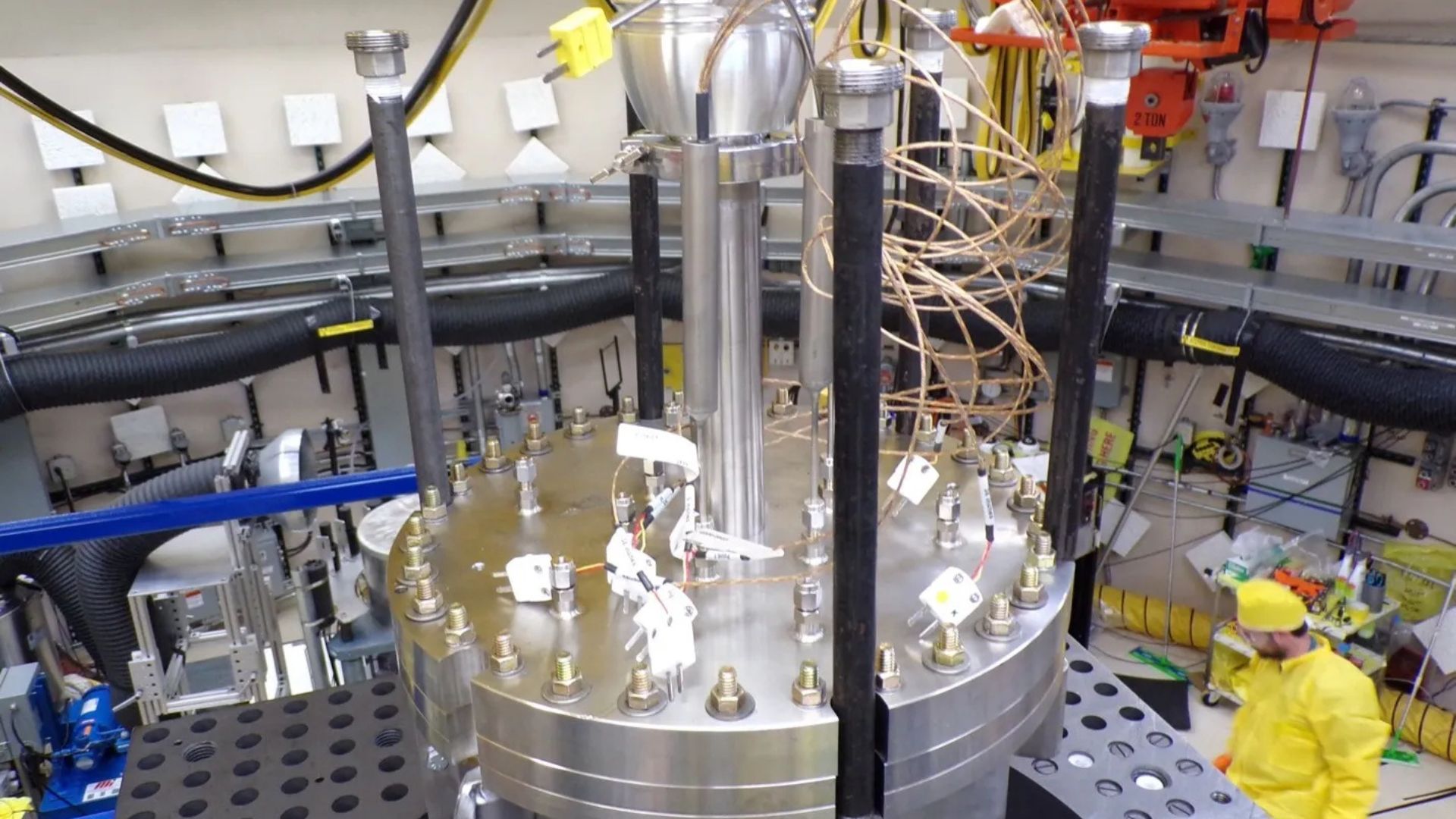
A US premier research facility has successfully brought its ZiaCore advanced nuclear microreactor to criticality, marking a key milestone for the low-enriched uranium reactor design. The proof-of-principle experiment conducted by the Los Alamos National Laboratory achieved high-temperature, zero-power criticality, confirming the reactor’s core physics without generating electricity. The achievement provides important validation for the ZiaCore design and is expected to support the development of a new generation of compact nuclear microreactors. “The experiment will provide valuable data for low-enriched reactor technologies, including components developed at Los Alamos, at representative reactor temperatures,” said Christopher Stanek, director of the Nuclear Energy Program Office at Los Alamos, in a statement. ZiaCore reaches criticality Los Alamos National Laboratory has successfully demonstrated a key milestone for its ZiaCore advanced nuclear microreactor, bringing the compact reactor design to high-temperature, zero-power criticality during proof-of-principle testing at the National Criticality Experiments Research Center (NCERC) in Nevada. The achievement validates the reactor’s underlying physics and marks an important step toward the development of compact nuclear power systems designed to provide reliable, low-carbon energy for remote sites, military installations, industrial facilities, and other applications where conventional reactors are impractical. Unlike traditional nuclear reactors, ZiaCore is designed as a factory-manufacturable microreactor that emphasizes compactness, fuel efficiency, and simplified deployment. The system uses low-enriched uranium dioxide fuel, a zirconium hydride moderator to slow neutrons and sustain the fission reaction, and passive heat-pipe cooling that transfers heat without the need for complex active cooling systems. The architecture is intended to reduce construction complexity while enhancing operational safety. Development of the ZiaCore technology began in 2021 to create a reactor that could efficiently operate on low-enriched uranium while remaining practical to manufacture and deploy. The design is also compatible with high-assay low-enriched uranium (HALEU), containing less than 20 percent uranium-235, once commercial supplies become widely available. HALEU is expected to improve fuel efficiency and extend operating life for many next-generation reactors. Nuclear design validated During the recent demonstration, researchers assembled a full-scale reactor core inside a specially engineered vacuum chamber housing the fuel assembly, heat pipes, zirconium hydride moderator, fuel elements, and custom electric heaters. The entire assembly was then installed on the Deimos criticality testbed at NCERC, where it underwent a series of experiments over four weeks in April and May. The reactor was heated to temperatures exceeding 800 degrees Celsius (1,472 degrees Fahrenheit) before reaching zero-power criticality. At this stage, the reactor sustained a controlled nuclear chain reaction but generated virtually no measurable heat from fission, allowing researchers to validate reactor behavior without entering power-producing operation. The tests confirmed that the reactor’s neutron behavior closely matched design predictions while providing valuable experimental data on temperature coefficients of reactivity, a critical parameter that measures how reactor reactivity changes as temperatures rise. These measurements are essential for validating reactor safety models, improving simulation accuracy, and supporting future licensing and commercial deployment. Because zero-power critical experiments produce negligible heat and only trace amounts of radioactive fission products, the reactor fuel remains largely unchanged and can be reused for additional testing. This enables engineers to continue refining the reactor design before progressing to higher-power demonstrations. According to Los Alamos, the ZiaCore project also demonstrates how advanced reactor technologies can leverage the laboratory’s expertise in heat pipes, reactor materials, fabrication, and criticality testing. The successful experiment is expected to generate valuable data not only for ZiaCore but also for a broader class of low-enriched uranium microreactors being developed to expand the role of advanced nuclear energy in future power systems. Recommended ArticlesGet the latest in engineering, tech, space & science - delivered daily to your inbox.Jijo is an automotive and business journalist based in India. Armed with a BA in History (Honors) from St. Stephen's College, Delhi University, and a PG diploma in Journalism from the Indian Institute of Mass Communication, Delhi, he has worked for news agencies, national newspapers, and automotive magazines. In his spare time, he likes to go off-roading, engage in political discourse, travel, and teach languages.
US lab validates nuclear microreactor with successful zero-power criticality test
Full Article
Original Source
Read the full article at Interestingengineering →KhanList aggregates and links to publicly available news content. We do not host full articles from third-party sources. Always verify important information with original sources.