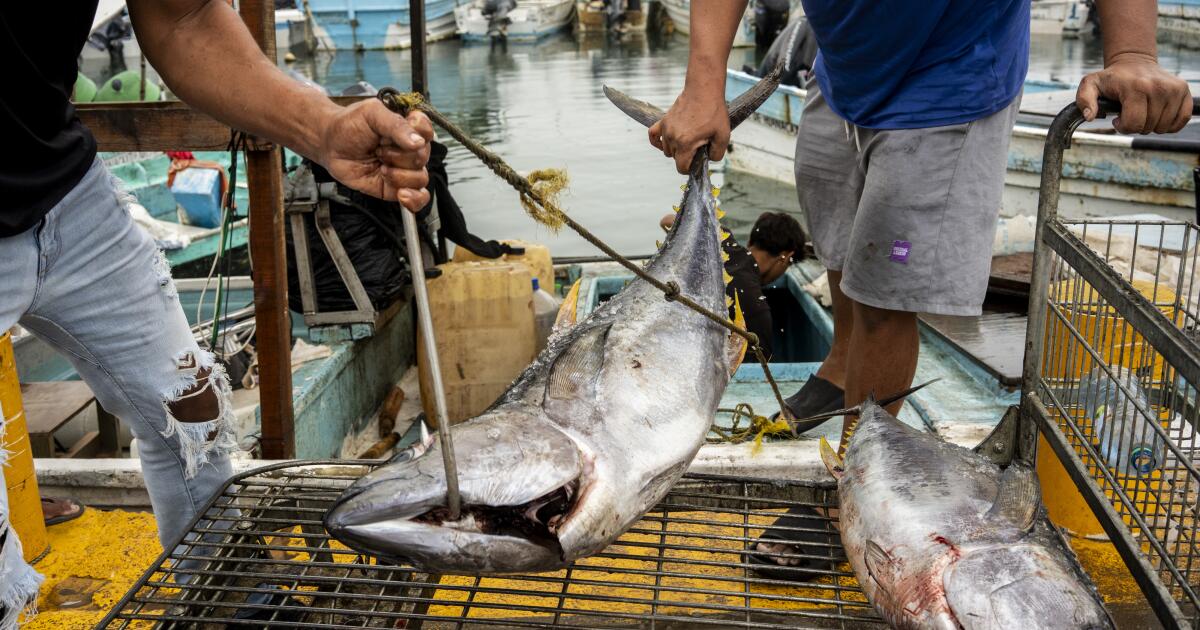
LA CRUZ DE HUANACAXTLE, Mexico — Before dawn one morning in mid-February, two boats carrying eight fishermen set out from Mexico’s Pacific coast. They never returned. The drug traffickers who had hired the men to help them smuggle cocaine said the boats had been bombed by the U.S. military, which had just released videos showing two missile strikes that it said killed eight “narco-terrorists” in the Pacific. 1 2 3 4 1. Cellphone photos show the memorial service held at sea July 7 for fishermen from La Cruz de Huanacaxtle. 2. During the memorial service, some mourners cracked open cans of beer in a salute to the missing mariners. 3. Some mourners sang during the service. 4. Mourners on dozens of boats gathered for the memorial service. For months, Washington has threatened to bomb cartel targets in Mexico, a scenario Mexican President Claudia Sheinbaum firmly rejects. “The Mexican people,” she has said, will never accept “violations of Mexican territory, whether by land, sea or air.” Yet U.S. airstrikes have already struck Mexican vessels carrying Mexican citizens in international waters off the country’s coast, according to a Times investigation. That includes the fatal strikes on Feb. 16 on the eight men from Nayarit state.At least five additional Mexicans have died in U.S. boat strikes in other parts of Latin America, according to Times reporting, casualties in the Trump administration’s new campaign against alleged drug traffickers.Their deaths highlight the proliferation of maritime narcotics trafficking — and the ways that some Mexican fishermen have been swept up in the drug trade.In towns such as La Cruz de Huanacaxtle, the village just north of Puerto Vallarta that was home to seven of the eight men killed in February, the strikes have spooked fishermen involved in legal activities who now fear being mistakenly targeted. And they have prompted a quiet reckoning among those who were aware that the victims were working for drug smugglers. “They knew the risks,” said Father Rigoberto Cruz, 53, shown inside his church in La Cruz de Huanacaxtle. (Cesar Rodriguez/For The Times) “They knew the risks,” said Father Rigoberto Cruz, a local Catholic priest, of the dead. As for those who grieve them, “they understand why all this happened.”The Trump administration’s strikes against alleged drug boats have killed a total of 221 people since September and have sparked outcry from human rights advocates and lawmakers who call the offensives both ineffective and illegal.Whereas attacks on mariners from other countries, including Venezuela, Colombia and Ecuador, have been widely reported, the killing of Mexican seafarers has gone unacknowledged by the Mexican government — and largely unnoticed internationally. The U.S. has not revealed the exact location of any of the 64 strikes it has carried out, saying only that they occurred in international waters in the Pacific Ocean or Caribbean Sea. It has not shared details about who was targeted or why. Mexican authorities say they, too, have been kept in the dark about the specifics of the strikes. Moisés López Pedroza, a spokesman for Mexico’s navy, said he could only confirm that no attacks had occurred within his country’s Exclusive Economic Zone, which extends 200 nautical miles from Mexico’s coastline. When asked whether it had knowledge about Mexican citizens killed in strikes, Mexico’s Foreign Ministry responded: “We have no information.” Yet in many ways, the phenomenon has been hiding in plain sight: In coastal towns across Mexico, mariners have set out to sea and then vanished, the dates of their disappearances corresponding closely with boat strikes reported by the U.S. An aerial view of La Cruz de Huanacaxtle, a fishing village just north of Puerto Vallarta. In some cases, local officials and members of organized crime told family members of the lost fishermen that their loved ones had been killed by U.S. missiles.The cases raise new questions about the ethics of the U.S. strikes, which some legal experts say amount to extrajudicial killings, and the fraught nature of U.S.-Mexico relations as President Trump wages what he has labeled a formal “armed conflict” with cartels, whom his administration has officially designated as terrorist groups. According to interviews with eight people in La Cruz de Huanacaxtle familiar with the case, it was common knowledge that the men sometimes earned extra cash by transporting gasoline to the high seas, where they would refill speedboats ferrying cocaine from South America. The men had freshly renovated homes, drove better cars than most, and were sometimes seen leaving the local marina carrying more fuel than would be necessary for a normal fishing trip, according to multiple sources who spoke on condition of anonymity because they feared repercussions for speaking out about cartel operations. They say the men set out early Feb. 16 from Punta Pérula, a town more than 80 miles south known as a stronghold for the Jalisco New Generation cartel. The U.S. reported the two strikes late that night. A Mass for the men was held at sea a few days later. Family members identified the dead as Edgar Valerio Ramos, Pedro Torres Falcón, Luis Torres Jiménez, Carlos Torres Zamora, José Reyes García, Diego Ocampo González, Abel Ramos Jiménez and Braulio Cruz Joya.Videos of the ceremony show dozens of boats carrying mourners dressed in black, tossing wreaths onto the waves, cracking open cans of beer and singing along to narco-corridos, songs that chronicle the lives — and sometimes deaths — of drug traffickers. Mexico boasts more than 5,800 miles of coastline, and for decades locals who make their living on the ocean have sometimes also played a role in moving drugs north. Marbella Para Amador, 27, said generations of men from Puerto San Carlos, her hometown on a stretch of rugged coastline of Baja California Sur state, have worked for traffickers. She said her husband, Jesús Rangel Romero, 28, was not a part of the trade. But after the town’s economy cratered with the closure of the local sardine cannery, Rangel, anxious to provide for the couple’s 1-year-old daughter, agreed to take a smuggling job. “He accepted it out of desperation,” Para said.Rangel last contacted his family on May 26 as he and two other men from Puerto San Carlos set out from Guatemala, heading toward Colombia. Then communications went dark. The U.S. reported several deadly strikes on boats in the eastern Pacific around that time: on May 26, May 27, May 29 and May 30. The drug smugglers who had hired Rangel told Para that her husband had been killed. Nearly two months later, she said in a phone interview, she is still waiting for confirmation of his death from Mexican authorities. She tries not to re-watch the videos of the strikes from late May, but finds herself returning to them. “You’re watching them being killed, and you feel helpless,” she said. Earlier in the year, on March 8, two other men from Puerto San Carlos, Enrique Meza and his son, known as Kikín, were killed in another U.S. strike in the Pacific, according to locals familiar with the case. Para acknowledged that those victims, and her husband, probably broke the law, but said that shouldn’t warrant their assassination. “They made a bad decision to try to get their family ahead,” she said. Agustín Del Castillo, a Mexican journalist who has investigated links between the fishing industry and organized crime, said criminals take advantage of the precarious economic nature of the fishing industry and sometimes approach fishermen and offer to help modernize their boats with a new motor or two. Later, they call in favors, with the threat of violence always in the background. “Fear is part of the system,” said Del Castillo, who added that much of the region near Puerto Vallarta is firmly under the control of the Jalisco cartel, a fact highlighted by the dramatic blockades that appeared after Mexican authorities killed the group’s leader, Nemesio Oseguera Cervantes, or “El Mencho,” in February. Del Castillo blamed the Mexican government for being largely “negligent” when it comes to policing coastal areas and the high seas. In October, the U.S. reported four strikes in the eastern Pacific. Shortly after, Sheinbaum announced that Mexico’s navy had been deployed from Acapulco in the ultimately unsuccessful search for a survivor.It was the first evidence of a U.S. attack near Mexico, although Sheinbaum and other officials downplayed its significance. The next month she announced that the U.S. had agreed “at least in principle” to work with Mexico’s navy so that it could intercept suspected drug vessels near its coastline. She presented it as a way to prevent further strikes. Since then, her government has touted an increase in drug seizures and arrests at sea: More than 77 tons of cocaine seized since the start of Sheinbaum’s term, and at least 242 arrests since the beginning of last year. The arrests include large numbers of people from Ecuador, Guatemala and Colombia, highlighting the transnational nature of the drug trade. A young fisherman stands aboard a fishing boat in La Cruz de Huanacaxtle. Still, the bombing campaign has continued. Del Castillo said Mexican leaders may be reluctant to call attention to the strikes for fear of provoking confrontations with Trump, and because the attacks “show that the country’s sovereignty is in question.”Other analysts worry that the boat strike campaign has helped normalize the idea of unilateral U.S. military action in Latin America — and think land strikes on Mexican cartel targets may be the next frontier. Trump said as much at a Group of 7 summit in May. “Now we’re going to go and focus on the land,” Trump said. “Mexico has lost control of their country. The cartels run Mexico. And it’s sad.”According to the White House, the designation of drug gangs as terrorist groups makes boats involved in trafficking legitimate military targets. Human rights advocates, many legal experts and some U.S. lawmakers disagree, saying that the strikes violate laws on the use of force and that the targeting criteria are unclear. Last month, two U.S. senators who received classified briefings on the matter said the military is targeting vessels even if there is no evidence they are carrying drugs or weapons. “In order to blow them up, we don’t have to say that they’re armed or have drugs,” Sen. Rand Paul (R-Ky.) said during a hearing in Washington. When asked about the incident involving the men from La Cruz de Huanacaxtle, a spokesman for the U.S. Southern Command said: “Every narco-terrorist killed during Southcom operations was an affiliated member of a Designated Terrorist Organization actively transporting illicit material along known trafficking routes in international waters.” The spokesman did not say whether gasoline constituted an “illicit material.” A statue of Saint Jude Thaddeus, the patron saint of hope and impossible causes, stands at the marina in La Cruz de Huanacaxtle, where fishermen and other visitors leave offerings. The Trump administration says the strikes have helped reduce the flow of drugs crossing the border.Yet the price of cocaine on U.S. streets remains essentially unchanged, and cocaine seizures at the U.S.-Mexico border have not decreased significantly since the strikes began. “They haven’t moved the needle,” said Adam Isacson, an analyst at the Washington Office on Latin America, a think tank. In La Cruz de Huanacaxtle, many balked at the idea that the eight men killed posed a threat to the U.S. “They didn’t have guns, they didn’t have drugs, they carried gasoline,” said one fisherman. “What they did was illegal, yes. But it doesn’t make them terrorists.” The fisherman said that these days, when he heads out to catch tuna, sharks or other fish found far offshore, he fears accidentally becoming the target of U.S. bombs. “Every time I hear a plane fly overhead,” he said, “I wonder if it’s coming to kill me.” People fish with hand lines near the marina in La Cruz de Huanacaxtle. Special correspondent Cecilia Sánchez Vidal in Mexico City contributed to this report. More to Read
U.S. airstrikes at sea are killing Mexican citizens
Full Article
Original Source
Read the full article at Latimes →KhanList aggregates and links to publicly available news content. We do not host full articles from third-party sources. Always verify important information with original sources.