
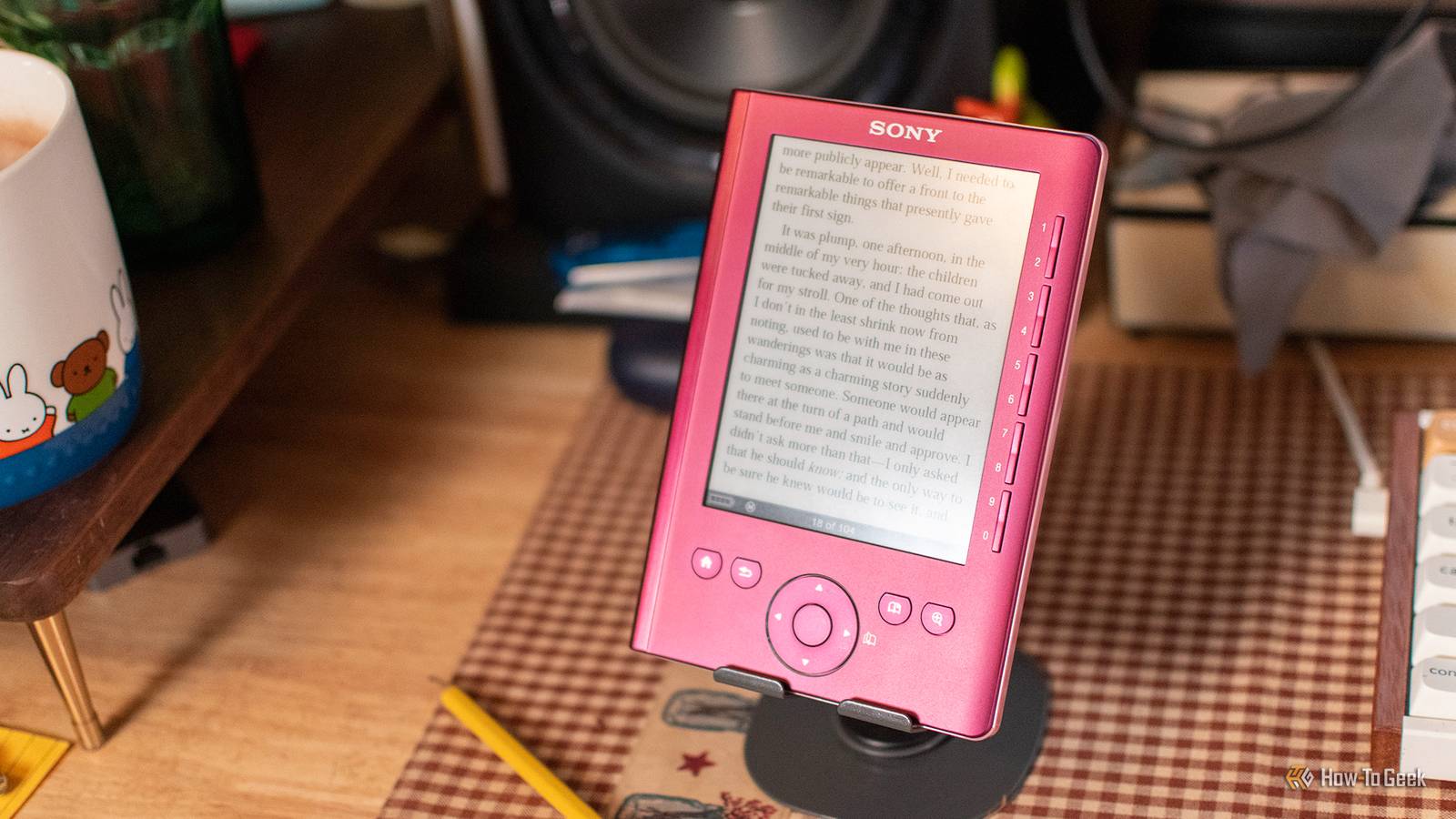
Published Oct 3, 2026, 6:00 AM EDT Andrew Heinzman is a seasoned tech writer with over half a decade of experience. He specializes in delivering insightful tech news and detailed product reviews, particularly focusing on audio and video technology, as well as computers and smartphones. His journey in tech writing includes a two-year stint as the News Editor at Review Geek, the former sister site of How-To Geek. Throughout his career, Andrew has consistently provided readers with valuable insights and up-to-date information on the latest developments in the tech world, earning recognition for his clarity, depth, and relevance. In his free time, Andrew likes to explore music and read books, just as he did when earning his bachelor's degree in English literature. We spend a lot of time talking about Kindle alternatives like Kobo, Xteink, and Boox. But there are some forgotten Kindle rivals that rarely make it into the conversation, including Sony, which might be the most unfairly unrecognized eReader pioneer of all time. It's been over a decade since Sony offered its final eReader, the PRS-T3. But I wish that the brand would take another shot at it, or at the very least, I wish someone would replicate all the things I love about my old Sony eReader, the PRS-300. Sony built great eReaders, but it struggled to sell eBooks A poor storefront made it impossible to keep up with Kindle and Kobo Sony began selling eReaders in 2004 and entered the U.S. market two years later. Its eReaders utilized the best E Ink panels that were available at the time and featured a wealth of compact, fairly intuitive controls. These eReaders had a surprisingly open ecosystem, too, with support for EPUB and library lending, the latter of which didn't arrive on Kindle until 2011. Plus, at a purely visual level, the Sony eReaders of the 2000s looked excellent. We're all suckers for aluminum, right? Even after the first Kindle's launch, which was by all means a massive success, Sony wormed its way into best-of lists and remained the darling brand of eBook enthusiasts. The problem, really, is that Sony failed to do the iTunes thing. It got the hardware and software right but didn't offer a seamless digital shopping experience. Kindles gave readers an on-device storefront (with free cellular connectivity) in 2007, but Sony didn't introduce a wireless eReader until December 2009's PRS-900, which cost a whopping $399. So, the Sony Reader Store was effectively locked to desktop. It was also a very clunky storefront, I've heard, but in any case, the process of buying and transferring books from a desktop PC scared away technically-challenged customers. Once Amazon solidified its place in the market, it kicked off a price war that buried most of its competitors. Amazon also began selling the Kindle internationally in 2009 with cellular support intact, effectively eroding its competitors' ability to maintain a foothold outside the United States. Sony's eReader business limped along until 2014, when it was unceremoniously laid to rest. Customers in the U.S. and Europe were told that they should purchase eBooks from Kobo, one of Sony's former rivals in the space. Curiously, the Sony Reader Store is still active in Japan. I've heard that a lot of people in Japan read eBooks on their phone or tablet, so maybe that's got something to do with it. Pristine hardware, simple software There's a reason people shop for Sony eReaders on eBay My old PRS-300 is pretty striking. It's one of those devices that is so Sony in its design, like a VAIO laptop or a Walkman. The reddish-pink aluminum chassis is something you just don't see on any device, the controls are bold but don't obstruct anything, and although the PRS-300 is large when compared to modern eReaders, it doesn't feel big or chunky in your hands. It's a confident little gadget. Yes, the old 5-inch E Ink Vizplex panel shows some age, as it's limited to 8-level grayscale (modern panels are usually 16-level) and has a pixel density of 200 PPI, which is lower than the 300 PPI density on today's standard-sized 6-inch eReaders. But it's still perfectly legible in decent lighting, and the slow page-turns aren't really noticeable once you get in a nice rhythm. It's honestly amazing that the display tech is still so usable 15 years later, though I'll admit that this factor isn't exclusive to Sony's devices. There's also an interesting timelessness to the software. Because the PRS-300 didn't have an integrated storefront, there aren't a bunch of unnecessary pages or ads on the home screen. You've got your digital library and your books. That's it. I recently fooled around with a 2010 Kobo Wi-Fi eReader, and I was kind of shocked by all the old broken storefront crap that dominated its operating system. Mind you, I ended up throwing away that old Kobo Wi-Fi because its plastic shell and rubber page-turn buttons were disintegrating. It's no surprise that Sony eReaders have become a bit of a cult classic. There was a time when you could buy them on eBay for dirt cheap, but they've gotten more expensive in recent years, with most models hovering between the $70 to $120 mark. You can find a semi-new Kindle for about half that price and jailbreak it to escape Amazon's lock-in, so it's hard to justify the old Sony units from a purely practical standpoint. Unfortunately, these old eReaders are a questionable option today Old screens, decaying hardware, legacy ports, and other hurdles As much as I love these old Sony eReaders, I'm kind of shocked that people are willing to pay $100 for them. E Ink tech has advanced a lot over the last 15 years, so even if you're committed to the idea of a stylish fully-offline eReader, the trade-offs just don't make sense. Remember, the goal here is to read books. My old Sony PRS-300 is still in pretty good shape, but there's no backlight, it doesn't use USB-C for charging or file transfers, and although I appreciate the concept of an offline eReader, it's often just annoying in practice. I also managed to damage some of the plastic around the device's USB port when I replaced its battery a few years ago. The battery swap itself was easy, but the PRS-300's plastic trim is thin, and it seems to have brittled a bit with age. There's also some weirdness with charging. I can't get the PRS-300 to charge from a USB power adapter, it only wants to accept a charge when connected to a computer. There's a DC 5.2V input, but I've only charged this device over USB. I should point out that Sony dusted off its E Ink panels and began selling selling "Digital Paper" tablets after scuttling its eReader business. These business-oriented tablets were intended for note-taking, PDF markups, and other relatively niche tasks for paper-averse professionals—kind of like a reMarkable tablet (or the Kindle Scribe, to some extent). But Sony gave up this venture in 2024, probably because the market got too cramped. Please, Sony, give it one more try I'm not saying that my Boox Poke 5 is perfect. I spent an embarrassing amount of time setting up a minimal launcher on it, and I regularly catch myself fiddling with KOReader settings when I should be reading books. The plastic build on the Poke 5 feels overly cheap for the price, too. But that's why I want Sony to get back into the eReader game; I want the aesthetics, the open philosophy, and the plain-Jane focus on reading, but with modern accoutrement like a high-DPI screen, a backlight, and a USB-C port. Yeah, some modern eReaders nail the aesthetics, but they're too big, and they tend to over-emphasize note-taking or other features I don't care about.
This 15-year-old eReader would be the ultimate Kindle replacement if it were remade today
Full Article
Original Source
Read the full article at Howtogeek →KhanList aggregates and links to publicly available news content. We do not host full articles from third-party sources. Always verify important information with original sources.