
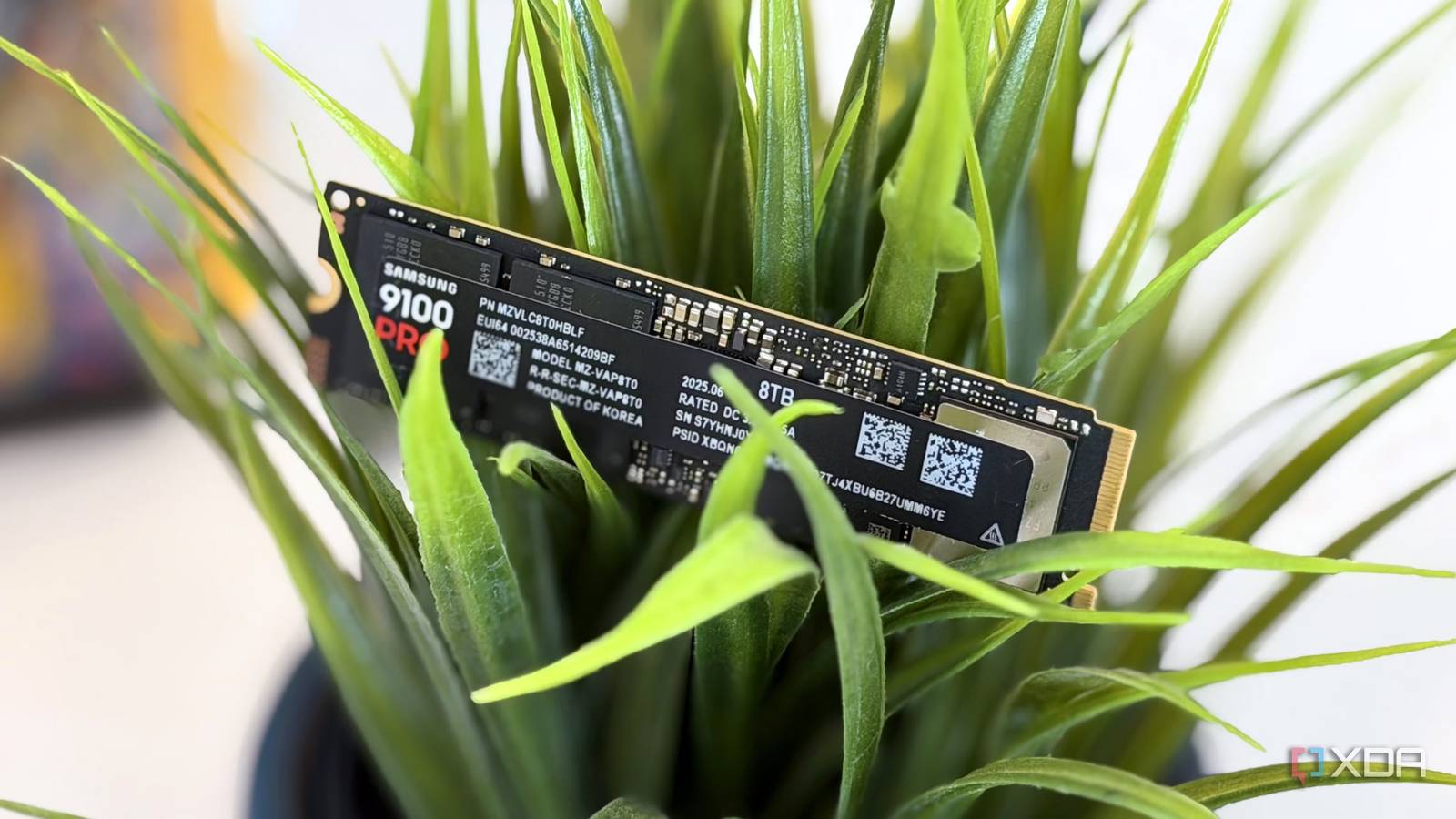
Published Nov 22, 2026, 4:30 PM EST Shivansh began his tech journey as an avid reader of tech publications, which inspired him to launch his career in video media at Sillycorns. He has led content across multiple tech YouTube channels and Instagram accounts, crafted go-to-market (GTM) strategies for Vivo, and consulted on digital growth. Coming full circle to his roots in written media, he now delivers deep-dive tech journalism. Outside of his professional work, Shivansh loves watching movies, riding bikes, and playing cricket. When I first saw the sticker on Samsung's 9100 Pro, I assumed it was just a regular label with the model number, serial number, and other details. But Samsung's own product page calls it a "heat spreader label." On a PCIe 5.0 SSD that uses 8.1W on average during sequential reads, this label helps keep the drive from thermal throttling. Some forum users say you should peel it off before installing your motherboard's M.2 heatsink. The problem is that removing the label also voids the 5-year warranty. So should you just press the heatsink's thermal pad directly on top of it? Many people are confused about this, so here's the full picture. The peel-it-off advice came from plain paper labels Even Intel's paper ones carried a warranty catch The peel advice made sense for drives whose label only carried a model number and a serial number. Intel says it plainly for its Optane SSDs, where "the label on the SSD does not work as a heat spreader" and only shows the markings. Even there, Intel says a removed or damaged label voids the warranty. The logic was that a thermal pad should touch chips, not printed plastic. However, if the label is there for cooling, it actually touches the chips with a very high conduction rate. Samsung's label is a heat spreader for the flash chips A thin sheet that carries heat sideways Samsung's own 9100 Pro product page points to two parts by name, a "Nickel-coated controller" and a "Heat spreader label." Its 980 Pro page splits the work. The nickel coating helps "manage the controller's heat level," while the label delivers "effective thermal control of the NAND chip." The NAND chip means flash memory here. Samsung doesn't publish the label's layers, only that the bare 2TB drive is 2.38 mm thick at most. A heat spreader is a thin sheet that conducts heat well along its length. Hot spots under it bleed sideways into cooler areas, so the 80x22mm stick runs at more consistent temperatures. Panasonic, which sells graphite sheets for this job, lists in-plane conductivity of 700 to 1,950 W/(m·K), or 2 to 5 times that of copper. Its thinnest sheets score highest, with 1,950 for 10 µm and 700 for 100 µm. What sets how much heat a film moves sideways is "conductivity multiplied by thickness." Take copper at about 400 W/(m·K), and a 25 µm Panasonic sheet rated at 1,600 carries as much heat sideways as 100 µm-thick copper foil. Printer paper is roughly 100 µm, so that's a layer a quarter as thick as paper, matching a thick copper foil. The catch is surface area, because a film this thin adds almost none. It evens out the heat, but the heat still has to leave through the label's face, the board, and the mounting screw. Every brand builds and words its label differently None of them publish a label-off test Drive What the maker calls the label Layers the maker names Power on the datasheet Samsung 9100 Pro 2TB Heat spreader label Not published 8.1W (average, sequential read) Kingston KC3000 2TB Low-profile graphene aluminum heat spreader Graphene, aluminum 9.9W (max, write) TEAMGROUP MP44L Heat Dissipating Graphene SSD Label Graphene copper foil, under 1 mm I could not find a mention Intel Optane SSDs Not a heat spreader, markings only None Not applicable A material name on a box isn't a test result, and no maker in the table publishes a label-on versus label-off curve. TEAMGROUP's release for the MP44L calls its label "the industry's first SSD label to incorporate graphene copper foil," under 1 mm thick and covered by Taiwan utility patent M628748. It also claims "double the cooling performance" with an M.2 slot heatsink on top. There's no method behind that figure, but notice what it assumes: the label stays on, under the heatsink. For people suggesting removing it, I want to know why brands don't mention label-off. Not just this, what about the left-out adhesives that will interfere with a perfectly uniform contact with the flash memory (NAND)! The pad fills the air gap between the flat label and the metal, while peeling swaps a spreading layer for bare chips of uneven height. Can you put a heatsink on top of the SSD label? Yes, with the thermal pad pressed onto the label The label just moves the heat sideways, while the heatsink adds fins, metal mass, and far more surface area to transfer heat to the air. Samsung's 9100 Pro with Heatsink shows what that surface costs. It grows from 22.15 by 2.38mm to 25 by 8.88mm, about 3.7 times the height, built to the PCI-SIG D8 height class. Lab work shows what a better spreader buys alone. A 2016 RSC Advances study found a chip on a 35 µm copper-graphite-copper sandwich ran about 8°C cooler than on 50 µm copper foil, at 1.4 W. The 9100 Pro averages almost six times that power during reads. What I want to convey is: past a few watts, even a great spreader needs fins on top. So it's label first, pad on the label, heatsink on the pad. Snug the screw rather than cranking it, since Samsung's heatsink-model datasheet lists over-tightening among the things that void its warranty. The drive tells you whether it needs the heatsink at all: Samsung's 0 to 70°C range is "Measured by S.M.A.R.T. Temperature," the drive's own composite sensor. Run smartctl -a /dev/nvme0 and read Warning Comp. Temperature Time, the minutes spent above the drive's own warning threshold. If it climbs after a Steam library restore, the label alone isn't enough in that slot. The sticker stays, and the pad goes on top Samsung's US limited warranty lists "any alterations, modifications, or removal of any SAMSUNG labels or barcodes on the Product" as an exclusion. The FTC did warn ASRock, Zotac, and Gigabyte in July 2024 over "warranty void if removed" stickers that block repairs. But do not fall into misinformation again. Those were letters, not rulings, and a label that is the cooling part and carries the barcode is a harder case. For now, read the heading above again. Starting next year, the same 22mm stick will have to handle more watts, and let's just hope for a fair price as well. Fingers crossed!
The sticker on your SSD is a heat spreader, and peeling it off for a heatsink is a mistake
Full Article
Original Source
Read the full article at Xda-developers →KhanList aggregates and links to publicly available news content. We do not host full articles from third-party sources. Always verify important information with original sources.