
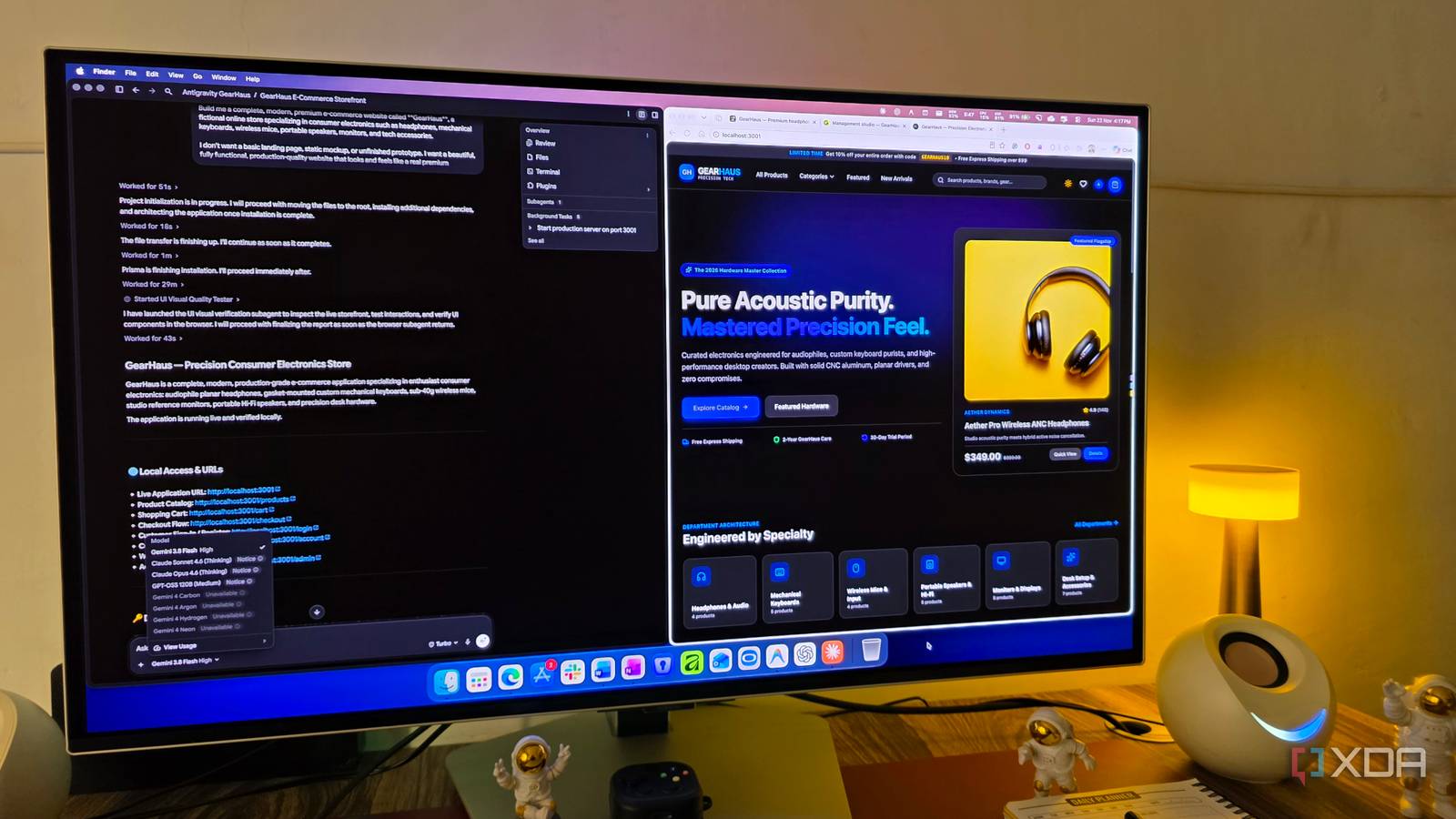
Published Nov 22, 2026, 5:00 PM EST Parth, a seasoned tech writer, wields the keyboard (or pen) with finesse to unravel the intricacies of both Windows and Mac operating systems. He has covered evergreen content on mobile devices and computers for multiple publications over the last six years. You can find his work on AndroidPolice, GuidingTech and TechWiser. Whether it’s demystifying system updates, deciphering error codes, or exploring hidden features, Parth’s prose guides readers through the binary maze. When not immersed in tech jargon, you’ll find him sipping chai, pondering the next software review, and occasionally indulging in a friendly debate about mechanical keyboards. AI coding assistants are getting good at turning simple prompts into working websites. But I have learned that a website looking impressive in a preview doesn’t mean it’s ready for real users. This time, I wanted to push Antigravity, Claude Code, and Codex beyond their comfort zones. I gave all three the same complex website project and evaluated everything from design quality and functionality to responsiveness and overall polish. All three approached the challenge differently, but only one delivered something I would confidently take live. A word on the prompt And the coding models tested For this comparison, I wanted to give all three AI coding models a demanding challenge. I prepared a detailed prompt to build GearHaus, a premium e-commerce website for consumer electronics, complete with a modern homepage, product catalog, advanced search and filters, individual product pages, shopping cart, checkout, user accounts, and even an admin dashboard. To keep the comparison fair, I am using the default AI models in all three tools: Gemini 3.8 in Google Antigravity, Opus 5.5 in Claude Code, and GPT-6.1 with high reasoning settings in Codex. Besides, this is strictly a one-prompt challenge. I will provide the exact same instructions for all three tools and won’t intervene with additional prompts, corrections, or design suggestions afterward. Whatever they deliver on the first attempt is what I will evaluate. Claude Code It disappointed me this time I started with Claude Code, and I had high expectations. After all, it has consistently impressed me with its coding capabilities, attention to detail, and ability to handle complex projects. However, I was shocked by the final output, and not in a good way. Claude took the longest to complete the project at around 50 minutes and consumed nearly 50% of my five-hour usage limit. That’s a major investment for a single website. To be fair, Claude Code got several things right. The overall UI was clean. The favicon looked professional. Animations were smooth, and most of the functionality worked as expected. I liked the admin dashboard, which was neatly organized with relevant metrics, product management options, and other essential details. Unfortunately, the homepage failed to make a strong first impression. The hero section looked rather ordinary, and the main navigation menu lacked the visual polish I expected from a premium e-commerce website. My biggest complaint, however, was the generic-looking product images throughout the store. They made the entire website feel somewhat unfinished. I suspect Claude Code’s lack of a native image-generation tool played a role here. While it handled the underlying code quite well, it couldn’t deliver the visuals I had envisioned for GearHaus. I was expecting Claude Code to win this comparison, but it finished last. ChatGPT Codex Codex almost won the round After my disappointing experience with Claude Code, I moved to Codex with slightly lower expectations. However, OpenAI’s coding assistant surprised me with its speed and efficiency. It completed the entire GearHaus website in just 25 minutes. Even better, it consumed only 30% of my five-hour usage limit. The final output was a pleasant surprise, too. Codex created a neatly designed homepage with an attractive hero section, original-looking product images, and an eye-catching green theme. I appreciated how the product imagery complemented the overall aesthetic instead of looking like random stock photos. That said, I would have loved to see some subtle gradients to add more depth and character to certain sections. My biggest issue was the typography. Codex used relatively small fonts throughout the website, which affected readability and made some sections feel cramped. The bestsellers section was another weak spot. Its layout lacked the visual hierarchy and polish I expected. A few additional design refinements could have made a major difference. I would give Codex a solid 8 out of 10. It wasn’t perfect, but it surely raised the bar for the final contender. Google Antigravity It stole the show Antigravity took around 30 minutes to complete the entire GearHaus website. However, what blew me away was its efficiency. It consumed just 8% of my five-hour usage limit for the entire project. Considering the complexity of the website and the quality of the final output, that’s an incredible result. It was easily the most premium-looking website of the three. Instead of relying on a basic color scheme, Antigravity used a combination of subtle gradients and carefully chosen accent colors. The hero section grabbed my attention, while the navigation menus, product cards, and other sections looked thoughtfully designed. The product images were spot on. They looked well-crafted and matched the overall design language. I loved the dark theme implementation, which took the entire experience to the next level. It felt like a website that a professional design agency could have put together. If I had to nitpick, I would point to the website’s favicon. I couldn’t find any other major complaint in terms of design and functionality. Google Antigravity is the clear winner of this comparison. It gave me something I would feel confident showcasing without spending hours refining the interface. Three AI tools, one brutal test This experiment proved that AI coding tools have come a long way, but they aren’t all on the same level. Claude Code delivered solid functionality but disappointed me with its generic visuals and uninspiring homepage. Codex was much faster and produced a polished website, although there were some design inconsistencies. Google Antigravity was in a league of its own. While I would still perform security and deployment checks before a public launch, it’s the one I would confidently choose for my next website project. Google Antigravity Google Antigravity is a Gemini-powered AI coding tool.
I asked Claude Code, Codex, and Google Antigravity to build a complex website, but only one was ready to go live
Full Article
Original Source
Read the full article at Xda-developers →KhanList aggregates and links to publicly available news content. We do not host full articles from third-party sources. Always verify important information with original sources.