
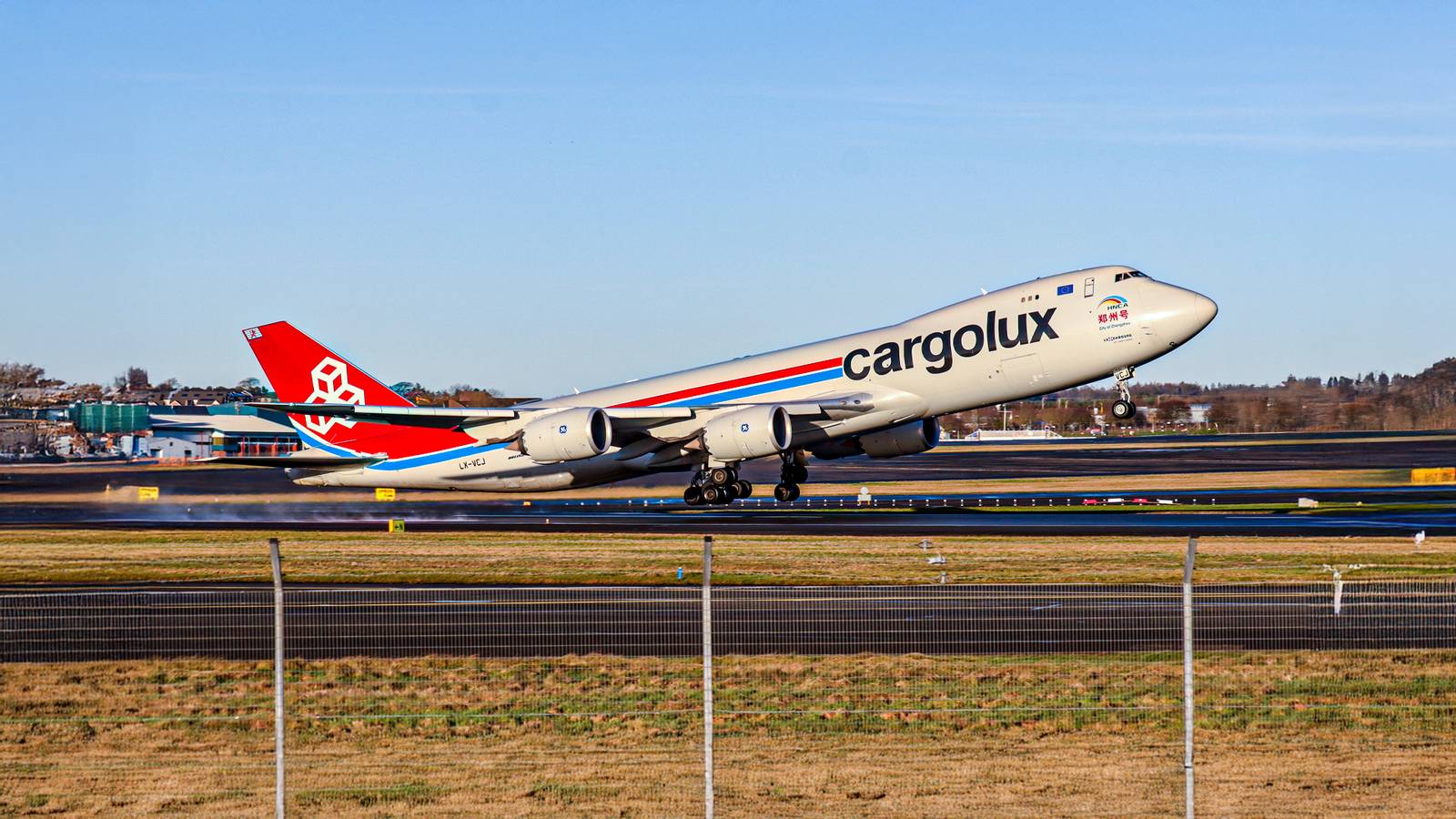
Credit: JacobHughes | Shutterstock, Simple Flying Published Nov 1, 2026, 11:00 AM EST Luke Diaz is a freelance military writer with experience with active duty experience in the US Navy as well as defense and industrial engineering. He is a former Naval Flight Officer who performed tactical air control on the carrier-based E-2 Hawkeye. Sign in to your Simple Flying account The instantly recognizable silhouette of a Boeing 747 is simultaneously the icon of the golden era of passenger jet travel as well as air cargo. That is not simply the product of excellent marketing by Boeing, but rather the result of decades of proven performance as the heavyweight champion of air freighters around the world. Since it entered passenger service in 1970, the 747 has been the undisputed 'queen' of air cargo for over 54 years. As the latest and greatest variant of the cargo-optimized jumbo jet, not only can the 747-8F haul just under 300,000 lb (136,078 kg), but its capacity to haul extra-large cargo has kept it at the top of the air express food chain even after the assembly line shuttered years ago. While most cargo planes rely on side doors, the 747-8F features a cockpit that is elevated into a 'hump.' This design allows the entire nose to swing up and open as a door. The 747-8F is the largest, most advanced, and final variant of the 747 ever produced. It takes everything that made previous models great and supercharges it with modern technology. Compared to the 747-400F, it carries seven more cargo pallets and 20 metric tons more than its predecessor. It also boasts a 15% improvement in fuel efficiency thanks to the General Electric GEnx engine and refined wings derived from 787 Dreamliner designs. For moving heavy industrial freight across global routes, the 747-8F is the gold standard of cargo freighters. Why The Boeing 747-8F Remains The Gold Standard Of Air Cargo Credit: ArtisanGreenLife | Shutterstock The Boeing 747-8F is the most flexible, versatile, and capable air freighter ever built. Unlike the new generation widebody twinjets that have succeeded the legacy four-engine freighter, it has a number of different weight configurations depending on the payload that allow operators to tailor each mission. By offering distinct configurations like the Basic Weight Option and the Higher Zero Fuel Weight (MZFW) Option, Boeing maximized the plane's versatility. Twin-engine cargo jets have fairly rigid operational envelopes; the immense lifting power of the four GEnx engines of the 747-8 and its jumbo jet fuselage allows for much more complex loading and diverse cargo. The genius of the 747-8F's design lies in how it handles the laws of physics. Both configurations share the exact same Maximum Takeoff Weight (MTOW) of 987,000 lb (447,700 kg); however, they allocate that weight very differently depending on the cargo. Specification 747-8F Basic Weight Option 747-8F Higher Zero Fuel Weight Option 777F Maximum Takeoff Weight 987,000 lb (447,700 kg) 987,000 lb (447,700 kg) 766,000 lb (347,450 kg) Maximum Structural Payload Including Packaging 307,800 lb (139,600 kg) 317,800 lb (144,150 kg) 235,900 lb (107,000 kg) Maximum Revenue Payload 293,700 lb (133,200 kg) 303,700 lb (137,750 kg) 224,900 lb (102,000 kg) Range At Maximum Revenue Payload 4,265 nautical miles (7,900 km) 4,100 nautical miles (7,590 km) 4,970 nautical miles (9,200 km) Total Cargo Volume 30,192 cubic feet (854.9 cubic meters) 30,192 cubic feet (854.9 cubic meters) 23,051 cubic feet (652.7 cubic meters) Main Deck Pallet Positions 34 34 27 Lower Hold Positions 12 pallets plus 2 LD-1 containers 12 pallets plus 2 LD-1 containers 10 pallets plus bulk compartment The higher zero fuel weight option increases the payload by exactly 10,000 lb (4,535 kg) to raise the total to 317,800 lb (144,151 kg). This maximizes the utility for lifting smaller but very heavy cargo such as industrial machinery, military vehicles, or even more exotic freight like pallets of solid gold bullion. The basic weight option offers the everyday versatility that a 747-8F operator values on normal missions. It extends the jet's range under maximum revenue payload out to 4,265 nautical miles—an extra 165 nautical miles (305 km) of range compared to the heavy-lift option. This is the ultimate choice for standard global supply chains moving high-volume goods over vast oceans. Why No Twinjet Can Truly Replace The 747-8F Credit: Robin Guess | Shutterstock The 747-8F offers 30,192 cubic feet (854.9 cubic meters) of total cargo volume, providing over 7,100 cubic feet (201 cubic meters) of extra space compared to the 777F. With 34 main deck pallet positions, versus the 777F's 27, the 747-8F can lay out very wide or oddly shaped freight that a twin-engine plane cannot fit, even before factoring in the 747's upward-swinging nose door. Additionally, in its high-payload configuration, the 747-8F can carry nearly 82,000 lb (37,194 kg) more revenue payloads than a 777F. While the 777F boasts a longer flying range, it simply lacks the raw power and package handling freedom of the Jumbo Jet. By giving airlines the choice between a long-range bulk hauler and a hyper-dense heavy lifter within the exact same fleet, the 747-8F solidified its status as the most versatile platform in global aviation logistics. It is true that the twinjets like the 777F and 767F are dominating the e-commerce era thanks to their fuel efficiency. However, operators like Atlas Air still fought hard to keep the 747 alive before Boeing shuttered the factory. Today's retail economy is obsessed with high-frequency, point-to-point delivery and ultra-low fuel burn. But the venerable jumbo jet is still a better platform in many cases to this day. Ultimate Cube-Out: Why The 747 Still Beats Twinjets In E-Commerce Credit: Sergey Kustov | Shutterstock Despite the fuel efficiency of twin-jets, the 747-8F is actually a superior e-commerce machine when it comes to raw volume and layout. Modern e-commerce is driven by giants like Amazon, Shein, and Temu, which rely on a concept called 'cube-out.' That is where consumer goods like clothes, electronics, and shoes, which are incredibly lightweight, take up all the physical space. The 777F wins out on fuel efficiency for delivering lightweight packages, but it still carries a smaller payload every single time. According to UPS, a full 747-8 holds roughly 30,000 packages, a count that shows how many separate shipments one flight can contain. After cubing out the upper hold, the 747-8F can still pack the lower hold with smaller and heavier cargo, like automotive parts or machinery, to offer a dual Revenue stream on every single sortie. In addition to the aircraft being the best air freighter for outside cargo thanks to its unique design, its side and nose doors allow ground crews to load and unload faster than almost any other plane, keeping it in the air where it makes money. Cargo giants like Atlas Air, Cargolux, and UPS desperately wanted Boeing to keep the 747-8F line open. To them, the 747-8F is irreplaceable. How The 747-8F Compares With The 777X Freighter Credit: Sergey Kustov | Shutterstock The primary driver behind the death of the 747-8F line is not just a lack of market interest, but strict international law. Global emissions standards are tightening. Even though the GEnx engines on the 747-8F are incredibly advanced, a four-engine aircraft inherently produces more emissions per flight than a twin-jet, making it harder to certify under future international climate rules. Boeing's answer is the 777-8F. The company lists its next-generation widebody freighter with a maximum payload of 260,600 lb (118,200 kg), an average revenue payload of about 247,600 lb (112,300 kg), and a range of 4,410 nautical miles (8,167 km). That is roughly 15% below the structural payload of the 747-8F's baseline, with just slightly more range than the older jumbo jet flies at full weight. Disappointingly, for many Express air carriers, the 777-8F is strictly a conventional twinjet with a traditional side-loading door. It completely lacks the 747's iconic upward-swinging nose door. This means the 777-8F physically cannot accept the ultra-long, rigid, heavy-industrial cargo like 50-foot pipes or intact military helicopters that made the 747 an immensely valuable commodity. The International Civil Aviation Organization has enacted enhanced emission standards beginning in 2027. The final 747-8Fs delivered to Atlas Air in early 2023 squeezed in just under the wire. Meanwhile, Boeing's widebody programs have suffered severe engineering and certification backlogs. The 777-8F's entry into service has slid toward 2028 or later. Frustrated by Boeing's delays and looking for a true next-generation solution to replace its aging 747-400Fs, Atlas Air shocked the industry by placing a massive order for up to 40 Airbus A350F freighters. The American freight-flying outfit is the owner of the largest 747 fleet still in operation today. This is a monumental shift; for its entire existence, Atlas Air was a fiercely loyal, all-Boeing operator. How The 747-8F Dominates The Skies Long After Production Ended Credit: Arjan Veltman | Shutterstock A jumbo jet factory cannot survive on cargo orders alone. Once airlines completely stopped buying the passenger version, the 747-8I, in favor of twin-jets like the 787 and 777X, the economics of the massive assembly line became unjustifiable. Because Boeing shut down the line, the remaining 747-8F fleet has become the most valuable real estate in the sky for air cargo flyers. Boeing delivered the final 747 on January 31, 2023, to Atlas Air, the largest operator of the type. According to Aviation Week, the airplane was line number 1,574, and the delivery took Atlas's 747 fleet to 56 aircraft. Atlas chief executive John Dietrich said the carrier could keep flying the 747-8 into the 2050s and 2060s, as AeroMorning covered. The shift away from the Boeing 747-8F toward twin-engine replacements is a major turning point in aviation history. As the iconic jets near the end of their tenure on the tarmac, the 777-8F has not proven to be a successor that even Boeing's most loyal customers are interested in buying. It remains to be seen if the company can regain the market share that it is already losing before its next-generation freighter even goes into production.
The Impressive Cargo Weight A Maxed-Out Boeing 747-8F Can Carry
Full Article
Original Source
Read the full article at Simpleflying →KhanList aggregates and links to publicly available news content. We do not host full articles from third-party sources. Always verify important information with original sources.