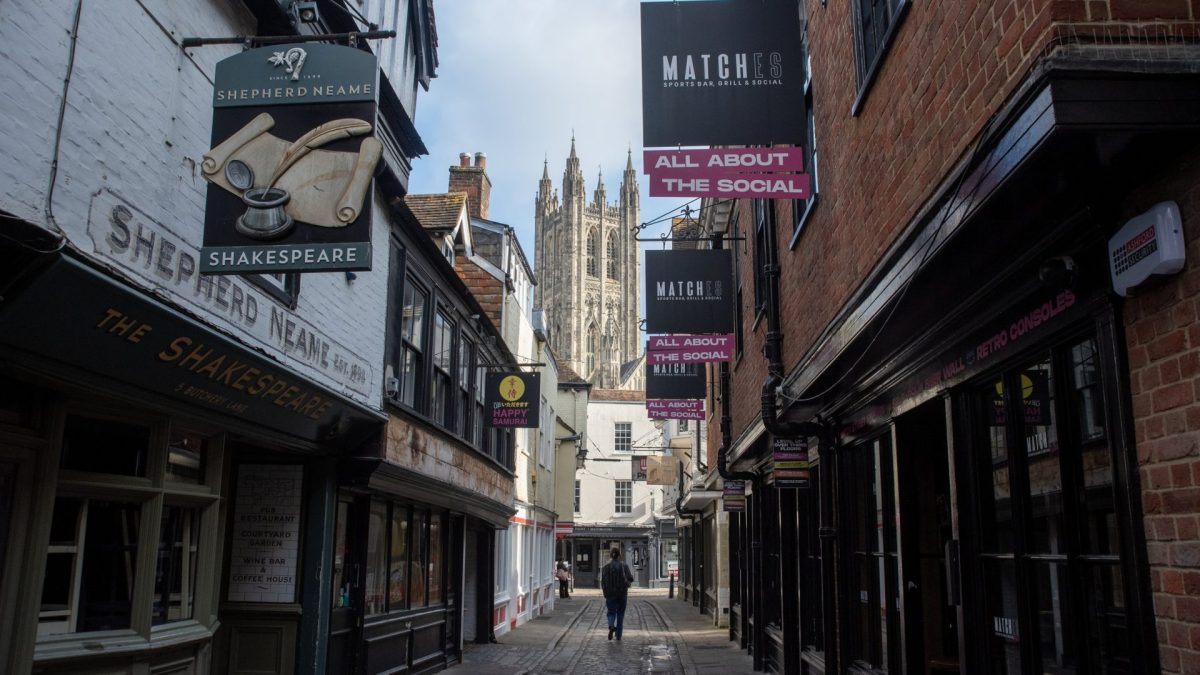
This is Dispatches with Patrick Cockburn, a subscriber-only newsletter from The i Paper. If you’d like to get this direct to your inbox, every single week, you can sign up here. In the early hours of 1 June, 1942, between 30 and 40 German bombers dropped high explosive bombs and incendiaries on Canterbury in a raid that destroyed much of the east and part of the south of the small city. Local people stood on the roof of the great medieval cathedral with metal rods to push off incendiaries before they could set fire to the building. Catherine Williamson, the former mayor of Canterbury who had overseen the building of bomb shelters and other preparations for an attack by the Luftwaffe, recorded in a memoir how she watched the raid develop: circling German aircraft dropped “chandelier” flares to mark the target which “hung in the sky over the whole area of the city and I knew we must be prepared for the worst”. She moved to an underground bomb shelter, but “became aware that a great part of the city was already on fire”. She heard a great clanging sound and feared that the central bell tower of the cathedral had collapsed. As the raid ended, she made her way through the blazing streets of wooden houses dating from the Middle Ages to a central control room which was efficiently dispatching fire engines, heavy rescue vehicles and ambulances. The staff were distressed because they had just heard that George Marks, the town clerk and civil defence controller for Canterbury, was trapped in the wreckage of his house after it was hit by a bomb. As the sirens sounded the all clear, he said to his wife: “I wonder how soon they will come and dig us out?” But when they did so, he was already dead. Photographs of Canterbury after the raid shows fire-blackened timbers and shattered walls. An official report details how “very heavy damage has been done to the main shopping areas and also to residential property by explosive bombs and incendiaries”. Canterbury was only a small city with a population of 25,000 people, but destruction was massive, with 3,110 buildings destroyed or damaged, including two churches and the cathedral library. The cathedral itself had only survived thanks to the heroic efforts of people pitching the incendiaries off its roof and because the German “chandelier” flares had been carried by the wind a little way to the east of the building. Much of Canterbury’s infrastructure was gone, with telephone communications disrupted and the sewers, water mains, gas and electricity damaged. Yet casualties among Canterbury townspeople were surprisingly low: some 48 dead, 55 seriously injured and 62 lightly wounded. Moreover, the city went on functioning, with 697 people who were homeless after their houses were destroyed and other bomb survivors able to go to a centre which told them where they could get extra clothes, find somewhere to stay, obtain travel vouchers, and apply for compensation for bomb damage. Everybody who asked was given between £10 and £15 for immediate needs. But the comparatively low loss of life – despite the severity of the raid – and the capacity of government to operate in its aftermath, were not accidental. Both were the outcome of a sustained effort by the local authority in Canterbury over the previous three to four years to prepare for a “blitz” on the city, which they were sure was inevitable. It did not happen during the blitz on London in 1940-41, but during the so-called Baedeker raids in 1942 when the Luftwaffe bombed medieval English towns in revenge for RAF attacks on German equivalents like Lübeck. What happened in Canterbury 84 years ago is relevant today because it demonstrates how local government in the UK was once so well organised and resourced that it could successfully prepare for – and later mitigate the impact of – a potentially calamitous air strike on close-packed houses, many built out of wood. Central government had provided the money, but all the planning and organisation to safeguard the city had been local. Marks, the town clerk, along with Williamson, the mayor, and leading councillors, were spending £600 a week on the wage bill for 207 Air Raid Precaution (ARP) workers. They dug air raid shelters everywhere and strengthened the joists in residential houses to withstand near misses by bombs. The crypt of the cathedral was turned into an ARP shelter and the nave filled with sandbags. Along with the ARP wardens, the council hired auxiliary firemen, messengers, members of light and heavy rescue units, and ambulancemen. “Canterbury has been given lavish powers to make itself safe,” says a press report at the time. “The government has delegated these powers.” I first began to find out in 2020 about the success of the mayor, town clerk and council in doing all they could to protect Canterbury from German air attack. When it occurred it was highly destructive, but nothing like as calamitous as the Luftwaffe’s bombing of the Basque town of Guernica during the Spanish civil war in 1937 – the subject of Picasso’s famous painting – in which as many as 1,600 civilians may have been killed, though the precise figure for the loss of life is disputed. I had become interested in the local authority’s actions during the Canterbury blitz because they were obviously far more effective than the attempts by a vastly over-centralised British government to cope with the Covid-19 pandemic in 2020-22. By then the powers and resources of local government had shrivelled disastrously. In 1972, the Conservatives pushed through the Local Government Act that redrew council boundaries, ignoring local and regional identities. In the 1980s, Margaret Thatcher abolished the Greater London Council and six metropolitan borough councils. Despite meagre shifts towards devolution under recent governments, local authorities were driven to the edge – and sometimes over the edge – of bankruptcy. No other state in the G7 grouping of richer countries is as fiscally centralised as the UK, with only 5.8 per cent of taxes collected at local level compared to 20.4 per cent in France, 36 per cent in Japan and 45.7 per cent in the US, according to the OECD. Any pretence that central government is cheaper and more efficient than local authorities sounds grotesquely hypocritical after the UK Covid-19 Inquiry revealed that out of £15bn spent on PPE during the pandemic, £10bn was wasted – and even these figures are dwarfed by the gargantuan overspend on HS2. The most serious bid ever to decentralise power and money away from Westminster and Whitehall is now beginning under former Greater Manchester mayor Andy Burnham as Prime Minister, with the Government announcing that all mayors of city regions in England will get a share in income tax revenues and of business rates levied in their areas. They will gain greater control over transport, housing and raising skill levels. “Under our plans more of the taxes raised in a community will stay in that community,” says Burnham, pledging to “bring power home” to “every postcode in the country”. Devolution as a policy sounds boringly marginal and airy-fairy because over-centralisation has become the accepted UK norm. But keep in mind that it was an empowered local government, not the UK central state, that saved Canterbury from becoming a second Guernica. Further thoughts The Archbishop of Canterbury, Sarah Mullally, is in Ghana, visiting an Anglican-led project in the African nation relating to the transatlantic slave trade. The idea of the project is to develop a pilgrimage site for members of the African diaspora and for those descended from slaves. Mullally’s predecessor, Justin Welby, apologised for the Church of England’s historic links to slavery, calling it a “source of shame”. Controversy splutters today over a plan for the church to pay £100m in reparations for its involvement in slavery. The right-wing press have denounced such plans as a sorry example of over-apologetic woke excess, with some suggesting that slavery was not so bad and admissions of historic responsibility are unnecessary. A curious aspect of this dispute over historic guilt for slavery, displacement of local populations and colonial conquests is that few participants on either side show real knowledge of history or even think that knowledge necessary. Yes, it is true that some church investments were in the slave trade and sugar plantations in the West Indies, though these were more generally the faults of the British state and society as a whole. In the 1790s, the British fought long and hard to crush the slave rebellions – and re-establish slavery – in the French-held sugar islands of the Caribbean following the French Revolution. The British Army lost more soldiers dead (perhaps 50,000 men, mostly from yellow fever and malaria) in this entirely discreditable campaign, which has been largely written out of British history, than the Duke of Wellington lost in Spain (40,000) a few years later in the war against Napoleon. The Anglican church benefited from slavery as did all others who had money to invest in it. This is rightly condemned, but parts of the Anglican church also played a central role in fighting to abolish slavery, while evangelical Anglican naval captains helped suppress the transatlantic slave trade. It is right that Archbishops Mullally and Welby should denounce the horrors of slavery – and utterly disgraceful that anybody should downplay or dispute them – but they should also show awareness of Anglicans who forcefully opposed slavery. I have a family interest in this because James Ramsay, a Royal Navy surgeon and later an Anglican clergyman for 19 years on the Caribbean Island of St Kitts in the late 18th century, was a direct ancestor of mine some seven generations back. He knew far more than other abolitionists about the terrible conditions of slavery because he was employed by slave owners to treat their sick slaves. He later wrote graphically about what he witnessed: a whip in the hands of a skilful slave driver “cuts out flakes of skin and flesh with every strike”. He described how a slave “may, for breaking a single cane, which probably he himself has planted, be hacked to pieces with a cutlass”. Finally forced out of St Kitts by the slave owners, he returned to England to become a country clergyman outside Maidstone and produced one of the best-informed books on slavery ever written. This was fiercely attacked by the plantation owners, which gave Ramsay the chance to go deeper into the cruelty of slavery. He explains how slave girls were “sacrificed to the lust of white men; in some instances, their own fathers”, and how the mistresses of slave girls earned pin money by hiring them out as prostitutes. No mention of this in Gone with the Wind. Beneath the radar Just as President Donald Trump’s administration cuts back on medical research, there has been a huge explosion in the disease-carrying tick population which is now moving into regions of North America where it was previously unknown. This matters because experts say that 90 per cent of all diseases caused by insect bites, often attributed to mosquitoes and other insects, are in fact caused by ticks. For multiple reasons – such as a warming climate, more people living in houses close to woodland, and the spread of deer and mice who carry ticks – voracious ticks are everywhere. Those once confined to the south are now common in Maryland. Other ticks have spread into Canada, where for the first time they can survive the winters because of climate change. As a result, the most common disease the ticks carry – Lyme disease – is surging, with 476,000 known cases last year in the US, though the real figure is estimated to be much higher because, as the illness becomes more common, doctors no longer report it. Its flu-like symptoms also make it difficult to diagnose and treat in its initial phase when antibiotics can be effective. Also ominous is the spread of the Lone Star tick that does not carry Lyme disease, but does carry Alpha-gal syndrome, a debilitating illness which also makes the victim allergic to red meat. Most tickborne illnesses have no known antidote or vaccine, while funding for those under development is being cut by Robert F Kennedy’s Health Department. Cockburn’s picks I was reassured to see my negative impression of Christopher Nolan’s The Odyssey mirrored in an excoriating but intelligent and enjoyable review of the film by Emily Wilson, a recent translator of The Odyssey, in the London Review of Books. “Nolan’s Odyssey lacks many of the elements that make the poem great,” she writes. “It has nothing convincing to say about time, memory, history, war, or about the relationship between one warrior’s glorious return and the lives of his family, adversaries, comrades, friends and neighbours. It lacks psychological, emotional, political and ethical depth. Its narrative structure is gimmicky. The writing is abysmal. None of the characters has convincing motivation for their actions or words. There are no sex scenes, and all the food looks horrible.” Yet this deeply flawed movie is bringing audiences back to cinemas and translations of The Odyssey are flying off the shelves of bookshops all over the world.
The city that shows devolution can work (and it’s not Manchester)
Full Article
Original Source
Read the full article at Inews →KhanList aggregates and links to publicly available news content. We do not host full articles from third-party sources. Always verify important information with original sources.