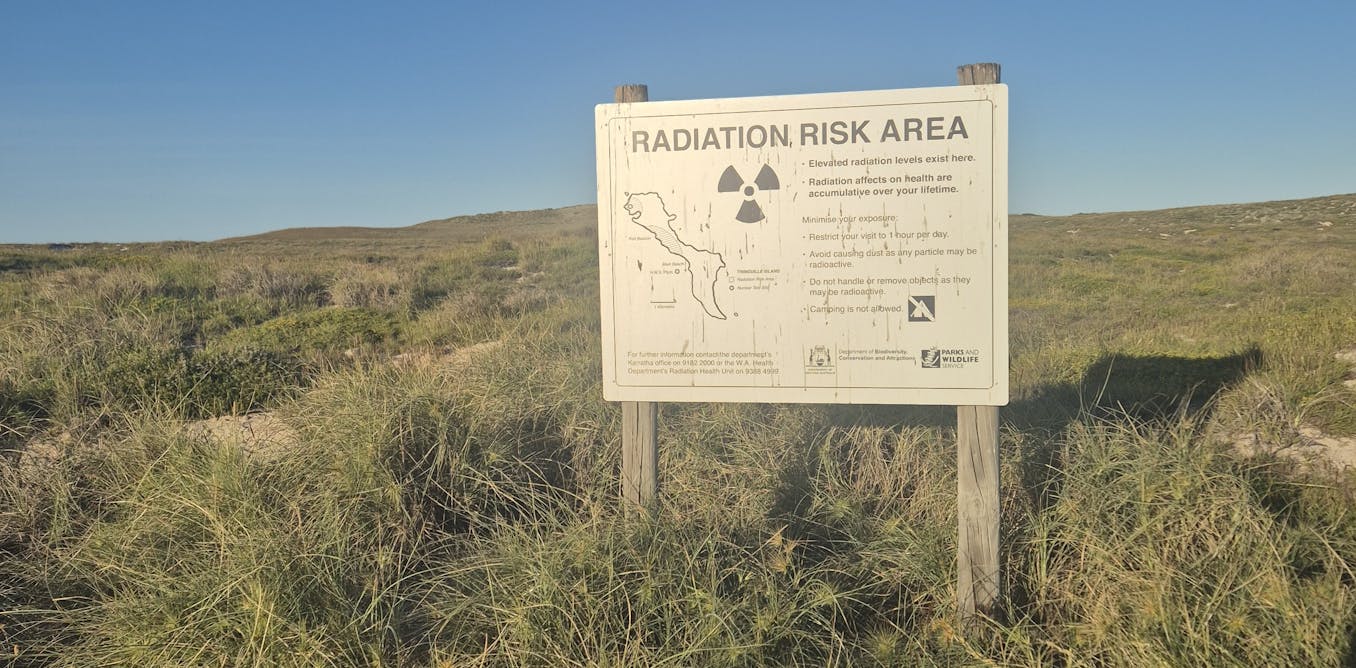
One winter’s day in June 1956, Britain detonated the largest weapon ever exploded in Australia. The test, code-named Mosaic G2, was conducted at Western Australia’s remote Montebello Islands, site of the first British atomic test in 1952, over 100 kilometres off the Pilbara coast. G2 was at least four times the size of the bomb that wiped out the Japanese city of Hiroshima in 1945 and perhaps six times as big. An earlier test held in May, Mosaic G1, was significantly less powerful. The tests happened at a pivotal moment in the evolution of Britain’s weapons program, as it sought to match the growing nuclear arsenals of the United States (which had stopped sharing information about its nuclear technology with the UK after World War II) and the Soviet Union. Britain was working towards developing a hugely powerful hydrogen bomb: the US had exploded its own in 1952. Operation Mosaic was made up of two tests, G1 and G2. Its devices were not hydrogen weapons, but “boosted fission” weapons, containing light elements that could potentially boost their explosive output. A component of G2, the “tamper” (a wrapping of dense material around the explosive core), was made of uranium, while G1’s was made of lead. With Operation Mosaic, the British scientists wanted to test what effect, if any, could be achieved by including these elements, potentially enabling the creation of a high-yield weapon using predominantly fission technology. (It draws its power from splitting heavy atomic nuclei – in this case, plutonium – to release energy.) A newspaper headline about the G2 blast. Trove ‘What the bloody hell is going on?’ The Montebello tests sparked (brief) panic in Australia. A uranium prospector at Marble Bar in WA, 400 kilometres east of the test site, recorded significant radioactivity on his Geiger counters a few hours after the test. When he contacted the British authorities, word of his discovery leaked into the Australian media. Some thought it was a nuclear accident. Acting prime minister, Arthur Fadden, reportedly sent a cable to British prime minister Anthony Eden bluntly demanding to know “what the bloody hell is going on, the cloud is drifting over the mainland”. xxxx. Trove/National Library of Australia A furore erupted, calmed later by soothing words from the Australian government’s Atomic Weapons Tests Safety Committee. It said the atomic cloud was safely over sea, 160 kilometres from the mainland – which had not been in danger. (This organisation’s objectivity would be questioned years later, when the British tests were the subject of a Royal Commission, held in 1984 and 1985.) In total, 12 mushroom cloud bombs were exploded here in the 1950s: three at Montebello, two at Emu Field in South Australia and seven at Maralinga, along with hundreds of non-nuclear but highly toxic radiological experiments. Seventy years on, we still do not know the exact size of the Mosaic G2 bomb exploded at Montebello, despite some recent document releases. Some key documents remain hidden and secrecy still surrounds it. Yet this confusion and misinformation could be instantly remedied if Britain chose to release the relevant files about the test. The Royal Commission accepted the official British assertion that Mosaic G2 had an explosive yield of 60 kilotons. But British files, some of which have only recently become available through the national archives of the UK, tell a different story – even if the confirmed figure remains elusive. Three mushroom cloud bombs were exploded at Montebello in the 1950s. Elizabeth Tynan Broken promises The British government had promised Mosaic G2 would be no more than 2.5 times the strength of the first British bomb detonated in Australia: 1952’s Operation Hurricane, also at the Montebello Islands. Hurricane had been 25 kilotons, making it significantly more powerful than the Hiroshima bomb of around 15 kilotons, which killed around 140,000 people. Mosaic G2, thus, would theoretically not exceed 62.5 kilotons. But behind the scenes, Eden’s bomb makers were planning a much bigger blast. During the Mosaic planning stage, physicist and designer of British nuclear weapons William Penney revealed to Sir Edwin Plowden, chairman of the UK Atomic Energy Authority, that he was planning for a weapon of around 80 kilotons. While the target strength was 80 kilotons, there was a provision to go up to 100. But the larger the weapon, the higher the fallout risk. Indeed the fallout from Mosaic G2 was detected 3,600 kilometres away at Rockhampton on the Queensland coast. Maralinga, a 3,200-square kilometre range in South Australia’s desert, about 800 kilometres northwest of Adelaide, was supposed to be the location of all British tests once it opened in September 1956. However, rather than delay the G2 test, Britain opted to detonate in Montebello in May and June that year. It was simply too large to be detonated at Maralinga. The British were also in a hurry, and needed to test before September. They were racing the clock because of the prospect of a moratorium on atmospheric nuclear testing that would come into effect in 1958, and needed to get their hydrogen weapon tested in the Pacific before then. A document in the Merlin database, a collection of files pertaining to the British atomic program only made available last year, points to the true strength of G2. A previously top-secret cable, it was sent three days after G2 by Charles Adams, scientific director of the Mosaic trials at Montebello, to his boss in the UK, William Penney. In it, Adams provides some early scientific calculations. The message said that some of the raw data he had obtained had put the G2 yield as high as 120 kilotons, a preliminary number that needed to be viewed in the context of other measurements. While he couldn’t be definitive in this first glimpse at G2 data, Adams’ message certainly indicates a much higher yield than the maximum proposed by Eden. He also noted that two other monitoring sites for the Montebello tests, at the command post on Hermite Island (part of the Montebello group and about eight kilometres from the detonation site) and aboard the lead British ship HMS Narvik, (anchored 19 kilometres south of ground zero) had recorded 90 and 107 kilotons respectively. The British insiders clearly had been placing bets on the strength of G2, because Adams suggested “a sweepstakes figure” would be 90 kilotons. Not 60, the officially accepted figure, but 90. Several secret documents produced later were either ambiguous or contradictory. However, one unambiguous document is a secret technical assessment by two British scientists, R. Potter and A.C. Purdie, published in 1957. Using two different methods to calculate yield, both of which had problems but were still considered sufficiently reliable to form part of this assessment, the scientists arrived at a G2 yield of 98 kilotons. That figure was explicitly rejected by Penney at the Royal Commission. The secret assessment by Potter and Purdie is not currently available at the British archives, though it is freely available at the Australian archives. Other files containing relevant data are still “retained by the [UK] Ministry of Defence”, a roadblock regularly deployed by the British government for reasons unknown. All British atomic weapons designs were obsolete by the end of the 1950s, so there is no obvious reason why this data can’t be released. A plinth on Alpha Island, Montebello at ground zero for Mosaic G2. Elizabeth Tynan G2’s unique design made it bigger G2 was so much bigger than the next-largest bombs detonated by the UK in Australia (Hurricane in 1952 and Antler 3 in 1957, both 25 kilotons) because of its unique design. Still, the Mosaic series effectively ruled out using fission technology as Britain’s path to a high-yield strategic weapon, clearing the way for a true hydrogen weapon, later tested in the Pacific. While G2 was certainly high yield for a fission weapon, it could not match the power of a hydrogen weapon. H-bombs are measured in megatons, which are 1000 times a kiloton. So G2 was a technological dead end. By testing it in Australia, the British created disquiet at the time and an enduring mystery to this day. We do not have all documents that show G2’s yield, specifically fireball growth and radio-chemical yield (that is, measuring the radioactive products created in the explosion to determine the strength of the blast). The British continue to maintain it was 60 kilotons, despite other documents suggesting otherwise. Fully understanding what other nations do on Australian territory should be non-negotiable, but for some reason British nuclear tests were an exception. The British government should release all relevant documents, including those that show the exact size of G2. The ground zeroes and the nearby marine sediments where the Mosaic bombs were detonated remain radioactive – and will remain that way for thousands of years into the future. Elizabeth Tynan’s latest book, Nuclear Archipelago: Secrets, power and the biggest atomic blast in Australia, is published by NewSouth.
The biggest atomic blast in Australia happened 70 years ago – mysteries about its impact linger
Full Article
Original Source
Read the full article at Theconversation →KhanList aggregates and links to publicly available news content. We do not host full articles from third-party sources. Always verify important information with original sources.