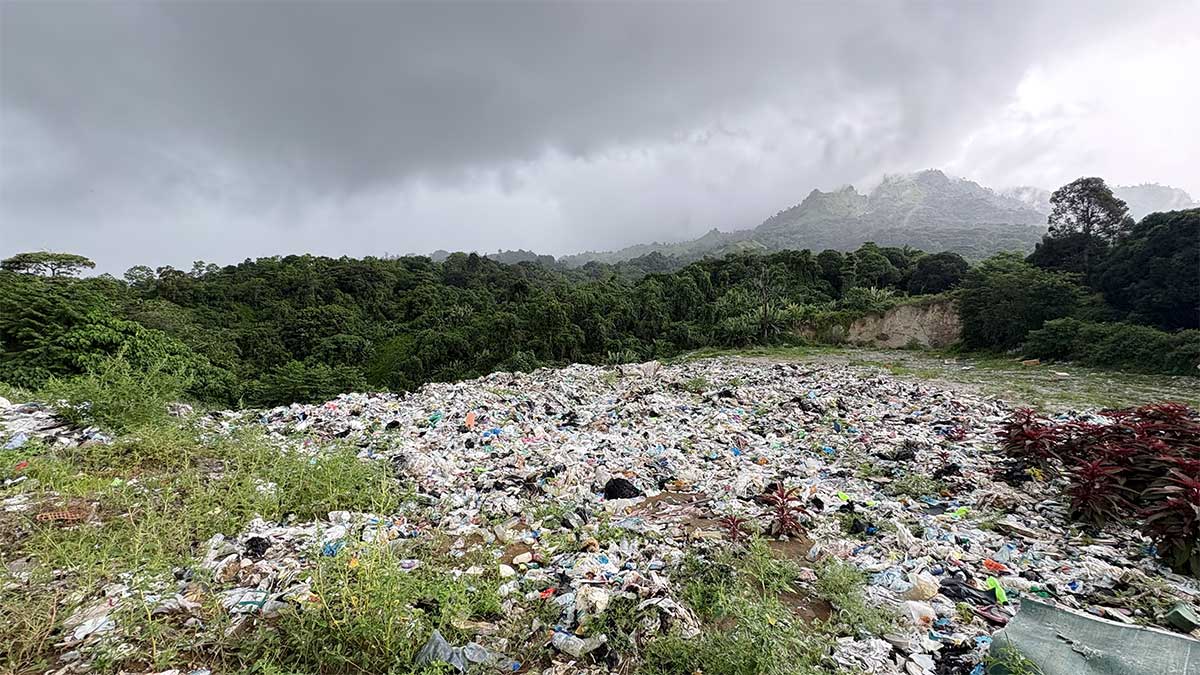
WASTE SITE A portion of the Aeta Ambala ancestral domain in Sitio Tibag, Subic, Zambales, was temporarily used as a garbage disposal site during the COVID-19 pandemic with the tribe’s consent, according to Aeta leaders. The site has since been ordered closed and is now undergoing rehabilitation. —Joanna Rose Aglibot SUBIC, ZAMBALES, Philippines — The National Commission on Indigenous Peoples (NCIP) said it found no evidence that Aeta Ambala families were displaced by a temporary garbage disposal site established within their ancestral domain during the COVID-19 lockdowns. In a memorandum issued on Monday, the NCIP Central Luzon office said it confirmed that the open dump is located within the Aeta Ambala’s 1,308.81-hectare certificate of ancestral domain title in Barangay Naugsol, home to 87 families, or 435 people. The commission said there was “no basis to conclude that any community was forced to relocate because of the dump,” noting that the disposal area was established in a ravine that had not previously been occupied or used as a residential site. Article continues after this advertisement It added that most Aeta families live in neighboring Sitio Alibang, while the few indigenous households in Sitio Tibag are located some distance from the dumpsite. READ: Subic dump ‘temporary fix’ during pandemic – Aeta leaders While acknowledging the extraordinary circumstances brought about by the COVID-19 pandemic, the commission said these “cannot serve as justification for setting aside, sacrificing, or endangering the rights, interests, safety, and welfare” of the Aeta Ambala people. Contaminated? On allegations that nearby rivers and other water bodies had been polluted, the NCIP said its July 17 validation did not establish contamination, as asserted by Aeta and environmental groups, because determining water quality is “a technical and scientific matter that requires appropriate environmental assessment and, when necessary, water quality testing.” READ: Boss Toyo draws flak after ‘narrative’ on Kara David’s Subic dumpsite documentary Article continues after this advertisement Without such evidence, the commission said it “cannot determine whether nearby bodies of water were contaminated” by the disposal site. The agency also said tribal leaders confirmed during NCIP consultations on July 17 that they had agreed to the establishment of the dump on the understanding that it would be temporary during the COVID-19 pandemic, when transporting waste to accredited sanitary landfills became difficult because of lockdown restrictions. Article continues after this advertisement According to the memorandum, members of the tribal council said they gave their consent “based on the understanding that the local government would remove or rehabilitate the site after the pandemic or once the temporary need for its use had ended.” However, the NCIP said it found no official record showing that the Subic municipal government coordinated with the commission when the community’s consent was obtained. “The NCIP has no official record or documentation showing how the alleged consent was obtained, including how the community was informed and consulted and who participated in the process,” it said. The commission acknowledged that the absence of coordination may have been due to the extraordinary circumstances during the pandemic, when urgent public health and sanitation concerns affected normal government procedures. Still, the lack of coordination meant it could not determine whether the community had freely and genuinely given its consent, the agency said. Rehabilitation urged The NCIP also said it could not verify claims that the Aeta community received P10,000 in exchange for allowing the dump because residents gave conflicting accounts during consultations. Some said the monthly payment had already existed before the dump was established, while others associated it with the garbage disposal site. Investigators also reported differing observations regarding foul odor. While NCIP personnel detected an unpleasant smell during a June visit, no foul odor or unusual number of flies was observed during the July 17 validation. The agency said the difference may have resulted from weather conditions and the fact that the dumpsite was no longer actively being used. In its recommendations, the NCIP urged the Subic municipal government to rehabilitate the dumpsite with the meaningful participation of the Aeta Ambala community and the commission. It also reminded local government units to coordinate with the NCIP and obtain all required certifications, permits, and clearances before implementing projects within ancestral domains or undertaking activities that may affect indigenous communities. The NCIP added that determining whether the open dump violated environmental laws remains under the jurisdiction of the Department of Environment and Natural Resources, which has the mandate to assess compliance with environmental standards and permitting requirements. The dump in Sitio Tibag became the subject of public scrutiny after environmental groups and advocates questioned its operation within an Aeta ancestral domain. Your subscription could not be saved. Please try again. Your subscription has been successful. The Subic municipal government has maintained that the site was established as a temporary measure during the COVID-19 pandemic after hauling garbage to accredited sanitary landfills outside the province was disrupted by lockdown restrictions. /cb
NCIP finds no Aeta displacement near Subic open dump
Full Article
Original Source
Read the full article at Newsinfo →KhanList aggregates and links to publicly available news content. We do not host full articles from third-party sources. Always verify important information with original sources.