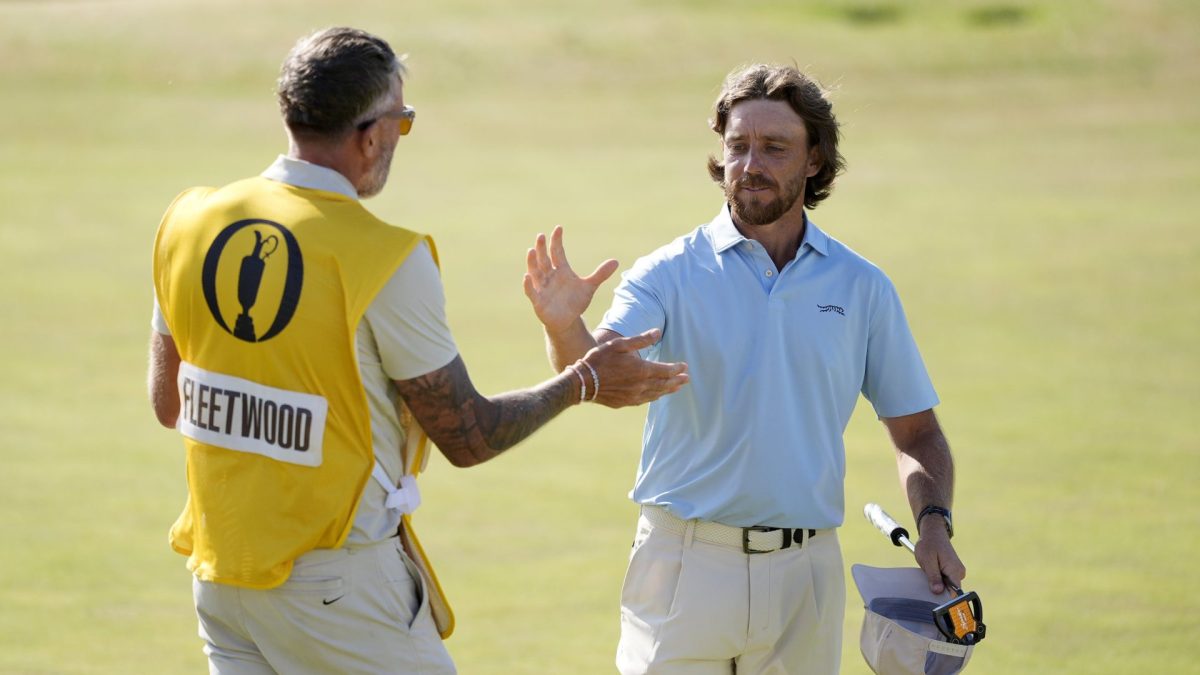
ROYAL BIRKDALE — If a tree falls in the forest and nobody hears it, does it really make a sound? The answer of course is yes it does, but it passes the world by. The roars as Tommy Fleetwood sunk a birdie at the 72nd hole of his home major – he grew up virtually on this golf course – were heard for miles, but not many would have seen it happen. That is because behind the paywall of Sky Sports, golf is quietly drifting into the semi-rough of the British sporting calendar. Ryan Fox’s dramatic victory was hidden behind the Sky Sports paywall (Photo: Getty) The first dropped shot en route to such irrelevance was the cash grab of accepting Sky’s offer to poach the rights to the Open, which had previously been one of the jewels of the BBC’s sporting summer. According to reports at the time, Sky paid £15m a year to show the Open from 2016, doubling the existing BBC deal and taking the championship behind a TV paywall for the first time in its history. Overnight, the tournament lost four million viewers. Four million. That’s like everyone in Liverpool, Leeds, Glasgow and Newcastle turning off in one fell swoop – or every man, woman and child in Wales and Bristol. These are mammoth numbers for a niche sport; in the UK, all sports that are not football can be considered niche. When the BBC gave up the Masters from Augusta 2019, it signalled an end to all live golf on BBC TV, a victim to increasingly regular cost-cutting operations at the corporation. Previously, there were at least a number of top golfers everyone in Britain could name. Now, according to YouGov, the three most famous golfers in the UK are (in order) Tiger Woods, Rory McIlroy and Jack Nicklaus. Scrolling down, Colin Montgomerie, Lee Westwood and Seve Ballesteros all feature before you find the next golfer actually in the field at Birkdale this week: Justin Rose, who didn’t make the cut. He is the quarterly survey’s 338th-ranked athlete in terms of fame. But golf actually remains one of the more resilient sports in the UK, in terms of participation. According to Sport England’s Active Lives survey, more than a million people in England play golf at least twice a month. That is virtually the same number as tennis, a sport that gets a month of prominence on the BBC, and four times more than track and field, which was shown on BBC One for three-and-a-half hours on Saturday. Of course linear TV is not what it used to be, but free streams are still easier to access than paid-for ones: all the same logic about eyeballs applies. So the bet golf made a decade ago has not had too much impact on participation, which has crept up a percentage point each year since. But there is no question that its prominence has been diminished. Rory McIlroy’s fame knows no bounds but he is a rarity among his peers (Photo: PA) None of this is to detract from the excellent job that Sky Sports do covering the golf. I very vividly remember the contrast between the first Open shown on satellite in 2016 and the year before on the BBC. Their focus on technical insight and broadcast innovation was a breath of fresh air. But there was also plenty to be said for Ken Brown wandering around the golf course at 6am with a ball and a putter to show you why the seventh green is so tricky. It felt like the club pro giving you a private lesson, yet was straightforward enough for the occasional golf-watcher to enjoy. The very idea of being an occasional fan of golf, which used to go along with being a tennis fan during Wimbledon and a one-Saturday-a-year horse-racing expert for the Grand National, is alien now. Perhaps that is because those people don’t do much for the people who own the sport. They don’t buy golf holidays, fairway woods or hospitality packages. But there is a greater value to their presence in the ecosystem. They give golf a place in society, and help retain its relevance. Its reduced visibility is a huge challenge for the sport going forward. Because when someone picks up a golf club for the first time, there is a role model for them to follow, someone they have heard of and whom their parents have heard of. Read more James Gray: The seven worst heckles aimed at Bryson DeChambeau – including Rory McIlroy’s dig Ian Baker-Finch: I won the Open at Birkdale – then quit golf sobbing on the locker room floor Plenty will say that Bryson DeChambeau, for example, has 2.78million YouTube subscribers, who watch his golf content for free there. Many of them will be far younger than the average BBC One viewer. But that comes with problems of its own. “Did you watch my latest video?” the American asked a young fan this week while he was signing a flag for him. “I’m not allowed YouTube,” came the reply. That’s one defence of free-to-air television: BBC Sport was a safe space for everyone to enjoy golf, free-to-air and free to spark a lifelong passion. Parents, kids, friends could all watch the same thing at the same time, a shared experience that increasingly only live sport offers. Those opportunities are starting to dwindle – and you worry that so too is golf.
The BBC turned its back on golf – and the sport has never been the same
Full Article
Original Source
Read the full article at Inews →KhanList aggregates and links to publicly available news content. We do not host full articles from third-party sources. Always verify important information with original sources.