
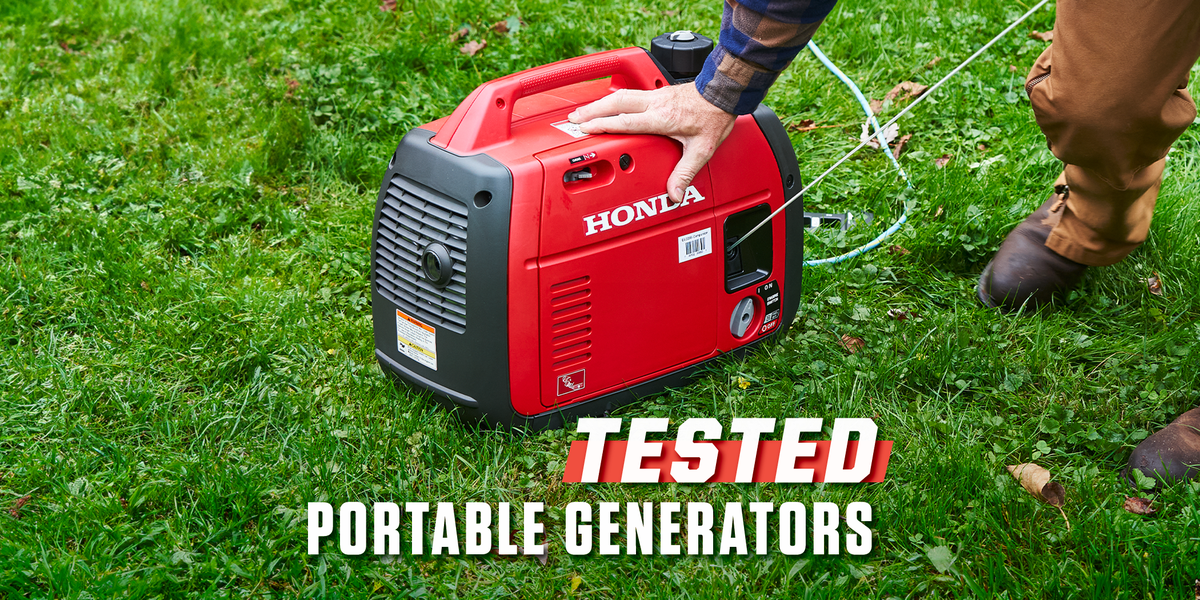
9 min readGenerators come in all sizes, but when you need power for camping or tailgating, or to power tools when you’re too far from an outlet, a large one meant for home backup is just too much. Power stations are handy, but once they run out of power, they take a long time to recharge. That’s where a smaller-sized portable generator can really shine. So long as you have the fuel, they can keep running.When you’re shopping for a portable generator, there are a few important things to consider, including power, weight, and fuel type. For portable power, models that output 2,000 to 5,000 watts will generally be simple enough to lift in and out of a truck, though some models that generate more are designed to be lightweight. Anything over 100 pounds starts to buck the idea of something being portable, even if it has wheels.Fuel type matters, too. All generators run on gas, but dual-fuel models can also run on propane. The drawback is that propane delivers slightly less power output and shorter running time, but it runs a lot cleaner and is much less messy to deal with.If you’re powering sensitive electronics like digital equipment or TVs, you’ll also want to look for an inverter generator, which delivers more stable “cleaner” power that won’t damage your gear. They also run quieter than standard models. For these reasons, all of the picks on our list are inverter generators.The Best Portable GeneratorsBest Overall: Honda 2,200-Watt Companion Portable GeneratorBest Budget: Wen 3,600-Watt Dual-Fuel Inverter GeneratorBest for RV Camping: Champion 4,500-Watt Dual-Fuel Inverter Portable GeneratorMost Versatile: Pulsar 7,250-Watt Dual-Fuel Inverter GeneratorBest for Powering Sensitive Electronics: Generac 3,800-Watt Inverter GeneratorHow We Selected and TestedKeeping portability in mind, the models we cover in this story are all 7,500 watts and under. For the models that we tested, we based our methods on our experience using generators for backup power with and without transfer switches, on construction sites to run power tools and equipment, as well as running sound systems and lighting at outdoor events. We measured the sound levels of these generators idling with no load, and while running under load at 2 feet and 25 feet. We then used an oscilloscope to observe the sine wave of the alternating current generated by these machines, and a clamp meter to check voltage output.Some examples of devices we used with large starting and running loads include a large air conditioner and a portable table saw. In one case, we even tested it paired to a solar inverter-charger. We evaluated these generators based on ease of starting, power response, sound levels, value, safety, and reliability to select the top performers.ProsHalf the size and weight of comparable generators Full enclosure makes it easy to move around without worrying about it catching on things.Runs very quietly, even when powering heavy loadsConsNot powerful enough for home backup applicationsFuel tank is quite small at less than 1 gallonKey SpecsTypeInverterWatts (running/starting)1,800/2,200FuelGasolineFuel Capacity0.95 galNoise Level59.9 dB at 25 ftOutletsOne 120 V, 20 A; one 120 V, 30 A twist lockWeight47.4 lbThe Honda EU2200i inverter generator has just about everything you want from a portable generator. It’s half the size and weight of comparable generators in its class; it’s very quiet and clean when operating; and it’s fully enclosed so you can quickly and easily transport it and move it around without worrying about it getting caught on anything.That enclosure is an important feature, as it protects the inverter electronics and helps contain noise—the EU2200i is remarkably quiet. In testing, we measured sound levels of 68.9 decibels at the generator under no load. When we switched it to “eco” mode, which reduces engine speed when power isn’t called for, the sound was reduced to 76 decibels.When we used an oscilloscope to look at the sine wave of the current generated, the curves were smooth and symmetrical, an indicator of “clean” power. This remained true even when running heavy loads from devices like a table saw or an air conditioner.There are some nice design features, too. The vent on the gas cap closes so fumes or fuel cannot escape. You could breathe free packing this in the passenger compartment of an SUV. Likewise, the power on/off switch doubles as a fuel shutoff, so it can’t be forgotten.Lastly, the EU2200i has ports for parallel operation. With the correct cable kit, it connects to a second EU2200i to double the output to 4,400 starting and 3,600 running watts. The EU2200i is ideal for camping and other outdoor events where generator noise might be frowned on.ProsHigh output for such a small sizeDuel-fuel option, which is not always found in generators this smallLightweight at just 47 poundsConsSmall fuel tank at just 1.1 gallonsFeatures at a GlanceTypeInverterWatts (running/starting)3,200/4,000 (gasoline); 3,000/3,700 (propane)FuelGasoline, propaneFuel capacity1.1 galNoise Level68 dB at full loadOutletsOne 120 V, 20 A; one 120 V, 30 AWeight47 lbWe like the GD400BN because it’s powerful, quiet, and portable at a reasonable price point. The interesting thing about this inverter generator is how much power it can deliver, yet it’s still as compact as similar generators that deliver half as much output. Even when running on lower-output propane as the fuel source, it can run up to 3,000 watts, which is considerable for a generator that only weighs 47 pounds.Another plug or two would’ve been nice, however. Its single AC outlet limits you to plugging one power tool or appliance at a time, despite having enough output to power more than one device. It does have a 120-volt, 30-amp outlet for connecting to an RV, though, so that does make up for it a bit, but only if you have that need. The 1.1-gallon fuel tank is also a bit limiting regarding runtime for gasoline, but that’s easily overcome by using propane. For all intents and purposes, this is a very nice dual-fuel generator, and at a list price of $600, it comes at a reasonable price to boot.ProsDual-Fuel allows you to power it from a propane tankLightweight at just under 50 poundsIncludes USB ports, which in not common on fuel-based generatorsConsSmall fuel tank at only 1.5 gallonsFeatures at a GlanceTypeInverterWatts (running/starting)2,900/3,600 (gasoline); 2,600/3,500 (propane)FuelGasoline, propaneFuel capacity1.5 gal (gasoline)Noise level65 dBOutlets1 x 30-amp; 2 x 120V; 1 x 12V DC; 2 x USB-AWeight49 lbThe Wen DF360iX offers a considerable amount of utility for an affordable price. You have the option to run the generator on gasoline or propane with a running output of up to 2,900 watts. While propane delivers a bit less at 2,600 watts, that’s plenty of power for a job site or camping use and even enough electricity for small to mid-size RVs.While this generator is fairly light at 49 pounds, it doesn’t cut back on ports, including a 30-amp port for direct connection to an RV. There are also two three-prong AC ports, a 12-volt DC receptacle, and two USB-A ports. Like most inverter generators, it produces less noise. This model is rated at around 65 decibels of noise at a quarter load, which is quiet enough that it shouldn’t bother the neighbors. There are some nice safety features, too, including auto-shutoff if the fuel runs too low and a carbon monoxide (CO) sensor that detects if dangerous levels are present.Of course, with any generator in this price range (under $500), there are compromises. This model has a pretty small fuel tank—only 1.5 gallons—so you won’t be able to run this on gasoline for long periods (around five hours with a half-load) without having to stop and refill. You can mitigate this, however, by relying on a larger tank of propane. For example, a 20-pound tank should enable you to run it for up to 14 hours.GENERATOR SAFETYWhile not hard to run, generators present dangers, so you need to follow basic safety rules. Never be operate them in a closed space, like a garage or shed. Exhaust gases contain carbon monoxide (CO), a lethal odorless, colorless gas. Most manufacturers offer models that shut down when they detect carbon monoxide building up. Do not run a generator in a garage with the door open, or in front of the garage with the door open, because carbon monoxide can still get trapped and seep into the house. Run generators least 20 feet away, including from windows and doors, with the exhaust blowing away from the house.ProsRuns on either gas or propane120-volt, 30-amp outlet can power a small RV.Enough power to provide some home backup power if needed.ConsNeeds an adapter to use with transfer switchKey SpecsTypeInverterWatts (running/starting)3,500/4,500 (gasoline); 3,150/4,500 (propane)FuelGasoline, propaneFuel Capacity2.3 gal (gasoline)Noise Level61 dB at 25 ftOutletsOne 12V DC; two 120V, 20 A; one 120 V, 30 A RVWeight97 lbRV owners need a generator outfitted with at least a 120-volt, 30-amp outlet, but it also helps to have a decent amount of power to go with it, so that you can run things like a heater or an air conditioner. This model from Champion offers both, with the outlet and up to 3,500 running watts, which is enough to power a small- to medium-sized RV.It also offers great fuel flexibility. With a full 2.3-gallon fuel tank, it should be able to run for up to 14 hours, but it’s dual-fuel, so with a full 20-pound propane tank, this generator can supply 21 hours of uninterrupted power.In addition to being a solid companion for camping and RVing, this generator could serve as a useful tool in an emergency at home where power is needed. Using a manual transfer switch, you could power a few 120-volt circuits using the 30-amp connection. And the inverter will help to keep it running more quietly, which is helpful at home or the campground.ProsDelivers excellent clean and stable currentRelatively light for its size and output capabilities at just over 100 poundsCan output 240-volt for high voltage appliancesConsA little louder than expectedKey SpecsTypeInverter, closed frameWatts (running/starting)6,000/7,250 (gasoline); 5,500/6,500 (propane)FuelGasoline/propaneFuel Capacity3.6 gal (gasoline)Noise Level62 dB at 25 ftOutletsTwo 120 V, 20 A; one 120 V, 30 A RV outlet; one 120/240 V, 30 A twist lock; one USB A; one USB CWeight118 lbOne of our test editors picked up this generator when faced with a home emergency where he needed a generator with specific features, quickly, and on a budget. A failed generator at a solar-powered off-grid cabin necessitated the quick acquisition and, happily, the Pulsar 7,250-Watt Dual-Fuel Inverter Generator showed up on the doorstep in only two days.In about 15 minutes, with minimal assembly and after adding oil, the generator was connected to the hose to a propane cylinder and was running on the first cycle of the starter. Since then, it’s run steadily at 500 watts, up to 5,500 watts, at 240 volts, to charge a battery bank during the winter when sunlight wasn’t enough to get the job done.This Pulsar puts out very clean power, too, with a claimed total harmonic distortion (THD) of less than 3 percent, which met the requirements of the solar inverter-charger it was paired with.Using the inverter to monitor the current frequency, we found that it was indeed very stable with minimal variance, between 59.97 and 60.09 Hz. All things considered, the Pulsar 7,250-Watt Dual-Fuel is a good value for the specs, capacity, and features.ProsVery quietConvenience of using gas or propaneEasy to read LED displayConsMore expensive than a standard generator with similar capacityFeatures at a GlanceTypeInverterWatts (running/starting)3,000/3,800 (gasoline); 2,700/3,400 (propane)FuelGasoline or PropaneFuel capacity3.28 gal (gasoline)Noise Level61 dB at 25 ftOutlets4 x 120V, 20-amp; 1 x 120V, 30-amp twist lock; 1x USB-A; 1 x USB-CWeight107 lbGenerac’s iQ3800 Portable Inverter Generator is a great example of what we love about dual-fuel, inverter generators. This type of generator can deliver cleaner power than a standard model, meaning there’s less distortion in the electrical current frequency. That’s ideal for powering sensitive electronics, such as TVs, computer equipment, and smart household appliances. This is also a closed-frame inverter generator, which tends to be quieter; the iQ3800 is one of the quietest generators we’ve tested of this size.We were very impressed with how easy the iQ3800 is to operate. The electric start and auto choke worked perfectly, taking only about four to five seconds, while the manual pull-start also fired up the generator with minimal effort. Switching between fuel types was also very simple to perform. Once running, you can view important information on an easy-to-read LED display that lists the total hours the machine has run, the fuel level for the gasoline tank (there’s no gauge for propane), and a load gauge that uses a bar graph to show power output level—knowing that helps to avoid overloading the generator.The inverter technology might be the most important feature of the iQ3800. This generator has a total harmonic distortion (THD)—a level of variance in the current frequency—of less than 3 percent, which is very low. Essentially, anything with a screen or any smart device would be best powered using an inverter generator like the iQ3800. It’s an ideal generator to power RVs in campgrounds or off-grid, and a great option for emergency backup in urban areas.Full Generac iQ3800 Portable Inverter Generator ReviewWhat to ConsiderTypes of GeneratorsHow to Size a Generator CorrectlyIt’s important to know what you intend to power with a generator in order to choose the right size. Manufacturers list two figures for generators: starting watts and running watts. Starting watts include the initial surge required to start appliances or tools with powerful electric motors or compressors. Once started, these devices require far less power to run continuously.Trevor RaabThe more power a generator can produce, the larger and heavier it will be, so you should balance that with how portable you need it to be.Many manufacturers have a chart with estimated power requirements for common appliances and tools to help you figure out what you need. For a more precise measurement, you can also calculate the figure yourself by adding up the power consumption of specific appliances and adding them together.To calculate watts, multiply voltage (usually 120 volts) by the amps (amperage) required to run the appliance (usually found on a tag attached to the appliance). Do this for each item that the generator will power.Fuel OptionsTrevor RaabWhen powered by propane, generators run cleaner and more quietly, but they also produce slightly less power than gasoline-powered generators.Does Your Generator Need to Be Grounded?If you’re powering appliances, tools, or other devices by plugging them directly into the standard outlets on the generator, the answer is no. If the generator is being used to power circuits in your home, maybe. It’s always best to consult the operator’s manual, a licensed electrician, or township ordinances with your local building officials—some localities may have requirements that differ from the National Electrical Code (NEC).Electrical circuits need to be grounded to operate devices safely, so that any current that shorts out or has a fault is directed to the ground, i.e., the actual, literal earth, so the user doesn’t become the conduit to “ground.”There are two ways that generators are grounded: neutral-bonded and floating neutral. Neutral-bonded means the neutral wire is connected (i.e., bonded) to the generator frame. With a floating neutral, the neutral is not connected to the frame. In the latter case, the generator should be grounded by connecting the ground terminal to a grounding rod driven into the ground.Generators with ground-fault circuit interrupter (GFCI) outlets, when used to power circuits in your home, require neutral switching and a manual transfer switch, and must be grounded by connecting the ground terminal to a ground rod driven into the soil. Neutral-switching transfer switches are also referred to as three-pole transfer switches.Portable Generators FAQsFAQs with Editor Brad FordDavid is a Reviews Editor for Hearst’s Enthusiast Group, contributing to Popular Mechanics, Runner’s World, Bicycling, Best Products, and Biography. He has over 25 years of experience writing about and reviewing consumer electronics, kitchen appliances, DIY products, outdoor gear, and more. He also spent years covering the ever-changing world of online retail. To relax, he loves experimenting with new recipes, tweaking his smart home setup, and spending time outdoors on his bike or camping. Brad Ford has spent most of his life using tools to fix, build, or make things. Growing up he worked on a farm, where he learned to weld, repair, and paint equipment. From the farm he went to work at a classic car dealer, repairing and servicing Rolls Royces, Bentleys, and Jaguars. Today, when he's not testing tools or writing for Popular Mechanics, he's busy keeping up with the projects at his old farmhouse in eastern Pennsylvania.
The 6 Best Portable Generators Give You Power Whenever and Wherever You Need It
Full Article
Original Source
Read the full article at Popularmechanics →KhanList aggregates and links to publicly available news content. We do not host full articles from third-party sources. Always verify important information with original sources.