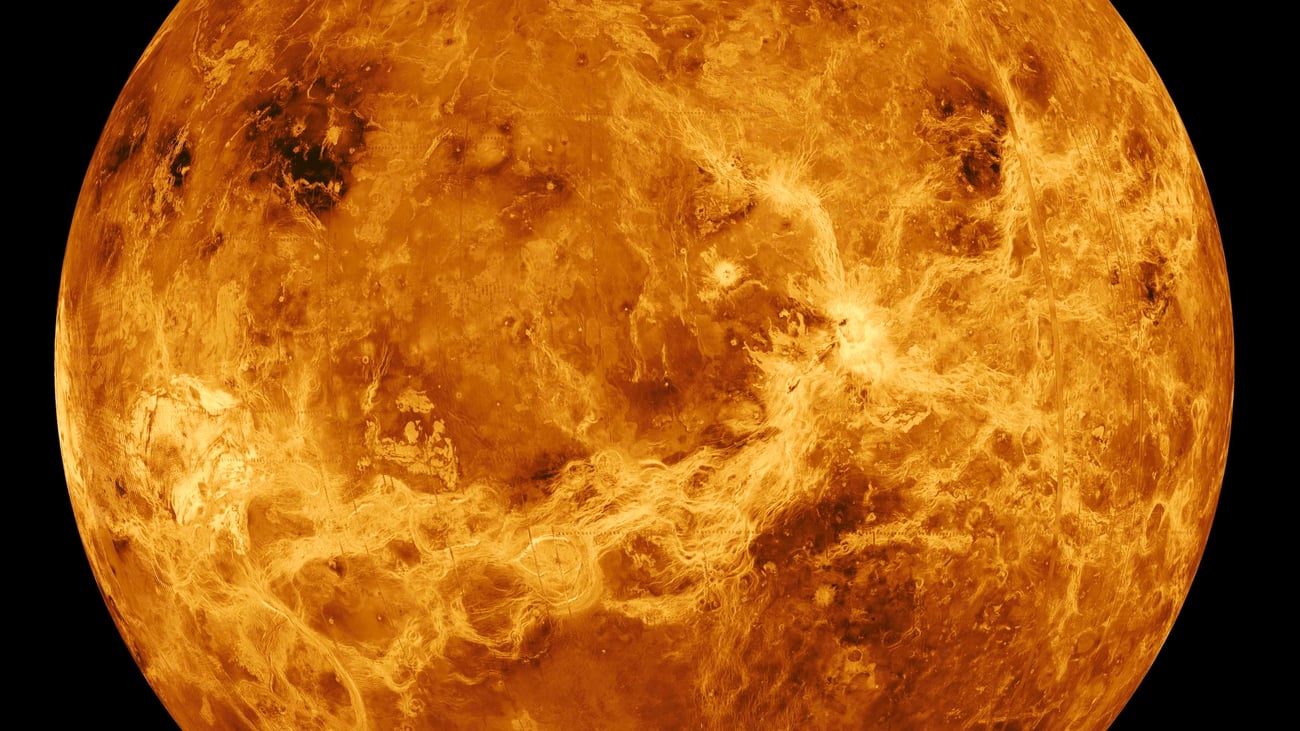
The geology of the rocky planet bears at least one similarity to that of Earth.(CN) — While no organic life has been found on Venus, scientists believe the planet is very much alive — geologically, that is.Researchers at the Swiss Federal Institute of Technology in Zurich indicate in a study published Friday that the planet is home to active volcanoes and relatively recent tectonic movement.Rift valleys are lowland regions sandwiched by mountainous terrain. Their formation comes about when shifting tectonic plates pull a planet’s surface apart, with sediment or liquid filling gaps left in between. Examples on Earth include the East African Rift and Siberia’s Lake Baikal, our planet’s deepest lake and largest freshwater body of water by volume.Though Venus lacks oceans and breathable air, the planet possesses these valleys, just like Earth. Commonality between the two extraordinarily different celestial bodies is nothing to overlook, even if it’s limited to a “rocky” relationship.The scientists, led by Taras Gerya and Xi Yang, used high-resolution 3D modeling software to simulate the surface of Venus in an acuity not achieved by past studies.Observing rift valleys spanning over 6000 miles, the team found “rift flanks” — ridges formed on the edges of active or recently active rift valleys — comparable, in theory, to what exists in places like South Africa’s Great Escarpment.Mapping imagery from the 1989 NASA Magellan probe also shows relatively recent rift flanks on Venus, corroborating the Swiss team’s findings from their 3D computer model and showing that the rocky planet is likely still in geologic motion.“The results help us to better assess the tectonic activity on Venus,” Gerya said in a statement.The researchers observed that, due to “crustal relaxation,” Venusian rift flanks quickly flatten out after plate movement stops, whereas similar surface features on Earth are more likely to be worn down from erosion over time.Apparent confirmation that Venus remains geologically active is a valuable finding on its own, but scientists are optimistic that more knowledge about the formation of terrestrial planets, like Earth and Venus, could be obtained using similar methodology.The team’s long-term goal is to better detect and study rocky exoplanets far beyond the Solar System.The European Space Agency is planning an unmanned orbital mission to Venus in 2031, intended to survey its surface and atmosphere more thoroughly than ever to uncover more of our planetary neighbor’s geological and historical secrets.Subscribe to our free newslettersOur weekly newsletter Closing Arguments offers the latest about ongoing trials, major litigation and rulings in courthouses around the U.S. and the world, while the monthly Under the Lights dishes the legal dirt from Hollywood, sports, Big Tech and the arts.Additional Reads
Tectonic activity on Venus hints at how planet was formed
Full Article
Original Source
Read the full article at Courthousenews →KhanList aggregates and links to publicly available news content. We do not host full articles from third-party sources. Always verify important information with original sources.