
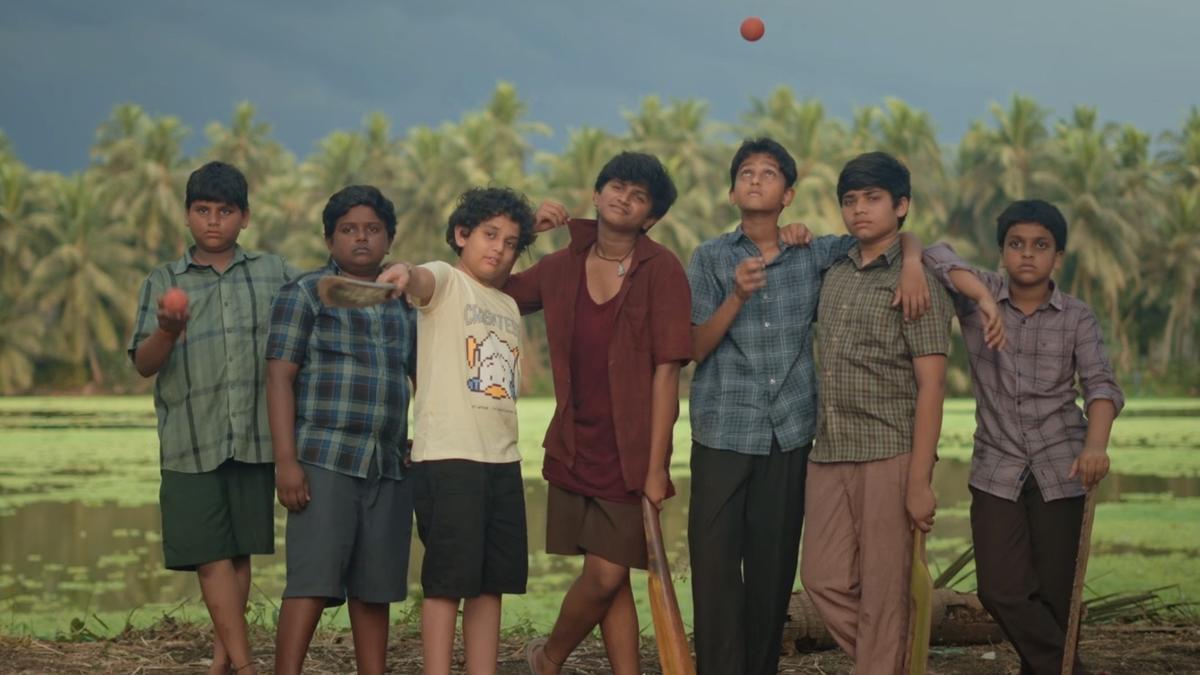
It’s 2001. A school-going city boy is taunted by his father to improve his grades each term. Meanwhile, a boy in a village, drowning in debt and doing odd jobs to make ends meet, knows how to live life to the fullest. What if they spend a summer together? The Telugu film Summer Holidays, set in Thotavaripalem in interior Andhra Pradesh, leans into the romanticised notion of villages as repositories of goodwill and nostalgia.Srikar Nayan’s directorial debut, true to its title, tracks the passage of summertime by the countryside. The film is a feel-good, syrupy coming-of-age saga that pays fond homage to childhood innocence, offering a peek into the urban-rural divide and several social barriers through a friendship between boys dealing with contrasting realities.Ravuri Venkatesh a.k.a. RV (Arun Dev) has a strict father binding him to his home, clipping his cricketing dreams. The film begins with his curious gaze at a window broken by boys playing cricket in his street. His empathetic mother (Vasuki Anand) offers him some respite with a trip to her hometown (Thotavaripalem) during the summer break.Getting a royal welcome from his grandmother (Jayasudha), RV breathes easy and finds an unlikely friend in Kasi Venkateswarlu or KV (Rohan Roy), the son of a widowed maid in his household. Despite doing odd jobs for a livelihood and facing financial woes, KV’s cheery spirit captivates RV (the name-play is intentional).Summer Holidays (Telugu)Director: Srikar NayanCast: Arun Dev, Rohan Roy, Jayasudha, Vasuki AnandRuntime: 126 minStory: A city-bred boy spends his summer in a rural Andhra Pradesh village, forging an unlikely friendship with a local boy.RV and KV bond over little pleasures, bathing by the lakeside, attending classes together, playing cricket all day long in expansive mango fields, and indulging in aimless chatter while watching lazy afternoons drift by. KV spends a major part of his day by a mango tree he has taken on lease (personified through a witty voice-over by Harsha Chemudu). His company rejuvenates RV in many ways, so much so that his troubles feel smaller.The absence of a precise plot is the film’s strength and weakness. As KV’s monetary issues deepen, RV stands by his side. Their integrity gets them past testing situations. There are stock characters such as a money lender, an uncompromising landlord, his crooked worker, and a drunkard father.The screenplay hinges on all the hardships that KV goes through to buy his single mother a sari from his earnings. An infectious mass sequence in the second hour even has the boys delivering a huge load of raw mangoes to a local market by themselves at night. The film could certainly have done with more of such sequences.Summer Holidays, in a bid to sustain its pleasantness, resorts to a convenient screenplay in which KV’s problems get solved magically. When the father almost breathes down RV’s neck for wasting his holiday time, a long Bommarillu-style monologue by the child instantly transforms people.The children often speak beyond their age, delivering soapy, dramatic lines drenched in philosophy, as if they were rehearsing for a stage play. There’s no space for restraint or imagination, and everything is spelt out. Most of the characters, except the children, have one-note arcs.Amid the film’s simplistic gaze at boyhood and village life, what truly clicks is its effort to portray the man-nature relationship. While people frequently end up exploiting KV’s fragile situation, the mango tree that he nurtures with care paves the way to a better tomorrow.Sinjith Yerramilli’s music infuses energy into the ambience, and the cinematography, even while confined to a handful of locations, adds to its sensory appeal through sharp frames comprising a vivid burst of colours.Child artists Arun Dev and Rohan Roy are natural in front of the camera, complementing each other’s distinct energies adeptly. Jayasudha and Vasuki Anand’s presence radiates warmth, while Rajeev Kanakala shines in one of the few well-written subplots. Harshini makes a mark with a brief yet crucial part, though Harshavardhan’s sudden change towards the climax is hard to buy.What can make viewers look at the film in a kinder light is the sheer absence of stories directed at children in Telugu cinema (35 - Chinna Katha Kaaduand Don’t Trouble The Troublebeing rare exceptions). Despite its blips, easy resolutions and generalisation, a lot of Summer Holidays remains heartfelt and engaging, and avoids forced commercial add-ons.
‘Summer Holidays’ movie review: A simplistic yet heartfelt ode to rural nostalgia
Full Article
Original Source
Read the full article at Thehindu →KhanList aggregates and links to publicly available news content. We do not host full articles from third-party sources. Always verify important information with original sources.