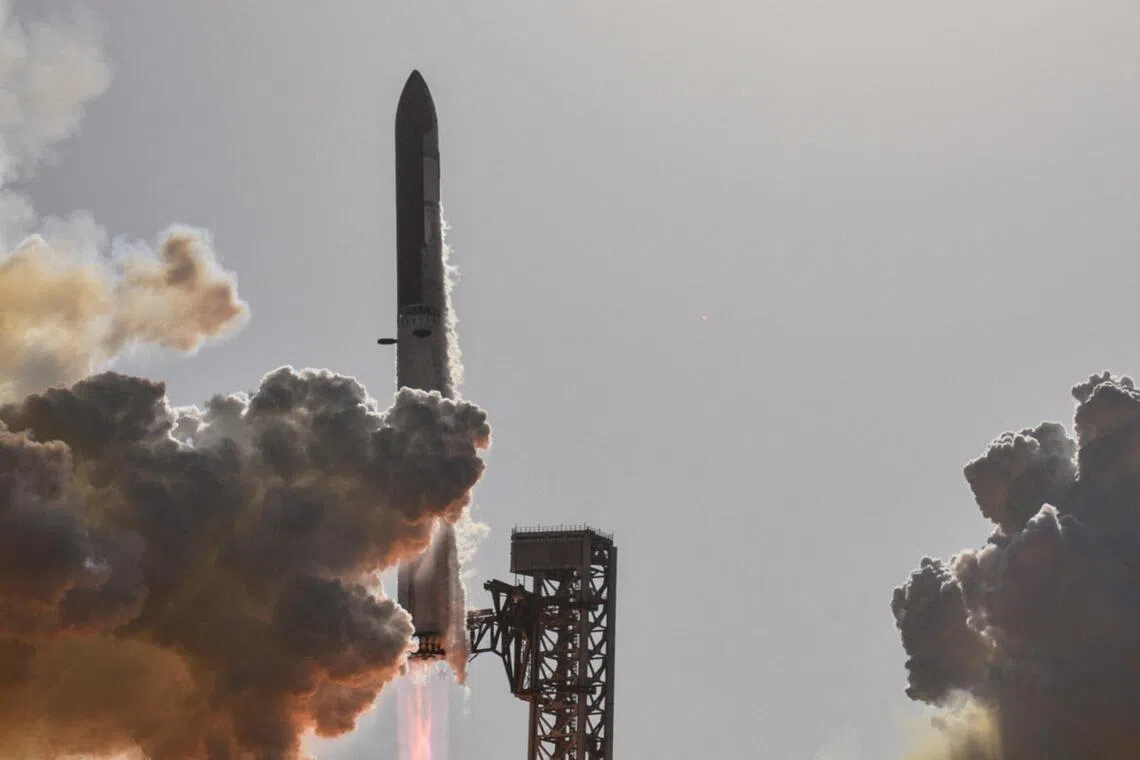
SpaceX’s mammoth Starship launched on its first major test flight since the company’s blockbuster initial public offering, a high-stakes mission to test technology vital to Chief Executive Officer Elon Musk’s ambitions.Starship, perched atop its Super Heavy booster, lifted off from the company’s Starbase facility in South Texas at 5.51pm local time on July 24 (6.51am Singapore time on July 25). The rocket is carrying upgraded Starlink satellites that are intended to burn up later in the atmosphere as part of the roughly hour-long test mission.Starship is central to Musk’s goal of expanding SpaceX’s Starlink communications network, sending humans to the moon and beyond and putting data centres in space. But it has faced an unstable development path marred by explosive setbacks, malfunctions and delays.A selloff of SpaceX’s shares partly fuelled by earlier mission delays demonstrates how certain investors are sensitive to the type of risks that are baked into SpaceX’s fly-fail-fix development strategy. Shares closed 3 per cent lower on July 24 in regular US trading and are down about 25 per cent over the last month – well below their US$135 IPO price. SpaceX is going all-in on Starship. The company has stopped taking reservations from satellite operators for dedicated rides to orbit beyond 2028 on its Falcon rockets, the backbone of the launch industry for years, Bloomberg reported on July 23.The Starship test is the rocket’s 13th flight. At liftoff, the Super Heavy booster ignited 33 Raptor engines, sending Starship on its way to space, where it will reach near orbital speeds. The booster then separated from Starship and splashed down in the Gulf of Mexico, with the company opting to skip the dramatic midair catch they nailed during a 2024 mission. While in space, Starship will attempt a number of tests, including relighting one of its engines and deploying 20 Starlink satellites. These satellites will extend their solar arrays and attempt to connect to the broader Starlink network using laser-based communications. About 20 minutes after deployment, the satellites should fall back to Earth, burning up in the atmosphere.About an hour after liftoff, Starship is scheduled to splash down in the Indian Ocean. Musk’s company has designed Starship to be fully reusable, something no other rocket maker has achieved, with both the Super Heavy booster and the Starship spacecraft intended to return to Earth intact after each launch so they can fly to space again.SpaceX has spent more than US$15 billion (S$19.36 billion) developing Starship. SpaceX also holds roughly US$4 billion worth of NASA contracts for Starship to land astronauts on the moon as soon as 2028.To do so, SpaceX will have to refuel the vehicle in space, launch it a dozen times or more in a row and ensure it’s safe to hold humans – a demanding list of tasks for a vehicle which has yet to complete a full orbital mission. BLOOMBERG
SpaceX launches major Starship test in post-IPO spotlight
Full Article
Original Source
Read the full article at Straitstimes →KhanList aggregates and links to publicly available news content. We do not host full articles from third-party sources. Always verify important information with original sources.