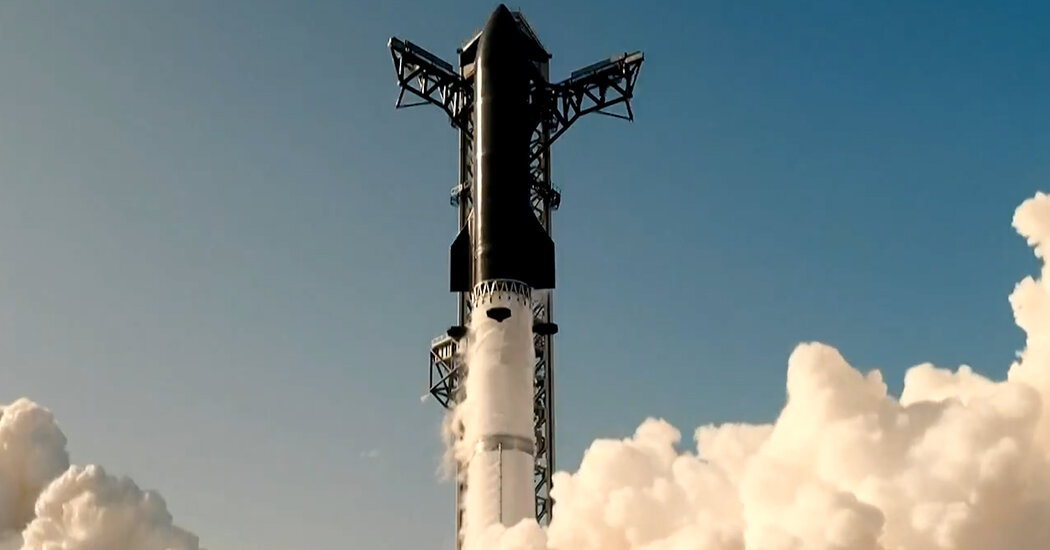
AdvertisementSKIP ADVERTISEMENTSpaceX completed a successful test flight of its Starship rocket on Friday evening, setting the stage for more ambitious developments in the months to come.The flight was the 13th for Starship but just the second for what SpaceX calls its Version 3, which incorporates a number of changes to improve performance and reliability. Friday’s flight appeared to accomplish almost all of its objectives, including correcting problems that occurred during the previous flight in May, deploying Starlink internet satellites and ending its journey bobbing intact in the Indian Ocean.“We’re really pumped about this,” Kate Tice, one of the hosts of the SpaceX webcast, said after the gentle water landing.This time, in contrast to an aborted attempt eight days earlier, all 33 engines on Starship’s booster stage ignited.The 407-foot-tall rocket lifted off at 6:51 p.m. Eastern time from SpaceX’s Starbase site in South Texas, near Brownsville.Starship consists of two stages: a booster, known as the Super Heavy, and an upper-stage spacecraft that is also called Starship but is often shortened to Ship. Both stages are designed to be fully reusable, which could greatly reduce the cost of sending satellites to space.On Friday, the return of the booster stage for a simulated landing over the Gulf of Mexico was not entirely successful. Instead of slowing to a hover, the booster appeared to hit the water while still descending at a quick pace.While in space, the upper-stage Ship deployed 20 functioning, next-generation Starlink satellites. Earlier flights released dummy versions to test the deployment mechanism, which resembles a large Pez dispenser, pushing out the satellites one by one.After deploying their solar arrays and antennas, all the satellites successfully connected to the rest of the Starlink constellation via laser communications.The upper-stage Ship also restarted one of the engines for 14 seconds. Demonstration of that capability was a prerequisite before Starship’s first orbital flight. An engine burn in orbit will be needed for the upper stage to drop out of orbit safely; otherwise, the spacecraft would be stranded in orbit, slowly dragged down by the friction of the atmosphere, with the possibility that pieces would land on populated areas.In contrast to an aborted attempt on Thursday, all 33 engines on Starship’s booster stage ignited.Credit...Steve Nesius/ReutersBy design, all of the flights of Starship so far have traveled along trajectories that re-enter the atmosphere above the Indian Ocean after a journey halfway around the world.On this flight, the accompanying Starlink satellites were traveling along the same suborbital path, so they also re-entered the atmosphere and burned up, just 20 minutes after they had been deployed.Before their demise, six of the Starlink satellites used cameras to scan Starship’s heat shield, observing how well the shield performed as temperatures heated up to thousands of degrees.The upper-stage Ship survived its fiery path through the atmosphere. Over the Indian Ocean west of Australia, it slowed down and mimicked the maneuvers of landing in a vertical orientation. And unlike in previous landings, the rocket did not explode in a fireball when it tipped into the water.“This is the first time we’ve put an intact Starship in the water,” said Dan Huot, another host of the SpaceX webcast, describing the fact that the cameras on the spacecraft were still sending back video as “just a little bit surreal.”He added, “Wow, lucky No. 13 — hell of a flight for Starship.”If data gathered during the flight does not reveal any major obstacles, SpaceX will be able to move on to the next set of more challenging objectives for Starship: entering orbit around Earth, returning the upper-stage spacecraft to Texas and catching it on the launch tower as it has done with the booster.Starship is key to NASA’s moon plans. SpaceX is slated to provide a version of the Ship spacecraft to take its astronauts from lunar orbit to the moon’s surface. But work on Starship has taken longer than Mr. Musk and SpaceX originally promised.For the moon mission, SpaceX needs to demonstrate several technological firsts. They include conducting multiple Starship launches over a short period of time, because the lunar-lander version of Starship will need to have its propellant tanks refilled before leaving low-Earth orbit.Transferring ultracold liquid methane and liquid oxygen between two spacecraft in the weightlessness of space has not yet been demonstrated.The successful test flight could also shore up investor confidence in SpaceX, which is planning to use Starship to deploy up to a million data center satellites in orbit. SpaceX debuted on the stock market in June in the largest initial public offering ever. A few days later, the share price shot up to $225.64, a jump of 67 percent over its debut price of $135, but it has slumped since. The stock closed at the end of this week at $115.07.Kenneth Chang, a science reporter at The Times, covers NASA and the solar system, and research closer to Earth.AdvertisementSKIP ADVERTISEMENT
On Second Test of Its Newest Starship Design, SpaceX Sticks the Landing
Full Article
Original Source
Read the full article at Nytimes →KhanList aggregates and links to publicly available news content. We do not host full articles from third-party sources. Always verify important information with original sources.