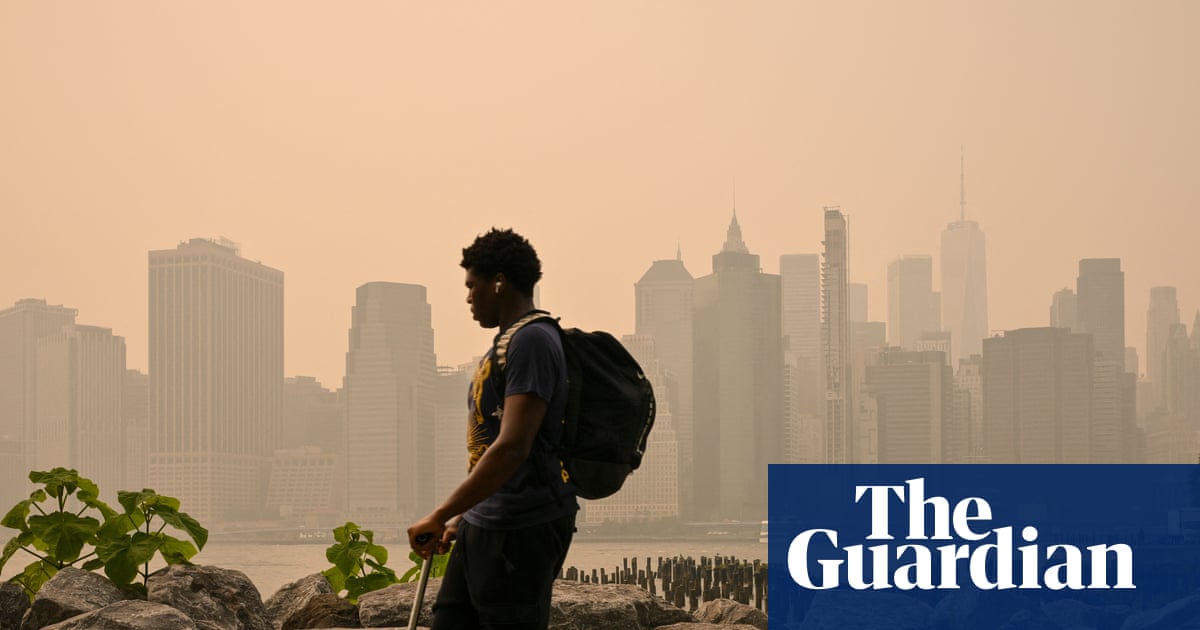
Scientists have reacted with incredulity after Donald Trump accused Canada of “poisoning” the US’s air with smoke billowing from a slew of forest fires and threatened sanctions upon the country’s northern neighbor.The US president has said that he raised the issue of smoke wafting into the US from nearly 1,000 Canadian wildfires with Mark Carney, the country’s prime minister, at the weekend’s World Cup final.“I told him, you got to stop these fires from coming in and poisoning our air,” Trump said. “If we can help them, we’ll help them. But maybe they should pay us some damages or something, or we should do some tariffs.”Trump, who has previously advocated the “raking” and “cleaning” of forests to prevent major conflagrations, this week announced 50% tariffs upon Canada, a long-term US ally that he has previously threatened with annexation. The US is being “unnecessarily invaded by filthy, polluted and unhealthy air”, Trump claimed last week.With palls of wildfire smoke causing unhealthy, hazy skies in cities including New York, Washington DC, Detroit and Toronto in recent weeks, some Republicans in Congress have issued further threats against Canada. Bernie Moreno, a Republican senator from Ohio, said he will introduce legislation to sanction Canada for the “atrocity” of not managing its forests properly.Donald Trump walks ahead of Mexico’s Claudia Sheinbaum and Canada’s Mark Carney at the World Cup final in East Rutherford, New Jersey, on 19 June. Photograph: Alex Livesey/Danehouse/Getty ImagesSuch threats have been met with shock in Canada, where thousands of people have been evacuated from fires that have badly burned remote towns. More than 8.1m acres (3.3m hectares) have been consumed by fires across Canada’s vast, mostly unpopulated boreal forests, a steep increase on the long-term average.Such fierce wildfires are a symptom of the climate crisis rather than a lack of management, experts warn, with the current blazes worsened by the recent severe heat dome that expanded from the US into Canada. The world is rapidly heating up due to the burning of fossil fuels, a process that Trump has actively sought to accelerate.“This is like crashing into the car in front of you because you were speeding and tailgating, and then demanding they pay for the damage to your headlights,” said Michael Mann, a climate scientist at the University of Pennsylvania, of Trump’s comments. “It’s victim-blaming by the assailant.“The policies of Trump and the GOP are worsening the problem by doubling down in fossil fuel production and doing their best to obstruct the clean energy transition while the rest of the world moves on,” Mann added.While Trump has falsely dismissed established climate science as “crap”, there is robust evidence linking prolonged hot, dry weather with fire-prone conditions. Elevated temperatures caused by the climate crisis more than doubled the likelihood of severe fire conditions when Canada was last engulfed by major wildfires in 2023, a previous analysis found.“The main cause of worsening fires in Canada is not mismanagement – most Canadian forests are remote and haven’t been managed at all, unlike the US – but instead a warming climate that has made large and extreme wildfires more common,” said Marshall Burke, an environmental policy expert at Stanford University.“These fires are not the result of Canadian action nor inaction, but instead largely the result of forces outside their control. So, punishment here would do nothing.”Attacking Canada over the fires is “unfounded, uninformed and even insensitive to people losing homes and firefighters putting their lives on the line”, said Lori Daniels, an ecologist and wildfire expert at the University of British Columbia.People look out from the CN Tower as smoke from wildfires in northern Ontario blankets the city on 15 July. Photograph: Cole Burston/AFP/Getty Images“It’s weak leadership to blame someone else when disasters are happening. It’s not helpful, [Trump] is not contributing to real solutions by playing the blame game.”Daniels said that while some densely thicketed woodland in North America could benefit from “thinning” to reduce the amount of potential fire fuel in them, thereby restoring the small, targeted fires used by Indigenous people before European settlement, such an approach would be futile in Canada’s boreal forests.skip past newsletter promotionafter newsletter promotionThese forests are dominated by spruce and fir trees that sit within soils topped by spongy mosses that are usually sodden with water. In hot, dry conditions like now, however, the forest floor itself becomes highly flammable, sometimes nourishing fires non-stop for extended periods.Clearing – or “raking” as Trump puts it – this organic material would only hasten fires, Daniels said. Such an endeavor would be logistically difficult regardless, with many of the current fires located in highly remote areas lacking roads and nearby firefighting resources. Canada has more than a quarter of the world’s boreal forests, spanning about 1.2bn acres of the country.“It would be physically impossible to do what Donald Trump has suggested, even with all the money and firefighters in the world,” said Daniels.The Brunswick Creek wildfire from Boston Bar, British Columbia, Canada, on 7 July. Photograph: Bloomberg/Getty Images“Some of the rhetoric from political leaders in the US is almost laughable, they don’t understand the ecosystem or the scope of the problem. This is a climate change-driven disaster and of course the Trump administration are climate deniers so they won’t take responsibility for US contributions to greenhouse gases. This is about deflecting attention from the cause of this.”Smoke from wildfires can trigger severe respiratory and heart problems for people living many miles away, with plumes of smoke eroding long-term improvements in air quality for Americans in recent years.But climate change-fueled wildfires is a global problem, including in the US, where smoke from fires in the west of the country has routinely spread into Canada. Huge blazes in Colorado and Utah have recently scorched 235,000 acres, sparking evacuations and causing the death of Nicholas Dale, a Canadian pilot who was helping fight the fires.“We crossed a tipping point in the last decade, just think of the shocking fires we’ve seen in the Amazon, Australia, Europe, the US and Canada,” said Daniels. “The smoke goes both ways across borders. Unless we address climate change we will continue to see this around the world, so that has to be our priority.“We can’t manage all these fires in Canada but we can triage and manage for safety and shift forest management,” Daniels said, adding that a range of methods, such as planting different tree species and fuel reduction could be suitable. For those in the path of wildfire smoke, air conditioning and filtration when indoors will be important.“We will have to try to adapt because we are in a new climate now,” she said. “Canada is warming twice as fast as the global average so this is the canary in the coalmine for the rest of the world. This is what happens when we heat the planet – we change the ecosystems and we get catastrophic disasters.”
Scientists decry Trump’s ‘blame game’ after he claims Canada ‘poisoning’ US air
Full Article
Original Source
Read the full article at Theguardian →KhanList aggregates and links to publicly available news content. We do not host full articles from third-party sources. Always verify important information with original sources.