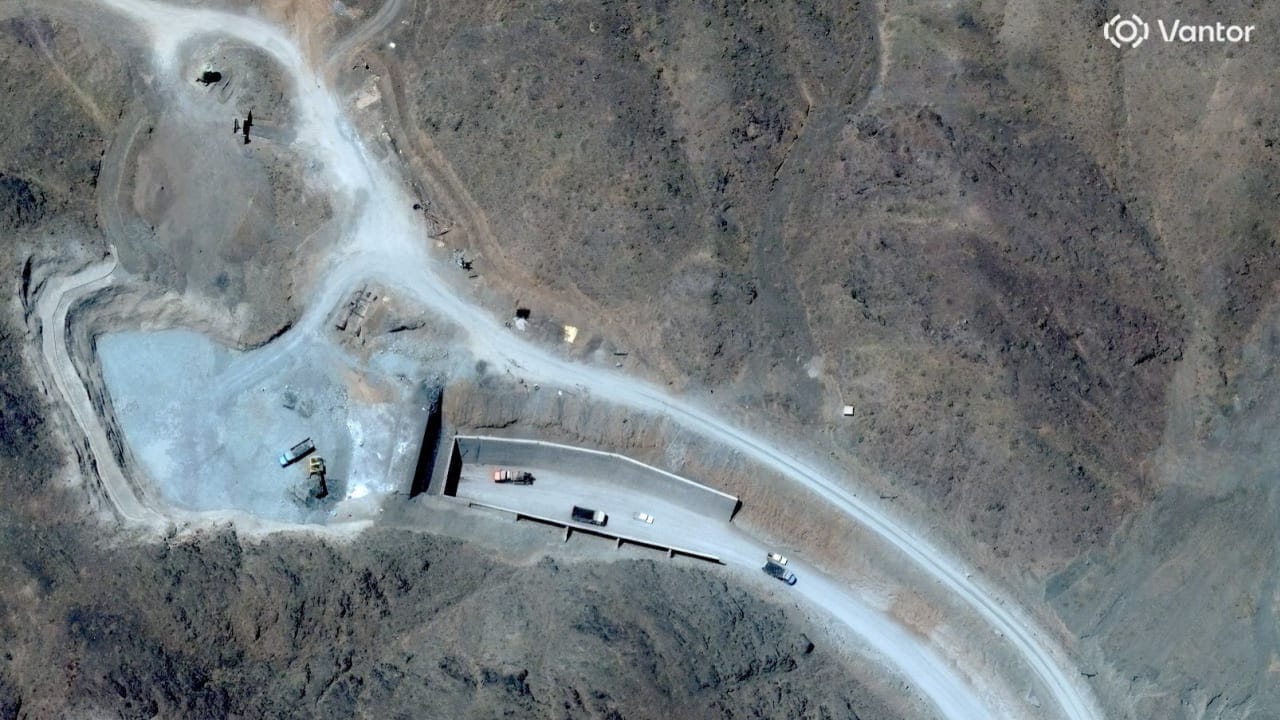
“They refilled their stockpiles,” WSJ quoted former IDF air defense chief Brig.-Gen. Ran Kochav as saying. “They have very impressive industrialization and reconstruction capabilities."Follow us on GoogleA satellite view shows vehicles at an entrance to Pickaxe Mountain tunnels, of the of the Natanz nuclear facility, near Natanz, Iran, June 21, 2026.(photo credit: VANTOR/HANDOUT VIA REUTERS)ByMIRIAM SELA-EITAMJULY 24, 2026 14:25Iran has managed to rebuild infrastructure damaged in US and Israeli airstrikes faster than expected, the Wall Street Journal reported on Thursday, citing satellite imagery of several Iranian military sites.In one instance, the Wall Street Journal noted that satellite imagery from Planet Labs in March showed two tunnel entrances to a reported Iranian missile base, and the adjoining access road that had been damaged by airstrikes near Kangavar in western Iran.According to the Wall Street Journal, satellite imagery accessed through Airbus weeks later showed freshly excavated entrances and a paved road where the destruction had been. In another case, the Wall Street Journal quoted an Israeli military official saying that Iran had succeeded in repairing a bridge that had been destroyed days prior.Planet Labs satellite images, dated to the beginning of July, also showed partial reconstruction efforts at a shipyard in the port of Bandar Anzali on the Caspian Sea, a site affiliated with the Islamic Revolutionary Guard Corps (IRGC).IDF GRAPHIC detailing Iranian Navy targets struck in the Caspian Sea. (credit: IDF SPOKESPERSON'S UNIT)In March, the IDF announced it had struck several Iranian naval targets in the Caspian Sea, including a major Iranian Navy port, at which dozens of ships were destroyed.Prominently among the destroyed vessels were four missile ships equipped with air defenses and anti-submarine missiles, as well as a corvette warship.“They refilled their stockpiles,” the Wall Street Journal quoted former IDF air defense chief Brig.-Gen. Ran Kochav as saying. “They have very impressive industrialization and reconstruction capabilities.”He added that Iran’s rapid recovery is “consistent with skills Iran demonstrated in rebuilding its infrastructure and missile stockpile after the 12-day Israel-Iran war last June.”Israel and the US had often only succeeded in collapsing the surface-level entrances to Iran’s missile bases rather than fully destroying them, the Wall Street Journal reported, meaning that Iran’s weapons stores had been left untouched and waiting to be dug up. Additional satellite imagery from Planet Labs of an Iranian missile base in Dezful, a city in southwestern Iran, that had been struck by Israel in June 2025 and in March 2026, showed that the base's entrances had been buried.However, footage from Airbus three months later reportedly showed Iran already excavating multiple tunnel entrances at the site.Satellite footage from another Iranian base in Kermanshah showed similar activity.Images from the beginning of June showed construction and rebuilding efforts already underway, after the site had been struck at the start of Operations Epic Fury and Roaring Lion.More recently, images from Planet Labs have shown partial reconstruction efforts taking place at Raja Shimi Industries near Tehran, according to a report from King’s College London, according to the Wall Street Journal. Raja Shimi Industries is reportedly involved in producing missile parts.Jim Lamson, a visiting research fellow at King’s College London and former Central Intelligence Agency analyst who wrote the report, was quoted by the Wall Street Journal as saying that facilities that make more advanced missile parts, like carbon fiber, could take Iran months or years to rebuild.However, Lansom noted that it is possible Iran could have stockpiled such components at underground facilities to use in the short term.Iran moved thousands of uranium centrifuges into fortified Pickaxe MountainIran transferred thousands of uranium enrichment centrifuges to underground facilities deep inside Natanz's Pickaxe Mountain last fall, the Wall Street Journal reported on Monday, citing Israeli and US officials.The centrifuges were transferred to the mountain following the 12-day war in June 2025.During the war, American and Israeli strikes pummeled three of Iran’s main nuclear sites, in an operation the US called "Midnight Hammer."US and Israeli officials noted that the transfer of sensitive equipment inside the mountain increases concerns that Tehran is working to ensure continued uranium enrichment, even in the event of a large-scale military attack on its soil.Pickaxe Mountain is located south of the Natanz nuclear complex, the site of two of Iran’s uranium enrichment plants bombed in June 2025.Tzvi Jasper and Idan Kweller contributed to this report.Follow us on Google
Iran repairing missile bases, sites bombed by US, Israel faster than previously anticipated - WSJ
Full Article
Original Source
Read the full article at Jpost →KhanList aggregates and links to publicly available news content. We do not host full articles from third-party sources. Always verify important information with original sources.