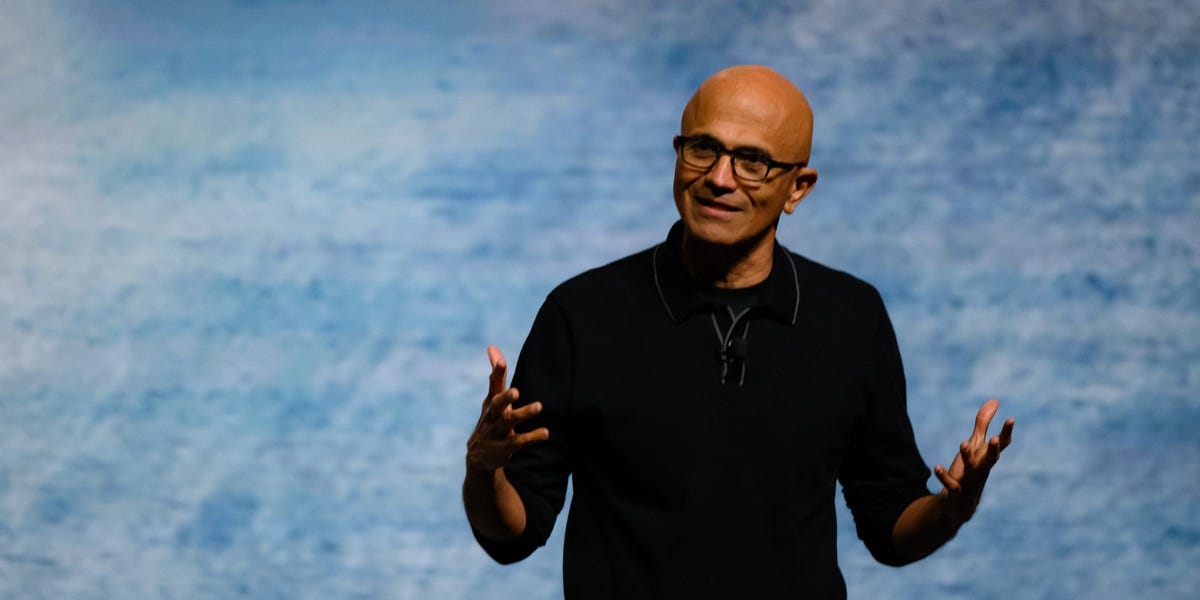
Microsoft CEO Satya Nadella. George Chan/Getty Images Microsoft CEO Satya Nadella says trust in the US's AI technology and its robust training ecosystem will keep it competitive against Chinese products.Nadella was speaking to CNN's Fareed Zakaria on an episode of "GPS on CNN" that aired on Sunday. Zakaria asked Nadella whether Moonshot AI's Kimi K3 — a model that upset US tech stocks — and Chinese technologies have an edge over American products, because they're "much cheaper" and can do what most companies need.Nadella responded that the US has taken an "ecosystem approach" to shore up the competitiveness of its digital sector."It's been about trust in our technology, right? So, for example, if you take the Chinese models, guess where these models run? They run on a lot of the hyperscalers — that are American — all over the world," Nadella said.He added that because the Chinese models are open weight, US companies can monitor, test, and post-train them."I think that one of the things that's lost in this is the understanding even of how the US became competitive in the first place," Nadella said."We became competitive because we took our technology, we built a rich ecosystem where others could participate, in other countries, and trust our stewardship of this ecosystem," he added. "And as long as that remains, we will absolutely be competitive, and we will win." Microsoft has big stakes in the US AI game. The tech giant holds about 27% of OpenAI's for-profit public benefit corporation.American AI companies face fierce competition from Chinese rivals, some of which have released bombshell products that roiled tech stocks.Last year, the emergence of the Chinese AI lab DeepSeek prompted a $1 trillion tech sell-off, one of the first major signs that China could rival US AI capabilities at a much lower cost.In July, Moonshot AI's new AI model, Kimi K3, made waves in the tech sphere for its coding, reasoning, and knowledge work abilities, all of which could rival those of models from Anthropic and OpenAI. Read next Cheryl is the news editor for Business Insider's Asia bureau in Singapore.Her team covers global news, including retail trends, military tech, and US politics. She frequently speaks on international media about top news stories — please email her for booking.As a reporter, Cheryl specializes in the business of nerdworld, covering crews like Critical Role and Dimension 20, as well as new releases in mobile and video gaming.Cheryl joined Business Insider in 2021. She was previously a journalist at the crime and consumer desks at the Straits Times, Singapore's national paper, and a researcher at the Institute of Southeast Asian Studies in Singapore. She has an MA in Cultural and Creative Industries from King's College London.Selected features:The cofounders of nerdworld giant Critical Role are expanding in 5 areas. Here's an inside look at their master plan.Dimension 20 just played a sold-out gig at Madison Square Garden. Here's what is next for one of the nerdworld business' biggest names.Our quest to make AI love us back is futile — and dangerousI watched 60 hours of MyPillow CEO Mike Lindell's 96-hour election-fraud livestream so you don't have to. Here are 5 things you missed.Japan is trying to lure people into rural areas by selling $500 homes, but it's not enough to fix the country's 'ghost town' problemSouth Korea's millennials say their lives aren't that different from 'Squid Game' as they face a crisis of mounting debt, unaffordable homes, and dead-end jobsMore and more Chinese 20-somethings are rejecting the rat race and 'lying flat' after watching their friends work themselves to deathPeople are pouring into the streets in China to protest COVID lockdowns. It's a rare moment of mass dissent, and experts say it's a demonstration to Xi — and the world.
Satya Nadella says trust in US technology will outweigh the allure of cheap Chinese models
Full Article
Original Source
Read the full article at Businessinsider →KhanList aggregates and links to publicly available news content. We do not host full articles from third-party sources. Always verify important information with original sources.