
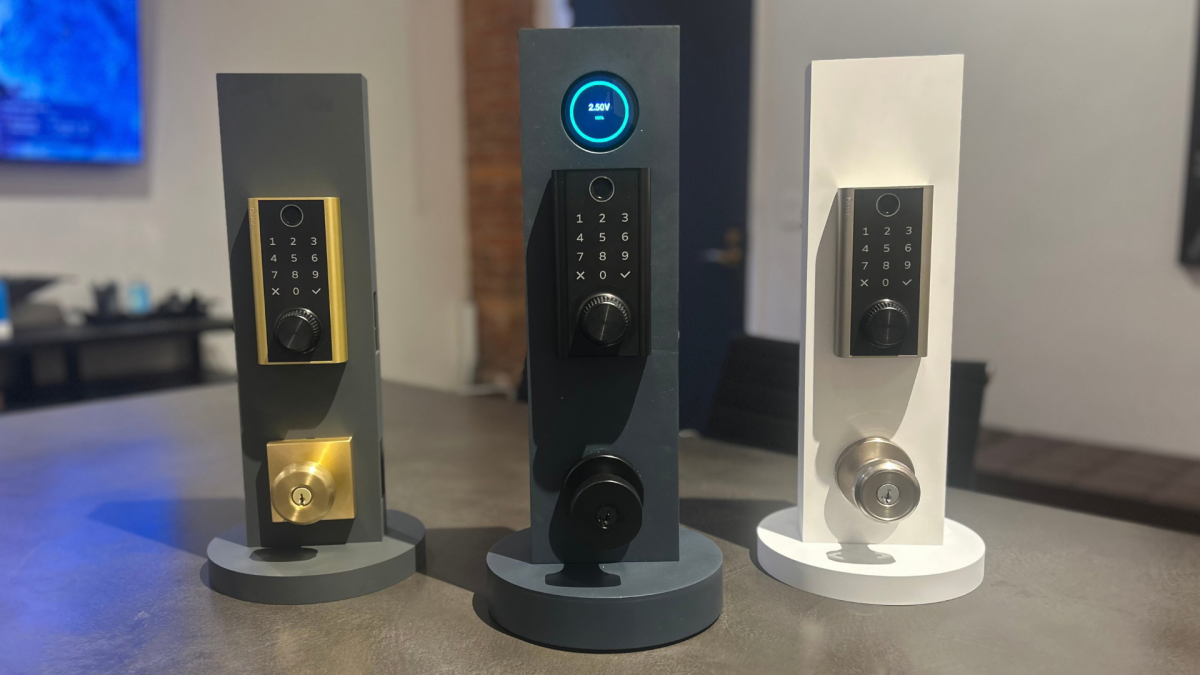
Joel Cunningham Joel Cunningham Deputy Editor ExperienceJoel Cunningham is Lifehacker’s Deputy Editor. He has 15 years of experience as a writer and editor. Previously, he was managing editor of content marketing for Barnes & Noble, where he founded the Barnes & Noble Sci-Fi & Fantasy Blog. Read Full Bio October 7, 2026 Add as a preferred source on Google Add as a preferred source on Google Credit: Joel Cunningham Table of Contents This past summer, I replaced the deadbolt on my front door with a smart lock, and it's possibly the best house upgrade I've ever made. I'm still not over the convenience of being able to leave the house without worrying about where my keys are, or if my absent kids have their keys. The only thing I need to worry about is the battery going dead, as that means the, uh, deadbolt will, too; thus, I still need to make copies of the manual key and figure out where to hide it in case of a lockout. But what if there was a smart lock that you could open without a key, even if the batteries were totally drained?Turns out that Ring built one, and the concept behind it is as simple as it is ingenious. In the first quarter of 2027, the Amazon-owned company, whose name is synonymous with video doorbells, will release its first-ever smart lock, and it will include a truly innovative feature: a built-in "Power Dial" that will allow you to manually generate enough energy to quickly unlock your door, even if the battery is totally dead—no manual key required. I got a chance to preview the mechanism at a meeting with Ring founder Jamie Siminoff, and I walked away kicking myself that I didn't wait to get one.Why Ring's "Power Dial" will stand out among smart locks Credit: Ring / Amazon According to Siminoff, Ring had long resisted stepping into the smart lock market, as he saw no real upside in dropping another virtually identical product into an overcrowded market. But then, when trying to choose a smart lock for his own guest home, located in a remote area, he couldn't find a device he wanted: one that would work reliably every time, even if no one had been at the house to change the batteries, and that didn't require worrying about hiding a backup key in a fake rock somewhere. So he designed one.Inspired by those battery-free flashlights that charge via friction when you turn a crank, Siminoff sketched out plans for a rotating dial built directly into the lock's keypad that could generate enough energy to open it after just a few seconds spent turning it back and forth. Once recharged, the lock will open in all the usual smart lock ways: with a numerical code, or a fingerprint, or the Ring app, or an Alexa request. The Power Dial is a way to "get rid of [the need for a] backup key without the anxiety," said Siminoff, who noted that, considering the pace of technological development (he's able to turn on his Tesla using his phone), "it's insane that we still use keys [to enter our homes]"—pin tumbler locks being essentially unchanged from technology invented nearly 200 years ago. With no keyhole that can be picked, a smart lock can also be that much more secure. What do you think so far? Despite this innovation, when it comes to market early next year (after receiving FCC approval), Ring's smart lock will cost about the same as its competitors, around $250 in one of three finishes (brass, stainless steel, or black). There's no exact release date yet.Ring is also releasing a new line of security cameras Credit: Image courtesy of Ring / Amazon In addition to the new lock, Ring has also announced an expansion of its line of smart security cameras. It's releasing four new indoor and outdoor 4K cameras with (according to the company) improved viewing angles, better low-light recording, and options like true 360-degree panning and 175-degree tilt. These devices are available for purchase or preorder now, ranging in price from $70 to $220. Lifehacker has been a go-to source of tech help and life advice since 2005. Our mission is to offer reliable tech help and credible, practical, science-based life advice to help you live better. Our Mission Our Team Newsletter © 2001-2026 Ziff Davis, LLC., A ZIFF DAVIS COMPANY. ALL RIGHTS RESERVED. Lifehacker is a federally registered trademark of Ziff Davis and may not be used by third parties without explicit permission. The display of third-party trademarks and trade names on this site does not necessarily indicate any affiliation or the endorsement of Lifehacker. If you click an affiliate link and buy a product or service, we may be paid a fee by that merchant.
Ring Designed a Keyless Smart Lock That Can Still Open When the Battery Dies
Full Article
Original Source
Read the full article at Lifehacker →KhanList aggregates and links to publicly available news content. We do not host full articles from third-party sources. Always verify important information with original sources.