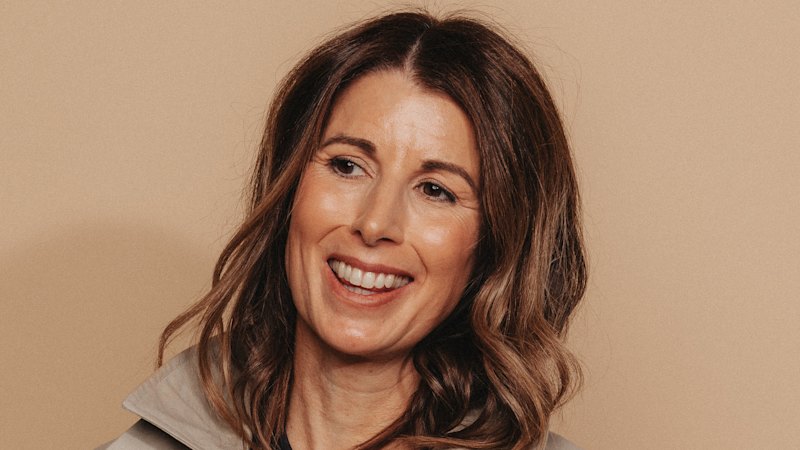
Meg Mason is a bestselling author, winner of British Book Awards Fiction Book of the Year for her hit 2020 novel Sorrow and Bliss (much shortlisted elsewhere as well), and friends with high-profile authors. But she was still surprised that when she approached several novelists to ask if she could use their names in her new book, they all agreed.Sophie, Standing There, her much-anticipated third novel, is set in the backstage world of writers festivals, and while it’s fiction, real authors appear throughout; George Saunders complains about his mic before an in-conversation event; Ann Patchett declines to read an aspiring writer’s short story; Elizabeth Strout cancels a sold-out appearance.“There was no question that I wouldn’t ask their permission, but I was expecting to get one ‘no’ after another,” Mason says over Zoom from her home in Sydney. “Everybody said yes, and I was incredibly relieved. I’ll never get over that. I’ll never believe it! And now I have this incredibly precious file of emails from each of them that are written so much in the style of the author that they are. It’s like having 10 tiny little novels.”Mason with fellow author and good friend Ann Patchett.James BrickwoodMason’s novel is the story of Sophie Pattison, a freelance sound technician who works mostly for literary festivals. Upbeat, friendly, and well liked by her colleagues, Sophie is meticulous in a job she loves, but outside work, she’s desperately lonely; her marriage has recently ended and her brother Laurie, to whom she is very close, lives miles away. She also has a best friend, Emma, but the pair have drifted a little.Sophie is also a book lover, and when, at perhaps her lowest point, she discovers a new work by one of her favourite authors, she throws all her love in that direction, re-reading the author’s books, devouring every interview and podcast she’s done, and falling, in a sense, in love with her.The story is inspired partly by Mason’s time on the festival circuit. “The natural thing would have been for me to write it from the perspective of an author, except I’d sworn up and down that I would never write from the perspective of any author,” she explains. “There is such a disproportionate number of novels about writers. But Sophie ... I sort of feel so much like I am her because we both get to be very near this world that we have a version of in our heads.”Sophie, like Mason, only discovered reading as a young adult and her remove from the ‘talent’ – as the authors at festivals are referred to – resonates with Mason. Which is not what one expects from an established author.“There’s just something I recognise in the idea of being so near and yet so far … close to this world, but not fully in this world.”Or is this, Mason wonders aloud, an Antipodean thing? “Most of my success was in the UK and suddenly, I found myself in the middle of all of these British authors who I’ve loved my entire life. It was like a library come to life. I was having this kind of meta-narrative with myself of thinking, here I am, and I don’t know how I ended up here and there’s this author who I adore, and who am I in relation to these people?”Meg Mason wants her new novel to be “an easy read”.James BrickwoodThe success of Sorrow and Bliss fundamentally changed her life; it’s been published in more than 20 countries, translated into over 30 languages and there’s a screen adaption in the works.“You don’t expect that to happen when you’re 43 and to have to build a slightly new identity around a career that has been very quiet, and suddenly, you’re somewhat known,” she says, before adding, with characteristic understatement, “in the smallest corner of the smallest world in which you can be known.”She quotes novelist David Nicholls here, who once said, “fame for an author is a very mild sensation”. “Which I think captures it perfectly,” she says. “But this was all new to me and so that element is where I found Sophie.”I don’t want to spoil too much about Mason’s new novel, but as well as an affecting exploration of loneliness, Sophie, Standing There turns, in the second half, into something quite different, examining parasocial relationships and the corrosiveness of fame, among other things.It also becomes autobiographical when Mason draws on her own childhood for Sophie’s backstory; Sophie, we learn, came late to reading because she grew up in a strict religious sect.Mason reveals that she had “very, very strict religious upbringing”. “The other day I was like, could I really call it a sect? Then I was like, well, we weren’t allowed to cut our hair, so …”She stresses it was not a cult. “A cult is attached to one personality and a sect is usually attached to ideas that are based on some conventional religion that have just schismed off and started their own thing. It wasn’t personality-driven with a supreme leader. It was just very, incredibly legalistic.”This was in her childhood in rural New Zealand. The sect had around 100 members, and Mason “loved it – like Sophie. I loved it because you don’t know there’s anything odd about it when it’s your childhood and, you know, we lived next door to all our cousins.”There was church twice on Sunday and once during the week. Television was supposedly banned, but “people had televisions, but everybody put a tablecloth over it, and we’d all pretend that no-one knew what was under your tablecloth. And you weren’t allowed to listen to the radio. But my mother was a reader. I don’t know if reading was banned, but it would have been frowned upon because everything was frowned upon! But (while) my mother did read, I just didn’t adopt the habit – and it was a tiny town with no bookshop, no library, so my mum had to really go out of her way to acquire novels.”She compares her experiences to those in Jeanette Winterson’s memoir Why Be Happy When You Could Be Normal. ” There was lots of talk of end times, and an apocalyptic focus, which is a really strange thing to have shadowing you as a child … but we just thought it was completely normal.”It wasn’t until she was 18, when her family moved to Sydney, that Mason fell in love with books. “It was my first period of extreme loneliness – that’s when I discovered that books are for the lonely.” Photo: She wrote Sophie as an earnest, somewhat naive woman, before considering why she was that type of person. “I thought, oh, she’s had this kind of … strict upbringing. But then I thought, ‘ooh, I don’t know, in this moment of only being able to write your own lived experience … maybe I’ll get in trouble, and maybe I’ll get cancelled?’ How do I know anything about a sect? Then – honestly - I was like, oh, because I was in one. I’ll just use that!”Mason feels a little weird discussing the sect because it still exists, “and it was a really good group of people. When I was there, that’s how they understood the world. It just made sense at the time. It’s not until much later that you’re like, oh some of that was a bit curious.”In terms of narrative style, Sophie, Standing There is also unusual. A mix of first and third-person narrative, Mason has used a Russian literary device that uses casual, unstructured storytelling.“It’s called ‘Skaz’, and I had never heard of it when I started doing this! I read about it, latterly, in the amazing George Saunders book A Swim In A Pond With Rain.”Mason wanted to evoke a naivety with Sophie, and it begins with the novel’s opening line which, grammatically speaking, is incorrect. “I thought well, this can never be seen by the world, but it made me laugh, so I kept writing it,” she says. “Then I was suddenly 20,000 words in with this voice. And then I read about Skaz.”Skaz is also often used for narrators trying to sound more sophisticated than they are. “Chekhov uses it – and I use it! Sophie never says ‘I’, but it’s absolutely her monologue. But because she is self-educated, and she’s a late reader, she has flashes of articulateness – which I know isn’t a word! – but then she stumbles, and she says ‘pressurised’ when she means pressured and a lot of her participles dangle. It just felt true.”Chekhov aside, Mason describes her novel as “anti-literary”. “Yes, it’s about that world, but it’s not sophisticated, and it isn’t clever, and it’s hopefully not all in-jokey.”(It’s not in-jokey, but I definitely wouldn’t call the book unsophisticated; it’s already garnered praise from literary heavy-hitters such as Bonnie Garmus and Ann Patchett.)“Hopefully, that makes it an easy read – I don’t want anyone to feel excluded by this book,” she says. “I wanted it to be this really fast read that could almost be a text message. A hundred thousand-word text message!”Sophie, Standing There (4th Estate) is out July 28.What else is happening in the book world?These are all the reasons why you shouldn’t feel guilty about re-reading your favourite novel.This novel has plenty of sex – but it’s far more than a racy read.Can’t get published by the Big Five? Win a major prize instead!Here are five thrilling and chilling new novels to keep you up at night.Our critic shares 10 of the best audiobooks of 2026 (so far).
No books, no haircuts: Meg Mason reveals her childhood in a religious sect
Full Article
Original Source
Read the full article at Smh →KhanList aggregates and links to publicly available news content. We do not host full articles from third-party sources. Always verify important information with original sources.