
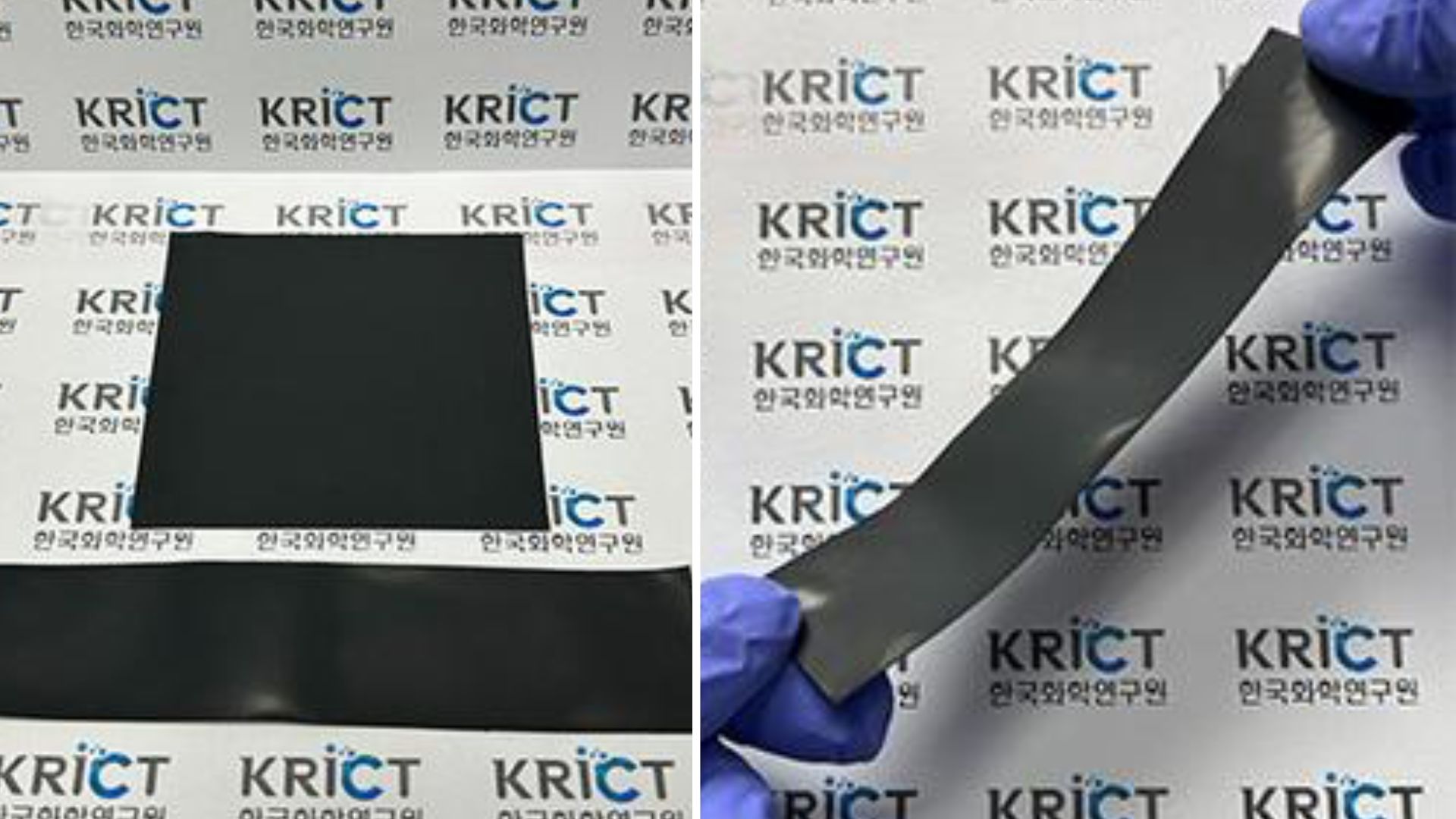
A new ingredient and manufacturing trick can make electric vehicle batteries thicker, longer-lasting, and faster to charge without clogging. South Korean research team has designed a dry thick-film cathode technology using porous graphitic carbon nitride as a cathode additive. This approach overcomes limitations in thick-electrode battery manufacturing, creating higher-energy-density batteries suitable for long-range electric vehicles. Increasing power density Sometimes the deadliest threat to an electric car’s performance could be an atomic pile-up known as an “ion traffic jam.” When drivers mash the accelerator, several lithium ions try to rush through the battery’s thick cathode at once. In thick, energy-dense batteries, this creates a massive issue. Ions get stuck near the surface, power output drops, and half the battery’s potential energy sits uselessly trapped deep inside. Now, South Korean scientists claim to have found the chemical equivalent of opening a fast-pass express lane. A research team led by Dr. San Moon and Dr. Jungdon Suk at the Korea Research Institute of Chemical Technology (KRICT) has integrated a specialized compound into dry battery manufacturing for the first time. The simple additive acts as a molecular “traffic guide,” helping ions slide through the cathode with dramatically less friction. Adding a tiny 0.5 percent dose of graphitic carbon nitride (g-C3N4) by weight to a 68-micrometer-thick dry cathode reduced the energy needed for lithium-ion movement by 56 percent. This single modification delivered a massive boost during hard acceleration, boosting the battery’s high-speed discharge capacity by 165.9 percent from 58.8 to 156.2 mAh/g. The structural improvement ultimately nearly tripled power density. Works for 600 cycles The key lies in nitrogen atoms on the surface of the g-C3N4 structure. These atoms briefly grab passing lithium ions via temporary lithium-nitrogen bonds, stripping away bulky electrolyte solvent molecules and guiding them smoothly into the cathode active material. Apart from speed, the technology tackles a major manufacturing hurdle: the transition to “dry” electrode production. Standard battery manufacturing depends on a “wet” process. Components are mixed with toxic solvents, coated onto foil, and baked in massive industrial ovens. It is slow, energy-intensive, and expensive. As wet electrodes get thicker, the liquid binder migrates unevenly during drying, ruining the battery‘s structure. Dry manufacturing eliminates solvents and ovens, shrinking factory footprints and power bills. But early dry electrodes still struggled with high internal resistance when built thick — until KRICT introduced its nitrogen-rich guide. In long-term testing, pouch-type full cells using the new dry cathode retained 81.3 percent of their capacity after 600 cycles, outperforming typical additive-free electrodes (72.9 percent). The development does come with a catch: balance is everything. Graphitic carbon nitride is inherently a poor conductor; hence, adding too much of it to the mix actually increases resistance. Furthermore, compressed dry electrodes tend to “spring back” and expand over time, twisting internal pathways out of shape. The team stated that commercial success will depend on precisely balancing additive placement, pore structure, and chemical concentration.Although factory-floor testing is still needed to confirm mass-production yields and exact cost savings, the technology provides a clear roadmap for next-generation energy storage. Optimizing internal ion flow enables longer-range, faster-charging EV batteries that hold more power without losing performance.Get the latest in engineering, tech, space & science - delivered daily to your inbox.Mrigakshi is a science journalist who enjoys writing about space exploration, biology, and technological innovations. Her work has been featured in well-known publications including Nature India, Supercluster, The Weather Channel and Astronomy magazine. If you have pitches in mind, please do not hesitate to email her.
New dry-cathode tech eliminates ‘traffic jams’ in thick lithium-ion EV batteries
Full Article
Original Source
Read the full article at Interestingengineering →KhanList aggregates and links to publicly available news content. We do not host full articles from third-party sources. Always verify important information with original sources.