
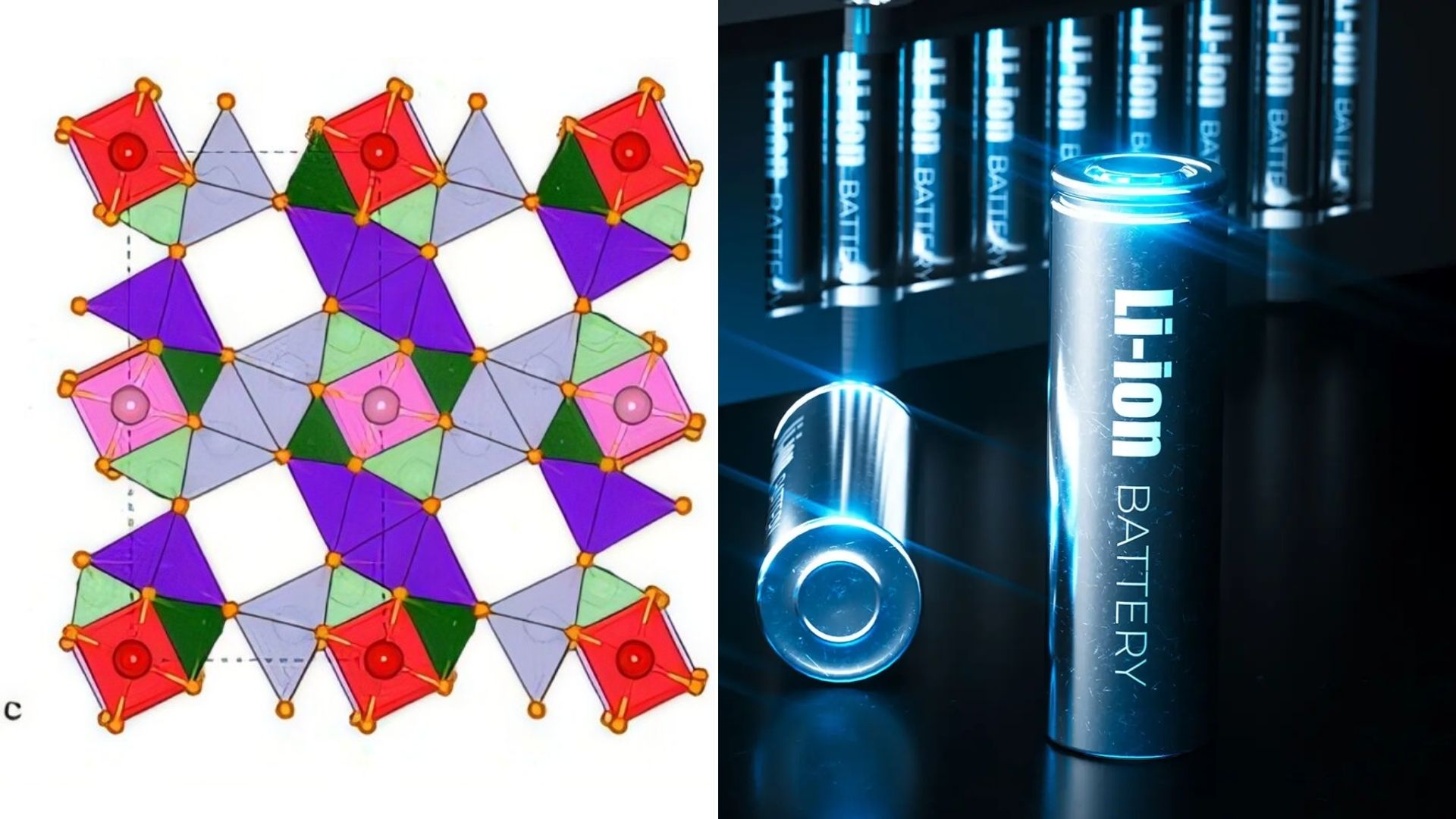
A newly identified crystal framework could help address a key challenge facing all-solid-state lithium batteries: increasing energy density without adding weight. Researchers from the University of Electro-Communications (UEC Tokyo) and Nichia Corporation have investigated a solid electrolyte made primarily from relatively light elements. The material, RbLi(Li₃SiO₄)₂, has a theoretical density of 2.74 grams per cubic centimeter, considerably lower than the 5.12 g/cm³ density cited for some widely studied oxide solid electrolytes containing heavier elements such as lanthanum and zirconium. The researchers found that the material’s crystal structure can support rapid lithium-ion movement through a three-dimensional transport network. However, the team also identified a bottleneck that currently limits conduction in stoichiometric samples, pointing to a possible route for improve the material by changing its composition. A lighter route to solid-state batteries All-solid-state lithium batteries replace the flammable liquid electrolyte found in conventional lithium-ion batteries with a solid electrolyte. This can improve safety while potentially enabling fast charging and higher-performance battery designs. The weight of the solid electrolyte itself, however, can affect a battery’s gravimetric energy density and the amount of energy it can store relative to its mass. The researchers therefore turned to the UCr₄C₄-type crystal framework of RbLi(Li₃SiO₄)₂. The material has a monoclinic crystal structure and a theoretical density of 2.74 g/cm³. At first glance, the framework appears to provide one-dimensional pathways for lithium ions along one crystallographic direction. Computational simulations, however, showed that these channels connect with one another, creating a three-dimensional network through which lithium ions can move. That interconnected structure could help prevent localized crystal defects from completely blocking ion transport. Lithium ions face an unusually low migration barrier The researchers used experimental synthesis alongside computational methods, including preferred potential molecular dynamics and density functional theory calculations, to investigate how lithium moves through the material. Their simulations found a lithium-ion migration barrier of just 0.30 electron volts (eV) through interstitial sites. A lower migration barrier generally means that ions can move through a material more readily. The researchers attributed the low barrier to strong Coulombic repulsion between neighboring lithium ions. The reported value is also close to the 0.26 eV migration barrier cited for garnet-type Li₇La₃Zr₂O₁₂, a benchmark solid electrolyte that contains substantially heavier elements. The result suggests that the crystal framework has the structural characteristics needed for fast lithium-ion transport. But low ion-migration energy alone does not guarantee high overall conductivity. Defects are the current bottleneck The team found that the main limitation in stoichiometric RbLi(Li₃SiO₄)₂ samples is not the movement of lithium ions once a transport site is available. Instead, creating the lithium defects needed for that movement requires substantially more energy. According to the researchers‘ calculations, lithium defect formation requires 1.26 eV—far higher than the 0.30 eV required for lithium migration. This difference makes defect formation the rate-limiting step in the material’s overall ionic conduction. The researchers therefore propose lithium-rich compositions as a way to address the bottleneck. Increasing the lithium content could make the necessary defects more readily available, allowing the low migration barrier of the underlying crystal framework to contribute more fully to ionic conductivity. “Our findings demonstrate that the previously overlooked UCr₄C₄-type framework serves as a highly active platform for lithium-ion conduction,” said Jun Nakamura, a professor at UEC Tokyo. The findings provide what the researchers describe as a compositional roadmap for developing lighter solid electrolytes for all-solid-state batteries. The work, published in Advanced Functional Materials, does not demonstrate a complete battery using the new material. Instead, it identifies a promising electrolyte framework and a specific materials-design strategy for addressing its current conduction bottleneck. Further work will be needed to determine whether lithium-rich versions can deliver the predicted improvements and how the material performs when incorporated into practical battery cells. Get the latest in engineering, tech, space & science - delivered daily to your inbox.Kaif Shaikh is a journalist and writer passionate about turning complex information into clear, impactful stories. His writing covers technology, sustainability, geopolitics, and occasionally fiction. A graduate in Journalism and Mass Communication, his work has appeared in the Times of India and beyond. After a near-fatal experience, Kaif began seeing both stories and silences differently. Outside work, he juggles far too many projects and passions, but always makes time to read, reflect, and hold onto the thread of wonder.
New crystal could help make solid-state batteries lighter without sacrificing speed
Full Article
Original Source
Read the full article at Interestingengineering →KhanList aggregates and links to publicly available news content. We do not host full articles from third-party sources. Always verify important information with original sources.