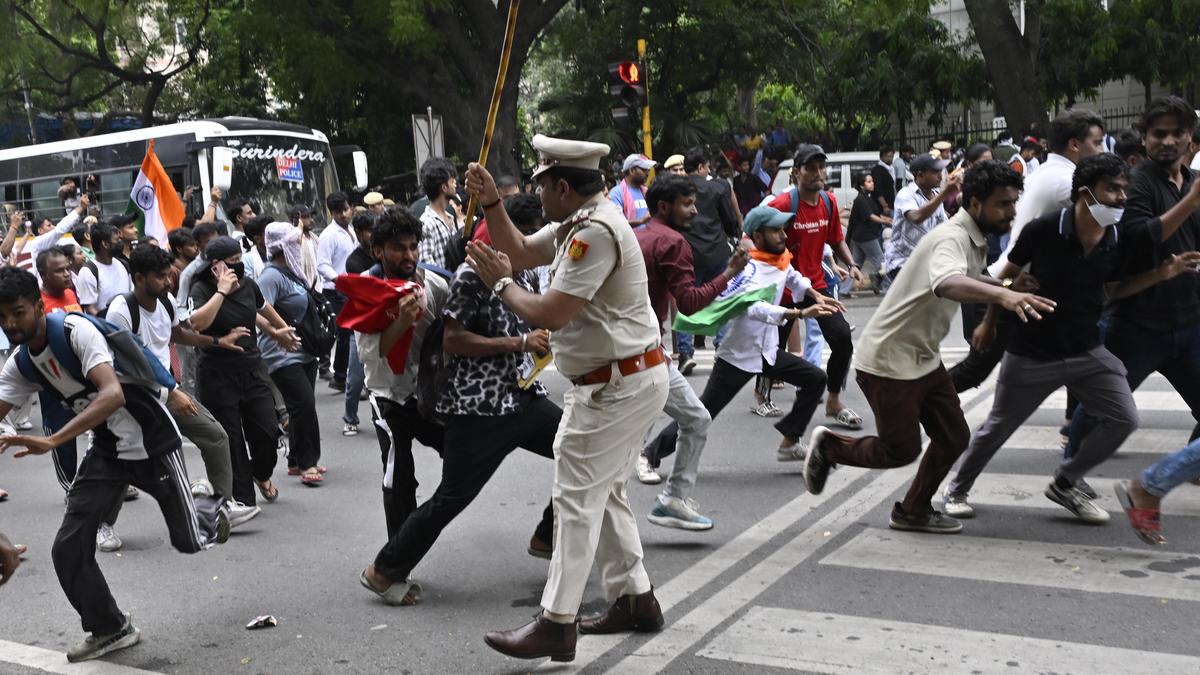
Police personnel using lathi charge to disperse supporters of the Cockroach Janta Party (CJP) during a protest march, near Parliament House, in New Delhi on Monday, July 20, 2026 | Photo Credit: SHIV KUMAR PUSHPAKAR The police response to the Cockroach Janta Party’s (CJP) “Chalo Sansad” march earlier this week has once again put the spotlight on the limits of police power. As videos showing the use of tear gas, pellet guns and lathi charges during the protest circulated widely, the incident reignited questions over when force may be used, the safeguards governing arrests, and the balance between maintaining public order and protecting civil liberties.Under the Bharatiya Nagarik Suraksha Sanhita (BNSS), force may be used to disperse an unlawful assembly only after an order to disperse is disobeyed, and the Code of Conduct for the Police in India says officers should first rely on persuasion, advice and warning, using only the irreducible minimum force when force becomes unavoidable. The NHRC’s Manual on Human Rights for Police Officers similarly describes democratic policing as protecting “the rights of citizens and the rule of law.”Yet a nationwide survey of police personnel suggests that many officers themselves favour broader coercive powers than those contemplated under these legal standards. The findings come from the Status of Policing in India Report 2025, the sixth report in the Status of Policing in India (SPIR) series brought out by Common Cause and the Lokniti programme of the Centre for the Study of Developing Societies (CSDS) since 2018. The report surveyed 6,000 police personnel across 17 States and Union Territories on policing practices, institutional attitudes and the criminal justice system.Perhaps the most striking finding concerns police powers. More than 70% personnel agreed that police should be allowed to use force without fear of punishment in order to properly discharge their responsibilities.Nearly as many (69%) believed police should be allowed to arrest and detain suspected criminals without any court investigation. It shows the support for expanding police discretion even where the law subjects the exercise of these powers to judicial oversight and constitutional safeguards.Attitudes towards the use of force also stand out. More than half of the respondents (55%) considered it either very or somewhat important for the police to use “tough methods” to create fear among the public.And around two-thirds said public pressure influences the police to deal with suspected criminals with a “heavy hand” to at least some extent.Moreover, preventive policing is preferred. Nearly half of the respondents (48%) said more preventive arrests of “anti-social elements” would be very useful in reducing crime, while another 36% considered them somewhat usefulThe survey also raises questions about perceptions of due process after arrest. Only 41% of police personnel said statutory arrest procedures are always followed. These procedures include informing the arrested person of the grounds of arrest, preparing arrest and inspection memos, notifying family members, ensuring a medical examination and informing the accused of the right to contact a lawyer.Only about one-third (32%) believed an arrested person should be allowed to meet a lawyer immediately. An equal proportion said access should depend on the investigating officer’s decision, while 17% believed a lawyer should be allowed only after the accused is produced before a judicial magistrate. Nearly one in ten respondents said lawyers should either not be permitted before a person is produced before a magistrate or were simply unavailable.Just 14% of police personnel believed an accused should always be allowed to speak privately with a lawyer in police custody.The findings do not establish how police behave in any specific protest or investigation. However, they offer a glimpse into institutional attitudes within the force. As debates over protest policing continue following the CJP march, the survey highlights a broader question: whether the police culture reflected in these responses aligns with the legal standards governing the use of force, arrests and civil liberties.The report itself notes that “India’s otherwise robust crime data begins to waver when it comes to incidents of torture or deaths in custody” and that the available data is “inaccurate and inconsistent,” arguing that better data is essential to understand patterns of police excess and accountability. (With inputs from Gandla Sneha) Published - July 28, 2026 08:00 am IST
More than 70% police personnel believe they should be allowed to use force without punishment : 2025 survey
Full Article
Original Source
Read the full article at Thehindu →KhanList aggregates and links to publicly available news content. We do not host full articles from third-party sources. Always verify important information with original sources.