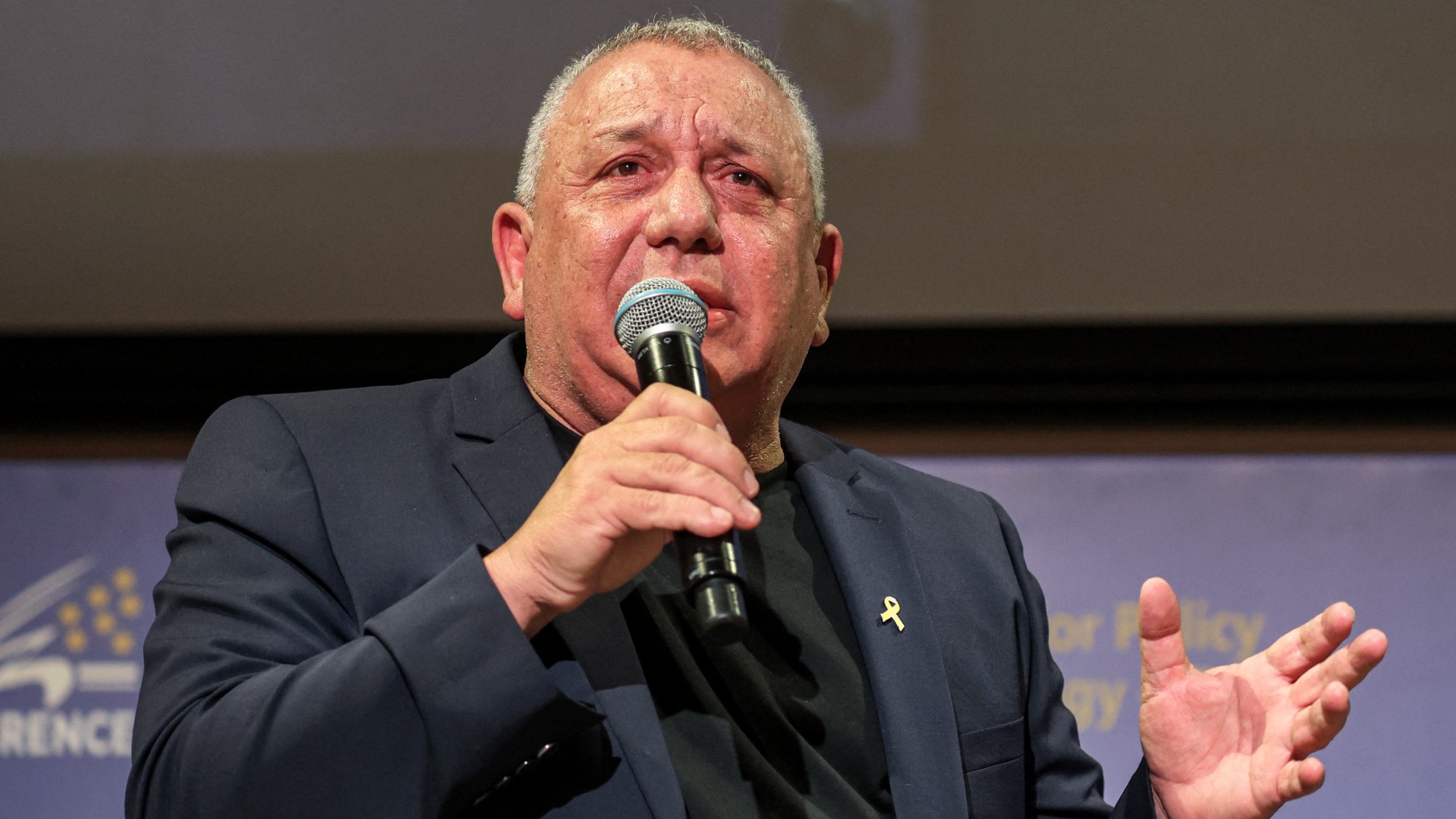
Three months from now, Israeli Prime Minister Benjamin Netanyahu will face the toughest election of his political career. The fallout from the Hamas-led attacks of 7 October 2023, Israel's military campaigns across the Middle East and the contentious issue of conscripting ultra-Orthodox Jewish men have reshaped the country's political landscape, eroding support for Netanyahu and his governing coalition. At the centre of that shift is Gadi Eisenkot, the former army chief who has emerged as the prime minister's strongest challenger. With Israelis due to vote on 27 October, opinion polls consistently suggest that Netanyahu's Likud party and its allies are struggling to secure the 61-seat parliamentary majority needed to form a government. Eisenkot now leads a broad opposition bloc spanning right-wing, centrist, left-wing Jewish and Palestinian parties, with recent polling suggesting he has the strongest chance yet of ending Netanyahu's long grip on power. New MEE newsletter: Jerusalem Dispatch Sign up to get the latest insights and analysis on Israel-Palestine, alongside Turkey Unpacked and other MEE newsletters Middle East Eye takes a closer look at the former military commander who could become Israel's next prime minister. From humble beginnings to chief of staff Eisenkot was born in 1960 in Tiberias to Moroccan Jewish immigrants before growing up in Eilat, Israel's southernmost city. After finishing school in 1978, he enlisted in the Israeli army, beginning a military career that culminated in his appointment as chief of staff in 2015 and ended with his retirement in 2019 after four years in the role. Over four decades, Eisenkot rose through the military's ranks, holding a series of senior command positions. During the Second Intifada in the early 2000s, he commanded Israeli forces in the occupied West Bank before going on to lead the military's influential Operations Directorate and later its Northern Command. It was as head of the Northern Command that Eisenkot became most closely associated with the "Dahieh Doctrine", named after Beirut's predominantly Shia southern suburbs. 'The level of violence and fascism of this government led the Palestinian public to want someone normal, someone they can see as a partner for dialogue' - Amal Oraby, Palestinian human rights lawyer The doctrine advocates the overwhelming use of military force against civilian infrastructure in areas from which attacks are launched, with the aim of inflicting extensive destruction to achieve military objectives. Speaking to Yedioth Ahronoth in 2008, Eisenkot outlined the strategy. "In every village from which they fire at Israel, we will use disproportionate force and cause tremendous damage and destruction there." He added that "from our standpoint, these are military bases", making clear that villages from which attacks originated would be treated as legitimate military targets. Seven years later, Netanyahu appointed Eisenkot as chief of staff, replacing Benny Gantz after serving as his deputy. During Gantz's tenure as chief of staff, with Eisenkot serving as his deputy, the Israeli military killed more than 2,000 Palestinians during the 2014 war on Gaza, which remained Netanyahu's longest military campaign until 2023. "The Middle East is falling apart. States are collapsing. Into this vacuum an empire is charging: Iran. It aspires to arm itself with nuclear weapons," Netanyahu said as Eisenkot took office in 2015. "The people of Israel trust you, the government of Israel trusts you, and Gadi, I trust you," the prime minister added. "We will strive to deter the enemy, keep war at bay, threaten and win," Eisenkot said upon assuming command. Gadi Eisenkot places a prayer note in the Western Wall, Judaism's holiest site, on 16 February 2015 (Gil Cohen Magen/AFP) A decade later, the relationship between the two men would be transformed from cooperation to political rivalry. Although Eisenkot's tenure did not include a military offensive on the scale of the 2014 Gaza war, violence escalated in the occupied Palestinian territories. During the 2018-19 Great March of Return protests along the Gaza-Israel fence, Israeli forces killed more than 200 Palestinians and wounded thousands more, many of them shot while approaching the barrier. One of the defining moments of Eisenkot's tenure came in 2016 following the killing of Abdel Fattah al-Sharif by Israeli soldier Elor Azaria in the occupied West Bank. After Sharif, who had carried out a stabbing attack, lay wounded on the ground in Hebron's Tel Rumeida neighbourhood, Azaria shot him in the head, an incident captured on video that sparked widespread condemnation. 'Angel of destruction': What made Benjamin Netanyahu? Read More » Despite pressure from right-wing politicians and protesters, Eisenkot insisted Azaria stand trial before a military court, arguing that the soldier had violated the army's ethical code. Azaria was ultimately sentenced to 18 months in prison, although Eisenkot later approved a reduction of his sentence to 14 months. Azaria was released after serving nine months and never expressed remorse. After retiring from the military, Eisenkot entered politics in 2022, joining his former commander, Benny Gantz, in the right-wing-centrist National Unity party. He was elected to the Knesset, the Israeli parliament, later that year after Netanyahu returned to power. The Hamas-led attacks of 7 October prompted National Unity to join Netanyahu's emergency government, with both Gantz and Eisenkot taking seats in Israel's war cabinet. But tensions between the two former generals and the prime minister soon became increasingly public. Eisenkot repeatedly criticised Netanyahu's conduct of the war, accusing him of failing to prioritise the return of the 251 captives taken by Hamas during the 7 October attacks. He argued that political pressure from far-right coalition partners Bezalel Smotrich and Itamar Ben Gvir had undermined efforts to secure a deal. "Forty-six hostages who should have returned did not return, some of whom we could have brought back," Eisenkot told Channel 12 News in January. "We made mistakes," he said, accusing Netanyahu of having "sabotaged" an agreement with Hamas early in the war after initially approving it. "Everyone who held a command or leadership position must pay a price and go home," Eisenkot added, referring to both political and military leaders who were in office during the 7 October attacks. His appeal In September 2025, Eisenkot left Benny Gantz's increasingly unpopular National Unity party to launch his own political movement, Yashar - Hebrew for "straight" or "honest". Announcing the new party, Eisenkot said it would work towards "repair, healing, and hope for Israeli society" while placing "the security and national interests of the State of Israel above every other consideration", in a thinly veiled criticism of Netanyahu, whom he has repeatedly accused of prioritising his political survival over the country's interests. The gamble appears to have paid off. Recent opinion polls have consistently placed Yashar among Israel's leading parties, with some surveys putting it ahead of Likud and suggesting the opposition would have enough seats to form a governing coalition. But Dahlia Scheindlin, an Israeli political analyst, said Eisenkot's rise reflects broader political trends rather than personal popularity alone. "Some of the support for Eisenkot is not because of him," Scheindlin told MEE. "There is a whole constituency who opposed Netanyahu since the first months of the government's formation." Why Iran could be the one to finally kill Netanyahu’s career Read More » She pointed to the mass protests against the government's judicial overhaul in 2023, arguing that anti-Netanyahu voters have been searching for a credible opposition leader ever since. "This camp is not small," she said. "Its support first went to Gantz after October 7 and later to [former Prime Minister Naftali] Bennett. It's not really thanks to Eisenkot, but because there is a political camp searching for a leader." Eisenkot's military career has also bolstered his standing, Scheindlin said. "Military leaders enjoy public support since the founding of the state, due to the high level of trust the Israeli public places in the army." Like other former generals who entered politics, she said, Eisenkot is widely viewed as "efficient, pragmatic, and professional". In addition, Scheindlin argues that Eisenkot's personal story is also a strong factor working in the former general's favour. Between October 2023 and November 2024, his son, Gal, and two nephews were killed during Israel's military assault on Gaza. "He lost his son and two nephews while the government sealed its heart to the bereaved families and to the suffering of people, at a time when most Israelis wanted a deal," Scheindlin said. She argued that Eisenkot is seen by many Israelis "as someone who himself suffered along with the people and sacrificed his son and nephews". "This creates a contrast between him and Netanyahu," she added. "It generates anger towards the government and channels public rage towards it." His background has also become part of his political identity. If elected, Eisenkot would become Israel's first Mizrahi prime minister. The son of Moroccan Jewish immigrants, he has recently been the target of what critics describe as racist attacks from Netanyahu's campaign. Mizrahim, Jews whose families originated in the Middle East and North Africa, have long faced discrimination from Israel's historically dominant Ashkenazi political and social elite. "My parents immigrated from Morocco, and I am proud of them and of my origins, but I would be glad if, first and foremost, we were proud to be Israelis," Eisenkot said amid attacks from Netanyahu's Likud party, which has long presented itself as the political home of many Mizrahi voters. Amal Oraby, a Palestinian human rights lawyer, said Eisenkot has also generated a measure of goodwill among Palestinian citizens of Israel. "He has a good starting point in the Palestinian society in Israel," Oraby told MEE. "Unlike Benny Gantz, Eisenkot did not conduct a war against the Palestinians when he was chief of staff." "Despite the disappointment of the Palestinian public in Israel with generals, Eisenkot's image isn't bad, also because he doesn't run a racist campaign," he added. While Oraby noted that Eisenkot has largely remained silent as opposition parties compete to adopt increasingly hardline rhetoric towards Palestinian citizens of Israel, he argued that many Palestinians nevertheless see him as a more pragmatic figure than Netanyahu. "My father says: 'Netanyahu made us miss Golda [Meir] and [Menachem] Begin,'" Oraby said. "The level of violence and fascism of this government led the Palestinian public to want someone normal, someone they can see as a partner for dialogue." Eisenkot's plans and how he would deal with Palestinians Eisenkot has presented himself as a leader focused on repairing Israel's political divisions after nearly three years of war. "The difficult and prolonged war has exposed the depth of the rift and the need for a different kind of leadership - professional, unifying and committed to democratic conduct," his Yashar party says on its website. The party has pledged to prioritise the conscription of ultra-Orthodox Jewish men, strengthen democratic institutions and ease political polarisation. Earlier this month, Eisenkot also vowed to repeal legislation passed by Netanyahu's government, accusing the prime minister of weakening the military by refusing to conscript ultra-Orthodox men. But analysts say Eisenkot has remained deliberately vague on many of the issues likely to define his premiership, particularly the Israeli-Palestinian conflict. "Eisenkot says nothing," Scheindlin told MEE. "He focuses on things that can be implemented immediately and on his personal life story." 'It's possible that centrist voters think Eisenkot has a willingness to reach some kind of agreement with the Palestinians' - Dahlia Scheindlin, Israeli political analyst She argued that his ambiguity extends even to issues that have dominated Israeli politics, including the judicial overhaul that triggered mass protests in 2023. "His advisers have adopted the approach that there's no need to talk about the Palestinian issue," Scheindlin said. "It's possible that centrist voters think Eisenkot has a willingness to reach some kind of agreement with the Palestinians, but he's like a blank canvas onto which you project all your wishes." Oraby said Eisenkot appears to favour a return to Israel's long-standing policy of managing, rather than resolving, the conflict. "Eisenkot wants to return to the conflict-management policy," Oraby said, referring to an approach largely abandoned under Netanyahu's current government. Even so, Oraby argued that many Palestinians view Eisenkot as a more pragmatic figure. "Palestinians can take comfort in the fact that he is not a settler," he said, referring to the ongoing war in Gaza and Israeli policies in the occupied West Bank. But Oraby said Eisenkot has made little effort to engage Palestinian citizens of Israel directly. "He doesn't speak to the Palestinian electorate as a public he wants to persuade," Oraby said, adding that Eisenkot has offered no proposals to tackle violent crime in Palestinian communities inside Israel. Since the beginning of the year, about 150 Palestinian citizens of Israel have been killed in criminal violence, with most cases remaining unsolved. "There is an understanding among the Palestinian public in Israel that a government led by Eisenkot won't perform miracles and certainly won't resolve the Israeli-Palestinian conflict," Oraby said. "The Palestinian public wants a return to normalcy." Scheindlin largely agreed, arguing that the main distinction between Eisenkot and Netanyahu lies less in their long-term vision than in their political style. "While Eisenkot is vague, he doesn't want to establish the Kingdom of Judah that controls the entire territory and expels Palestinians," she said. "That's the meaning of pragmatic. He won't move toward a fundamentalist vision." Eisenkot's own comments suggest he favours maintaining Israeli control over parts of the occupied West Bank while opposing outright annexation. "A reality in which we annex the Palestinians to Israel would be a severe threat to the Zionist project," he told Channel 13, adding that settlement construction should continue within the framework of Israeli law. "I have never spoken about a Palestinian state," Eisenkot said on Monday, fending off criticism that he is a left-wing candidate, but also adding that he will do everything he can so that Smotrich's annexation plan of the West Bank will not be accomplished. "The idea is foolish, it's a completely insane thing," Eisenkot said, arguing that Israel needed to separate "between terror and the population," referring to the Palestinians. On Gaza, Eisenkot has argued that Hamas should be replaced by a reformed Palestinian Authority. "The Palestinian Authority in Gaza is a less bad solution than Hamas," he told i24News last month. "Hamas must be eliminated as a military and governmental force, and a different leadership must arise, one affiliated with an upgraded Palestinian Authority, which will undergo a thorough process of de-radicalisation." Can Eisenkot become prime minister? Whether Eisenkot can translate his strong polling into electoral victory remains uncertain. "His chances aren't bad," Scheindlin told MEE. She noted that opposition parties have consistently held a majority in most opinion polls since Netanyahu returned to power. "For three and a half years now the opposition parties have had a majority in most public opinion polls," she said, arguing that it is now "much harder for Likud to form a government after the elections." Much may depend on whether Eisenkot is willing to work with Palestinian parties in the Knesset. "The Palestinian public wants to bring down the current government," Amal Oraby told MEE, adding that many Palestinian citizens of Israel say: "We are willing to do anything to unseat Netanyahu." The world must stop Israel's unprecedented assault on Palestinian children Read More » But he cautioned that "the sentiment against the involvement of Arab parties in the government is so strong that it's not certain Eisenkot has the courage to do that". In most opinion polls, Eisenkot's Yashar party and its Jewish opposition allies fall short of the 61-seat majority needed to form a government without support from Palestinian parties. Together, the Islamist and conservative United Arab List party - commonly known by its Hebrew acronym Raam - and the socialist Hadash-Taal alliance are projected to win around 10 seats, potentially making them kingmakers in coalition negotiations. Scheindlin argued that many opposition parties have unnecessarily limited their coalition options by refusing to work with Palestinian parties. Eisenkot, however, has left the door open, at least with Raam. "He leaves the door open to cooperation with Raam," Scheindlin said, noting that Eisenkot's three core principles - maintaining Israel as a Jewish and democratic state, upholding the values of the Declaration of Independence, and supporting military or national service - could provide common ground with the party. She said Eisenkot's emphasis on national service, a civilian alternative to military service supported by Raam, is widely viewed as a signal that he would be willing to include the party in a future coalition. Even so, Scheindlin warned that Netanyahu remains a formidable political opponent despite his coalition's weak polling. By consolidating support on the right and reshaping his coalition before the election, "there's a not-small chance that Netanyahu will be able to form a government", she said. Even if neither side secures a parliamentary majority, Scheindlin said Netanyahu could still force Israel into yet another round of elections, a scenario that has repeatedly prolonged his time in office.
Who is Gadi Eisenkot, the former army chief challenging Netanyahu?
Full Article
Original Source
Read the full article at Middleeasteye →KhanList aggregates and links to publicly available news content. We do not host full articles from third-party sources. Always verify important information with original sources.