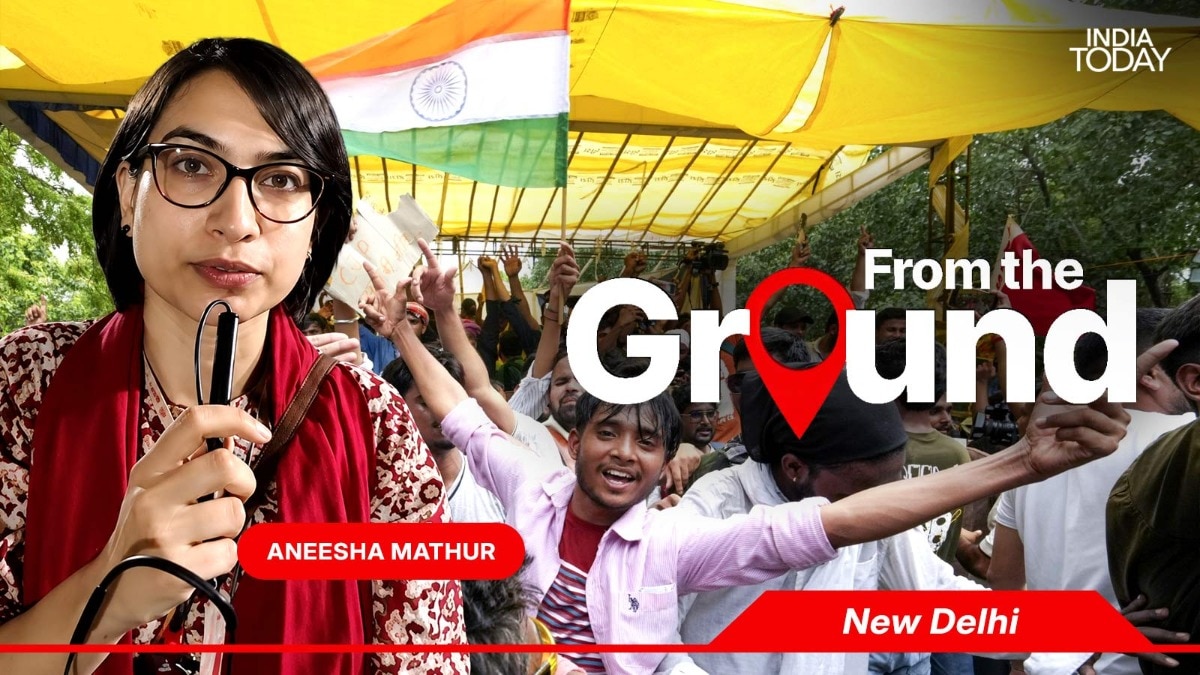
As a Delhi-centric reporter, I have covered several protests over the years, from the land acquisition protests in Noida in 2008 to the emotional outpouring of the Nirbhaya protests in 2012, political rallies, the 'Not In My Name' movement and the highly charged tribal sit-ins against the Manipur violence. I have seen many iterations of protest, but there is something different about a Gen Z protest.I have spent only one night at Jantar Mantar during what has now been almost a month of what we in the media have been calling the Gen Z protest over the NEET paper leak issue.Coincidentally, it turned out to be the night of July 23, when Sonam Wangchuk finally broke his fast around 11 pm on the 26th day. The most striking difference between these protesters and any other protest I have seen is the sheer irreverent seriousness of it all.In a political protest, or even one centred on a grave social issue such as sexual violence or religious violence, you usually see solemn, agitated faces, political naarebaazi and a palpable sense of urgency. These kids had none of that. Yes, they are deadly serious about what they want and are willing to sit there for as long as it takes to get it, but with a decided "why so serious?" attitude. The posters offer the first glimpse of it. The usual political placards saying "Istifa do" or "Nyay karo" are largely missing.Instead, I saw young people carrying memes as posters. "Nolan is showing The Odyssey, this b** is showing audacity" is one that I suspect will stay with me for a while. Loudspeakers blasted music from the stage as though it were a rave rather than a protest. I entered the site to find the crowd dancing and chanting to "Hum Indiawaale" from Happy New Year, followed by "Chak De India". Handheld fans and posters were raised in the air as everyone danced and jumped with abandon. The buzz reminded me of a college fest.As a woman reporter, one thing I always have at the back of my mind is keeping myself safe in a crowd. Here, that warning light in the back of my head simply didn't go off.Right at the entrance, where the police had set up barricades and door-frame metal detectors, a human chain of volunteers took over. People entering passed through one scanner, while those exiting were directed through another.The volunteers manning the entrance were polite but firm. The entry to the stage was right next to this barricade, making them doubly strict about anyone lingering there to take photographs."Please keep the line moving. Keep some distance from each other," shouted a young man perched on top of a barricade as though it were a horse.And the crowd itself was astonishingly well behaved. There was a long line, an actual line, of people waiting to get in. No pushing, no shoving, no attempts to jump the queue. These protesters were perfectly happy to stand patiently while making videos and taking selfies with their posters. I actually got a few disapproving looks when I walked towards the entrance instead of joining the queue.It was the volunteer sitting atop the barricade who stopped me."Ma'am, ye exit wala hai. Entry idhar hai. Exit wale se mat aaiye, crowd block ho jata hai."I entered the Jantar Mantar area around 11.30 pm on Thursday. My office car dropped me comfortably at Ashok Circle, near Kerala House. A large bus had been parked as a barricade to block Jantar Mantar Road, leaving just enough space for a car to pass through the yellow barricades if the police permitted it.Even at that hour, there was a river of humanity streaming through the gap towards the protest site -- youngsters, families and groups of friends.Then came a narrowing of the road through another set of barricades. This is where the television cameras and media crews stood, slightly removed from the crowd but watching everything unfold. Next to them were RAF vehicles and Delhi Police's mobile surveillance Ikshana unit, the one whose AI facial recognition technology has now become the centre of a major controversy. Just ahead lay the entrance to the main stage area.The back of the large stage and the barricades protecting it formed a wall.This line of barricades was where the queue to enter the main protest site began, winding its way between the two barricade walls. It was also where people stopped to give interviews, make reels and shoot videos.On one side lay the pavement, lined with tarpaulins where some of the exhausted protesters had curled up to sleep.As you entered the main area, barricades created a narrow gallery separating the pavement from the stage before opening into the larger space where protesters had been sitting, sleeping and living for the past 25 days.Just before the space opened into the crowd, there was a stall distributing water and chai."Modiji ki chai hai kya?" shouted a man walking in.Almost instantly, someone shot back, "Unki nahi hai... chai bhi hamari hai, desh bhi hamara hai."Nothing rehearsed. Just quick-fire banter.Inside was a sea of protesters.Many belonged to seasoned student organisations, carrying banners and dhaplis bearing the names of AISA, SFI, KYS and others. They appeared more organised, sitting on chatais in circles and raising slogans I had heard countless times before. This was the more familiar face of an anti-establishment protest.But they were vastly outnumbered by the so-called "non-affiliated" protesters, the unfiltered, irreverent ones with quirky posters, unusual outfits, and an almost constant cycle of filming videos and making reels.When I asked some of them whether they knew Sonam Wangchuk had broken his fast, they looked at me with suspicion."How do you know? There's no internet and nothing has been announced from the stage."They did not take my word for it. They did not immediately celebrate what another political protest might have considered a victory. They were cautious of information coming from a reporter representing a large media organisation.Meanwhile, CJP spokespersons remained near the stage, fielding calls and speaking to television cameras. Yet no announcement about Wangchuk ending his fast was made from the stage during the next couple of hours that I remained there. The news spread slowly, person to person.I stayed at the protest site until a little after 3 am.Even then, people were still arriving.Many were overworked millennials who had dropped in after finishing work. Families arrived with young children."I wanted to show my son this is for him. Agar hum aaj aage nahi badhenge toh inka kya hoga," said a young mother standing in line close to midnight with her six-year-old son.While I was interviewing her, a few younger protesters quietly held up a poster behind her that read, "The police don't stop crime, they stop revolutions."They did not shout slogans or interrupt the interview the way organised political groups often do. They simply placed the poster in the camera frame, their own faces covered.The way the protest site was structured, with so many groups choosing to remain outside the main stage area to film videos, also produced some unintentionally funny moments.One rather confused millennial, still dressed in office clothes, walked up to me."I came straight from office... is the protest the one inside the barricade or is it here?"He looked around at the queue and the multiple groups making reels and videos at 1 am, genuinely unsure.Another man told me he had accompanied his office interns to the protest. At 40, it was his first time attending one."I wasn't sure about coming, but the interns are here from Mumbai and I wanted to make sure they're safe," he said with the bewildered air of a mama duck whose ducklings had wandered off."I know this is an important issue, but it's almost 2 am and I don't know where they are, so I'm waiting here at the entrance."At around 3 am, as I was leaving, the volunteers outside the first row of barricades had started an energetic game of football near the Kerala House gate.RAF vehicles stood on either side of the road while a circle of boys and girls kicked a football around."Sona nahi hai... this keeps us up," one of them told me.The image that will stay with me long after this protest is over is this: a group of 17- to 19-year-olds making funny reels beside the Delhi Police's Ikshana surveillance vehicle, with one of them turning towards the van and asking, "How do I look from this angle?"- EndsPublished On: Jul 26, 2026 12:53 IST
Memes, music, midnight football: What a millennial saw at Gen Z protest
Full Article
Original Source
Read the full article at Indiatoday →KhanList aggregates and links to publicly available news content. We do not host full articles from third-party sources. Always verify important information with original sources.