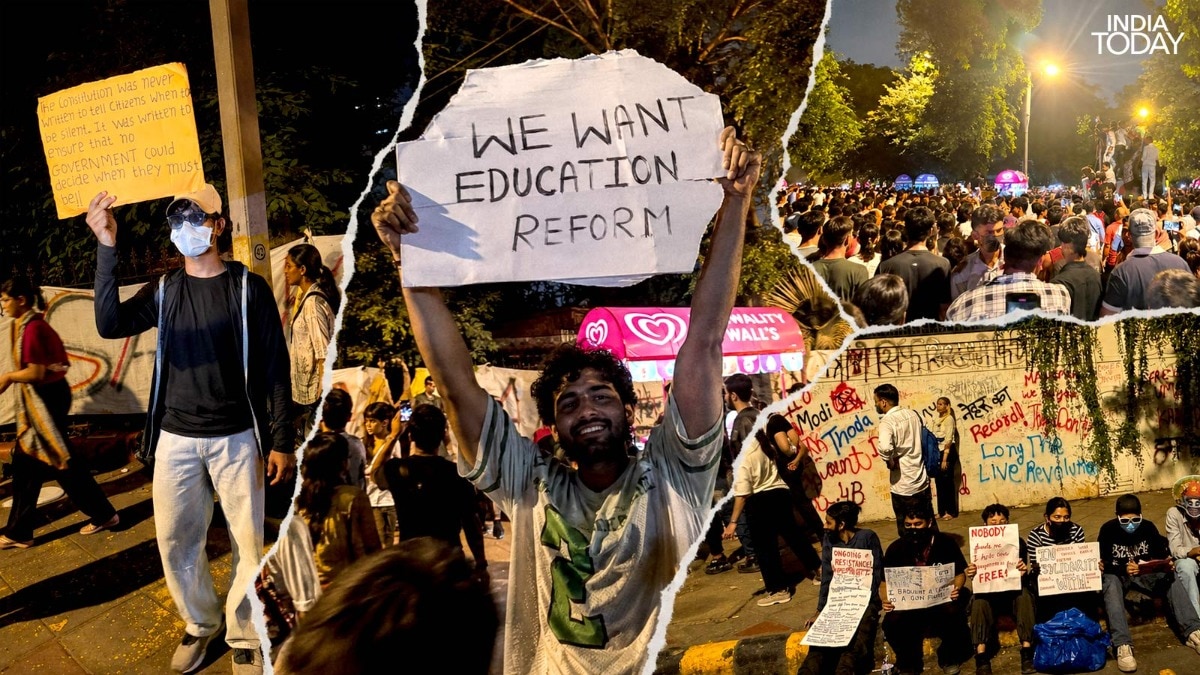
Most protests don't really end. Some simply run out of people. Others run out of time. A few end in compromise. Many fade so gradually that nobody can quite say when they were over.Very rarely, they end in celebration. I arrived just in time to witness one.By the time I reached Jantar Mantar on Saturday evening, volunteers were already dismantling the protest site. The podium from which speeches had echoed for weeks had disappeared. Tarpaulin sheets that had sheltered protesters through relentless rain, Delhi's unforgiving summer heat and the suffocating humidity of this year's monsoon were being rolled up and folded away.Yet with every step I took towards Jantar Mantar, the celebrations grew louder. Jantar Mantar buzzes with people on Saturday evening following the protest's victory. (Photo: Koustav Das) Chants of "Bharat Mata Ki Jai" and "Inquilab Zindabad" drifted along the approach roads, blending with music, cheers and the constant buzz of conversation. It felt less like I was walking towards the end of a protest than into the middle of a festival.Every road leading to the protest site was overflowing. Young people kept pouring in from every direction, many of them arriving hours after Union Education Minister Dharmendra Pradhan's resignation had already made headlines. Some had flags wrapped around their shoulders. Others carried portable speakers, selfie sticks and phones that had begun recording long before they reached the crowd. Many had spent weeks following the movement online and simply wanted to witness its final chapter in person. A protester stands with the Indian flag at Jantar Mantar. (Photo: Koustav Das) The infrastructure of protest was disappearing. The people weren't. If anything, there was more laughter than there had been slogans.For over a month, Jantar Mantar had been defined by uncertainty. Nobody knew whether the movement would force a political response or slowly lose momentum like so many protests before it. Saturday evening felt different.The waiting was over. Relief had replaced anxiety, and the place no longer felt like the site of an anxious, uncertain protest.It felt like a celebration—not the kind marked by food stalls or Ferris wheels, but a celebration of persistence. Of young people who had endured arrests, police lathi charges, rain, blistering heat and weeks of emotional exhaustion without knowing whether any of it would matter.They weren't merely celebrating the resignation of a Union minister. They were celebrating the feeling that showing up, day after day, had finally achieved something tangible.The Cockroach Janta Party, or CJP, had won. The movement had begun with what many dismissed as another fleeting internet trend. It took its name from a remark by Chief Justice of India Surya Kant, who likened unemployed youth and activists to "cockroaches" during a Supreme Court hearing. Though he later clarified his comments, by then the label had already been embraced online.Rather than reject the insult, young Indians adopted it. What started as satire online quickly spread to the streets with students and young professionals gathering at Jantar Mantar to demand accountability over the NEET paper leak and broader examination reforms.Weeks of relentless protests followed, enduring police lathi charges, detentions, heavy rain, blistering heat and emotional exhaustion before culminating in the resignation of the Union education minister.Yet, standing there yesterday, politics wasn't the first thing that struck me.The people were.Interestingly, the faces most associated with the movement weren't even there. The CJP leaders, who had spent well over a month living and breathing the protest, had already stepped away. Frankly, they had earned a long nap and perhaps even a drink or two.But the energy hadn't left with them. If anything, it had only become louder. People celebrate with songs, slogans and cheers at Jantar Mantar. (Photo: Koustav Das) Even before I reached the main protest site, I could hear the celebrations. Chants of "Bharat Mata Ki Jai", "Jai Hind" and "Inquilab Zindabad" echoed through the narrow approach roads, blending into laughter, music and hundreds of conversations happening all at once.Sweat clung to almost everyone. Handheld fans worked overtime. Water bottles moved freely from one stranger to another. Yet nobody seemed remotely interested in complaining about the weather. Every face carried the unmistakable expression of people who had waited weeks for a moment they had never been entirely sure would arrive.What surprised me most wasn't the size of the crowd. It was the number of microphones. Everywhere I looked, young men and women carrying wireless microphones, selfie sticks and mobile phones were weaving through the sea of people looking for their next conversation. Every few steps, someone was recording a reel. Another creator was speaking directly into a camera.Elsewhere, strangers who had never met before were happily giving interviews as if they'd known each other for years. The questions were remarkably similar."What do you feel after Pradhan's resignation?""What happens now?""Who's next?"That last question came up repeatedly. The answers differed only in how directly people chose to say them.I'll simply leave you with a hint.E20.One of the oldest criticisms of social media is that it encourages performative activism—that it rewards appearances over commitment and viral moments over meaningful action. Standing at Jantar Mantar yesterday, the argument felt strangely out of date.Content hadn't merely documented this movement. It had fuelled it. Memes had pulled people in. Instagram posts had kept them hooked. Viral clips had carried speeches far beyond the handful of people who could actually hear them in person.Every major moment of the protest had travelled across timelines within minutes, finding new audiences, new volunteers and new supporters before television news had even caught up. Everyone had their phones and cameras out, taking photos, recording videos. (Photo: Koustav Das) It sometimes felt as though every phone was recording a phone that was recording the celebration. History wasn't waiting to be archived. It was being created, edited and uploaded.Perhaps that was what made this movement different from almost every demonstration I've seen in recent years. I've seen protests that drew larger crowds—agitations that lasted longer, became more confrontational and generated far greater political drama.But I have never seen one that understood the internet so instinctively. Nor have I witnessed one celebrate victory quite like this.The soundtrack alone told its own story. There was music everywhere. Protest poetry still found eager listeners. Yet what caught me completely off guard was how often giant boom boxes erupted with songs from Rang De Basanti, Swades and Yuva.Two decades after those films were released, their music had found another generation. Many of the youngsters singing along hadn't even been born when those films first reached theatres.Yet they knew every lyric. Complete strangers linked arms, sang together and occasionally broke into dance. For a few fleeting moments, it felt as though Bollywood's greatest political soundtracks had quietly found a second life.Perhaps Bollywood should take note.The crowd offered another surprise. Everywhere I turned, superheroes had assembled. Spider-Man was dancing and posing for photographs with strangers. Nearby, a group wearing Avengers masks waved flags while chanting slogans. It would have looked absurd anywhere else. Here, it somehow felt perfectly natural. A masked protester raises a placard during the celebrations at Jantar Mantar. (Photo: Koustav Das) Some wore masks because they had become part of the movement's visual identity. Others did so after reports that protesters were being identified through photographs and videos circulating online.A few, I suspect, simply preferred not to answer awkward questions at home about where they had spent the day.Whatever the reason, every hero seemed to have reported for duty. Only this time, they weren't there to save the world. They were there to celebrate.The placards deserved a gallery of their own. Creative Gen Z placards became a defining feature of the Cockroach Janta Party protests. (Photo: Koustav Das) Some were hilarious enough to make complete strangers stop and photograph them. Others relied on layers of internet humour that would have baffled anyone who hadn't spent the past month following the movement online. Not just placards, spray-painted walls told stories of protest. (Photo: Koustav Das) A few were so inventive that any newspaper editor would struggle to publish them without reaching for the delete key. Gen Z, it turns out, has developed a remarkable ability to compress politics, satire and meme culture onto a single sheet of cardboard.Yet amid all the jokes, one placard refused to leave my mind. "I have lost my fear."There was nothing flashy about it. No elaborate artwork. No clever wordplay. No punchline. Just four handwritten words.For weeks, politicians, lawyers, activists and television anchors had all tried to explain what this movement represented. That placard managed it in four words. If there was one image that captured the spirit of the day better than the speeches, the slogans or even the celebrations, it was that.The cameras, however, rarely lingered on something else that struck me just as much.Compassion.While content creators chased interviews and crowds sang old Bollywood songs, volunteers quietly carried on doing exactly what they had done throughout the protest.Drinking water kept circulating through the crowd. Food packets moved from one corner to another without anyone keeping count. Youngsters stopped to fan complete strangers who looked exhausted by the heat.Others picked up discarded bottles, paper plates and wrappers before the grounds became littered.Nobody announced these efforts from a stage. Nobody demanded applause. Nobody seemed particularly interested in filming them either. These were the invisible acts that had kept the protest alive long before victory arrived.Every movement has its recognisable faces. It also has hundreds of people history almost never remembers. The accomplishment belonged to them as much as anyone standing on a stage.As the evening wore on into the night, one thing became increasingly clear. The protest had outgrown the demand that had first brought people to Jantar Mantar.Yes, people were celebrating the resignation of a Union minister. But that wasn't the only victory they believed they had won.They were celebrating the idea that their voice had mattered—that weeks of turning up every single day, designing posters, recording reels, organising food and water, sleeping on pavements, arguing online and refusing to disappear had finally produced something tangible.For many, Jantar Mantar had become more than a protest site. It had become a community—a place where strangers became collaborators, creators found audiences and students who had never imagined themselves attending a demonstration discovered that politics did not always have to look like television debates or election rallies. Sometimes, it looked like memes, microphones and music. Blurred by motion, but not by memory—people stream towards Jantar Mantar as celebration spills onto the streets. (Photo: Koustav Das) As a millennial, I have seen movements that were larger, angrier and politically more consequential. This one will stay with me for different reasons. Not because it was the biggest protest I have witnessed. Not because it forced the resignation of a Union minister. But because it made me rethink what political mobilisation looks like in 2026.For years, my generation has mocked Gen Z for living online. We complain that they spend too much time on Instagram, communicate in memes, chase algorithms and confuse visibility with impact.Standing at Jantar Mantar, those assumptions felt increasingly inadequate. This generation hadn't abandoned politics. It had simply found a different way to participate in it.The smartphone wasn't a distraction from the movement. For many, it was the movement. It organised people, documented events, challenged narratives, created communities and, perhaps most importantly, convinced thousands of young Indians that showing up in person was still worth it. And that is not a small achievement.THE ECHOES OF VICTORYEvery movement leaves something behind. Sometimes it is legislation. Sometimes it is a court judgment. Sometimes it is little more than photographs in an archive.Perhaps the Cockroach Janta Party will eventually be remembered for forcing political accountability over the NEET paper leak. Perhaps historians will write about how a movement born from a judicial remark and nurtured on Instagram found its way to the streets of Delhi. The roads leading to Jantar Mantar remained packed late into the night as celebrations continued. (Photo: Koustav Das) Those stories will be told. But I suspect the people who were at Jantar Mantar will remember something else.They will remember arriving after the stage had been dismantled, after the banners had come down, knowing the reels would eventually disappear beneath the algorithm—and finding thousands still streaming in, not to witness a protest, but to witness something far rarer: how one ended in victory.- EndsPublished By: Koustav DasPublished On: Jul 26, 2026 14:51 IST
Love, laughter and relief filled Jantar Mantar after a rare protest victory
Full Article
Original Source
Read the full article at Indiatoday →KhanList aggregates and links to publicly available news content. We do not host full articles from third-party sources. Always verify important information with original sources.