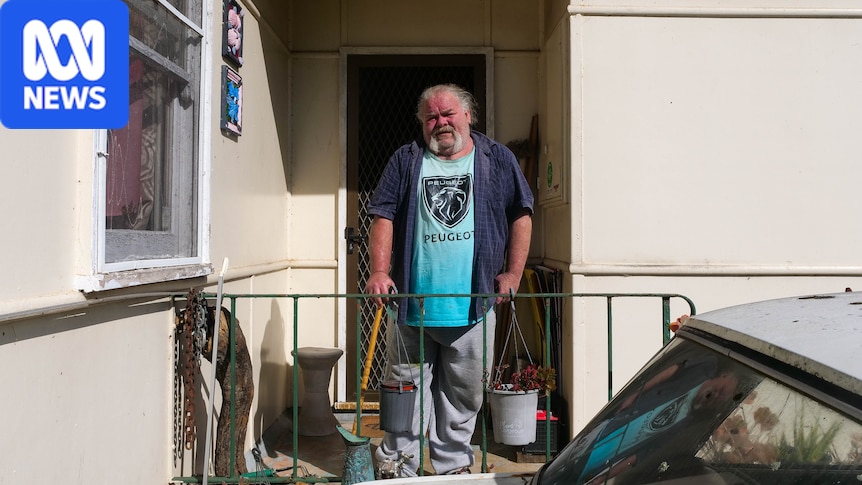
It gets so hot in Mark Hartley's social housing home in summer in Sydney's west that his TV breaks down.Mr Hartley lives in what he describes as a "fibro dog box" in South Windsor with no insulation, air-conditioning or cross-breeze."The sound goes, the picture goes. And it's basically all from heat," Mr Hartley said.In one recent summer, the front room reached an indoor temperature of 42 degrees Celsius and stayed above 35C for 11 hours.Mark Hartley says there is no place to escape the heat in his home in South Windsor. (ABC News: Declan Bowring)He says there is no cool part of the house, so when it gets too hot he drives to the banks of the Hawkesbury River to cool off."It's detrimental to my health, to think that I have to leave my home during the day when the sun's out," Mr Hartley said."What world do we live in where you can't put a ceiling fan in to keep someone cool?"It's an 80-year-old home that's very well built, but not built for … conditions of Australia."Cooling costs biteMr Hartley would like to make his place cooler but the home was made using asbestos, so he says he can't get a hole drilled without a hazmat suit.He tried using an air-conditioner but his electricity bill soared to $500 a quarter, chewing up a significant chunk of his Centrelink benefit."Actually affording the electricity to keep cool and, and then keep warm in winter is, is off the chart," Mr Hartley said.Lynne Dunn says she would rather not eat than not keep the house cool with fans and air-conditioning. (ABC News: Declan Bowring)It's a similar story for Lynne Dunn from Richmond in Sydney's Hawkesbury region, who is also in an uninsulated one-bedroom fibro home.The age pensioner says she spends most of the summer with the fan on, the curtains drawn and the door closed.She says wearing the $70 a fortnight to run air-conditioning and heating in winter is worth it."I'm not going to be hot or cold. I'd rather not eat than that," Ms Dunn said.Study finds low standards leading to extensive indoor hot spellsA new study highlights the low thermal safety standards of social housing in NSW, and the extreme heat currently being experienced.The study led by researchers from Western Sydney University found indoor temperatures in social housing across the city reached 29C for 70 days during summer.Using loggers inside and just outside homes across Greater Sydney, it found tenants of social housing experienced indoor temperatures above 35C for up to 32 days in one summer.Thermal safety in social housing should be seen as a human right, Professor Sebastian Pfautsch said. (ABC Radio Sydney: Declan Bowring)Professor of urban management and planning Sebastian Pfautsch said social housing was often built without thermal safety in mind, whether they were apartments or free-standing homes."This is mostly the case, because of the combination of single glazing, lots of window space with single glazing — so not very well insulated homes — and the lack of income," Professor Pfautsch said."Even if you have air-conditioning, you can't afford to switch it on because you can't afford the electricity bill."Professor Pfautsch said health risks associated with heat exposure increase once temperatures rise above 29C.The study published in Urban Climate suggests social housing tenants in Western Sydney will experience up to 148 days of indoor temperatures above 29C by 2060.Summers are getting warmer faster in Western Sydney than other parts of the city, according to the study. (ABC News: Berge Breiland)Professor Pfautsch said it was problematic that there were no standards for thermal safety in NSW social housing, given the homes built today will likely swelter through more frequent extreme heat with the warming climate."We need to realise that living thermally safe is a basic human right," Professor Pfautsch said."So what we really need to look at is how do we build the next generation of affordable and social housing in a way so that people are thermally safe?"In a warming future, we can't do that by putting single glazing in or aluminium frames or very, very little insulation."Higher standards in new builds under construction codesA spokesperson for Homes NSW said there was no standalone thermal safety standard for social housing in NSW, but new construction had to meet the National Construction Code and the NSW Sustainable Buildings SEPP which brought in thermal safety standard in 2004 was last updated in late 2023.Some of these standards require fans in all living areas and bedrooms and new homes with air-conditioning use solar cells to offset power bills."As part of the Social Housing Energy Performance Initiative (SHEPI), Homes NSW has upgraded the energy efficiency at more than 11,000 social housing properties since 2024, improving our tenants' thermal comfort and helping to reduce energy bills," the spokesperson said.Homes in Waterloo in Sydney's inner south are being demolished to be replaced by a mix of social housing, affordable housing and private dwellings. (ABC News: Declan Bowring)NSW Housing Minister Rose Jackson said not all social housing properties could be effectively retrofitted for thermal comfort."That's one of the key reasons why we are replacing aging social housing with modern, well-designed and energy efficient homes through renewal projects like at Waterloo Estate and Telopea," Ms Jackson said."Many of our public housing tenants are elderly or vulnerable so we take managing heat stress very seriously."Aging homes need government investment, provider saysA spokesperson for social housing manager Link Wentworth said many older properties, often built before current building standards, required significant investment to improve thermal comfort and energy efficiency."As a community housing provider, our rental income is intentionally low to ensure housing remains affordable, meaning major upgrade programs often require additional government investment," the spokesperson said."Continued investment in aging social housing stock will help accelerate these improvements and support residents to better cope with extreme weather."Link Wentworth's spokesperson said they had completed $1.3 million of energy upgrades funded through a NSW government grant in 2025.The study comes after the Bureau of Meteorology declared an El Nino weather event, which often leads to dry and warm weather on Australia's east coast.
Mark's home gets so hot he has to replace his TV
Full Article
Original Source
Read the full article at Abc →KhanList aggregates and links to publicly available news content. We do not host full articles from third-party sources. Always verify important information with original sources.