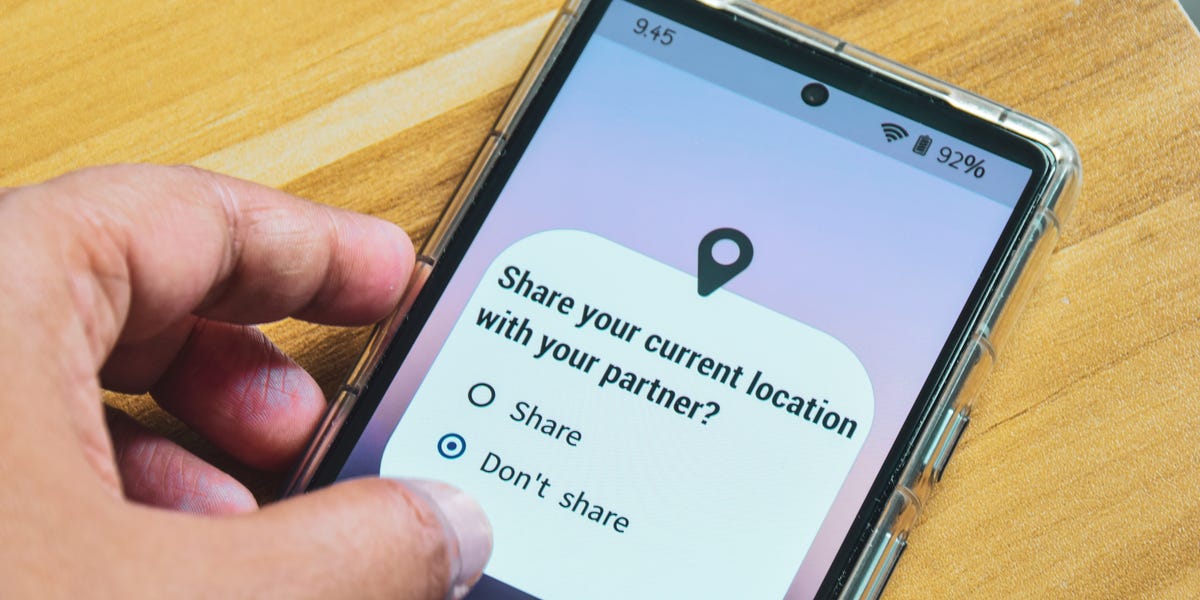
According to the New York Times, sharing your location with your partner is “the final frontier in digital expressions of couple life,” a bit like the first photo together on Instagram or what used to be setting the relationship status on Facebook. People share locations for a number of reasons—for convenience, like to know when the right time to call without disturbing the other person or to prepare dinner; others do it for safety reasons, like checking that their partner has arrived at their destination in one piece. Regardless of the reason, some say it is a form of love to be able to follow a partner's or friends' movements from a distance, especially when you are far apart. Others, though, use location sharing to delude themselves into thinking they can soothe their own possessiveness.In recent years, geolocation apps have become increasingly widespread. In 2009, “Find My iPhone” arrived, based on the same principle, and opened up new possibilities. In 2011 came the launch of “Find My Friends,” one of the best-known applications for sharing location with your contacts. In the following years, geolocation increasingly became a couples and relationship matter, and in 2019 Apple introduced “Find My,” confirming users' need to follow each other's movements. There are many others: applications such as Life360, Glympse, Google Family Link and Findmykids.The appeal of location sharingAccording to a survey conducted by the Life360 app, 95% of American adults in a relationship use some form of location-sharing technology and check the app an average of seven times a day. It is mainly young people who use them, being more accustomed to sharing their data online, and they often see it as a harmless habit and a form of emotional closeness. A recent Australian survey found that almost one in five young people between the ages of 18 and 24 think it is acceptable to track their partner whenever they want.Add Cosmopolitan as a preferred source in your Google search results.Use your Google account to add this to your settings.Naturally, there is also no shortage of misgivings about how it could be used, about the recriminations and obsessions that can arise from constant monitoring. I Can’t Track You? We’ll Have to Break Up is the headline of an article in the Wall Street Journal that analyzes the dynamics behind tracking: what does it mean if your partner refuses to share their location? And if they agree, but then ask you to stop doing it? What should you do when your partner turns off their phone and stops sharing?A matter of trust? Allowing the other person to monitor our movements and knowing that we can know where they are whenever we want can be seen as a demonstration of mutual trust and, for this reason, today it has almost become proof of a couple's solidity. And yet behind it lies a need for control that seems to characterize modern love. “A location-sharing app can be a practical help in everyday life, or it can turn into a tool for constant monitoring that suffocates the relationship,” explain the experts at Unobravo, the online psychology service. “A useful sign for understanding what role GPS plays in a couple is the reaction that may arise when one of the two suggests turning it off. If that request triggers anxiety, suspicion, or conflict, the sharing is probably not being experienced calmly.”It is important to ask yourself why you do it and how you experience it, whether it has to do with anxieties and insecurities, with trust issues linked to past relationships, with jealousy and tendencies toward possessiveness, or with the need to reduce unpredictability. A good test is to analyze how often you check the location and why you do it, how you react if your partner is in an unexpected place, and when geolocation becomes a form of blackmail to prove that you have nothing to hide.“Protecting your autonomy and your privacy does not mean loving less,” Unobravo emphasizes. “Being a couple does not mean merging and losing your boundaries: authentic trust is built on mutual respect, not on the forced transparency of every movement. No app can replace dialogue and working on oneself. True security in a relationship does not come from knowing where the other person is at every moment, but from the emotional certainty that you can count on the bond even when you are not in control.”
Is Sharing Your Location With Your Partner Actually Healthy?
Full Article
Original Source
Read the full article at Cosmopolitan →KhanList aggregates and links to publicly available news content. We do not host full articles from third-party sources. Always verify important information with original sources.