
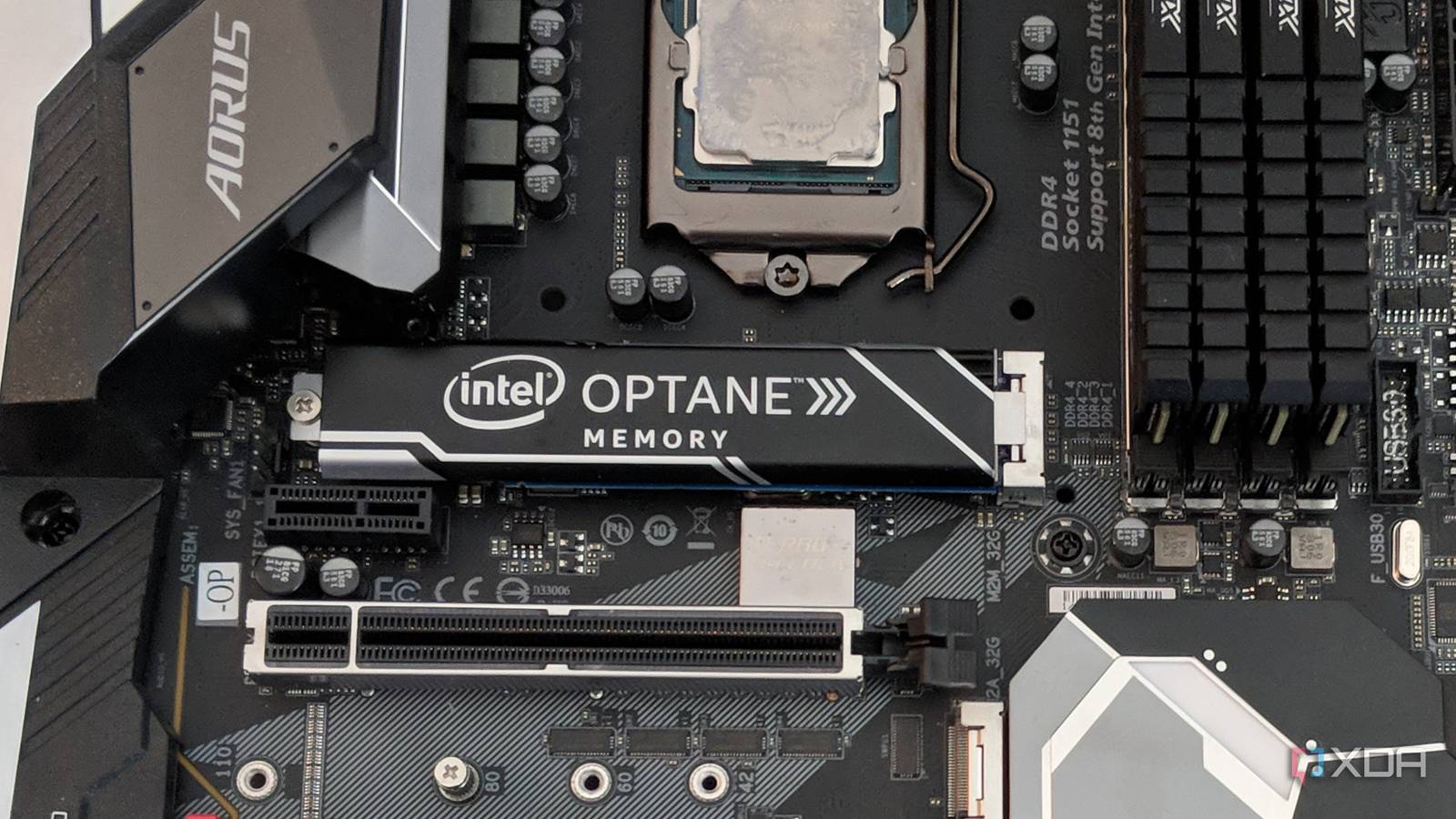
Published Oct 2, 2026, 4:30 PM EDT His love of PCs and their components was born out of trying to squeeze every ounce of performance out of the family computer. Tinkering with his own build at age 10 turned into building PCs for friends and family, fostering a passion that would ultimately take shape as a career path. Besides being the first call for tech support for those close to him, Ty is a computer science student, with his focus being cloud computing and networking. He also competed in semi-pro Counter-Strike for 8 years, making him intimately familiar with everything to do with peripherals. Intel pulled the plug on Optane in July 2022, wrote off more than half a billion dollars in inventory, and walked away from one of the more interesting storage technologies of the past decade. More than four years later, the P1600X, a 118GB M.2 drive Intel built to boot data center servers, keeps turning up in home lab communities and build threads. On paper, it doesn't make any sense: the drive is PCIe 3.0, smaller than most modern SSDs, and any current NVMe will beat it in sequential transfers. The reason why home labbers want it has nothing to do with normal SSD performance, though. It's a specialist, and whether it belongs in your home lab really depends on what you're running. Optane isn't a faster SSD, it's a different kind of storage entirely Uber-fast latency Every standard NAND SSD manages the same kind of compromise behind the storage that's actually on it. NAND can't overwrite data in place, so it has to erase large blocks before rewriting them, and that's where garbage collection, write amplification, and SLC caches come from. The caches hide the slow parts until they fill up, and then speeds slow down significantly. 3D XPoint, the memory inside Optane, writes in place, so there's no erase-before-write cycle and no cache to run out of. The drive behaves the same whether it's empty or nearly full, and whether it's been writing for one second or an hour, and that can be a huge advantage depending on the workload. Intel rates the P1600X at around 7 microseconds average read latency and 10 microseconds for writes, and that's where its value lies. Small random operations at a queue depth of one aren't something that normal users hammer all the time, but it's what a lot of server work produces. NAND drives post huge random IOPS figures by servicing deep queues in parallel, but give them one small write at a time and make each finish before the next, and the advantage Optane has becomes really clear. Sequential speeds are, of course, slower than even a budget Gen 4 drive, but that's not why people buy Optane. The endurance numbers are absurd I've never seen this before The 118GB model is rated for 1,292TB written. That works out to six full drive writes per day for five years. Raw TBW alone isn't a fair comparison, since a 2TB consumer drive can post a similar total just by having more cells to spread wear across. Per gigabyte, though, consumer drives aren't close, and per-gigabyte endurance is what matters when one small device absorbs every write passing through it. It's also a key benefit of used Optane, which is all that's left at the moment. Where a 118GB drive actually fits into your home lab Here's what you actually use one for Intel built the P1600X as a boot drive, and on a Proxmox host, logging, RRD graphs, and the cluster database write constantly in the background, so the endurance argument is real, especially on a ZFS root. The use home lab enthusaists talk about most, though, is SLOG. When an application asks for a synchronous write, ZFS records it in the ZFS Intent Log before confirming. By default, that log lives on the pool's own disks, so on hard drives every sync write waits on platter latency. A SLOG moves the log to a dedicated device. It isn't a write cache, because ZFS only reads it back after a crash, but what it needs is low latency and power-loss protection, and the P1600X happens to have both in spades. It also needs very little space. ZFS commits transaction groups every five seconds by default, so a SLOG only has to hold a few seconds of incoming writes, which is a few gigabytes at 2.5GbE. That leftover capacity is why some people partition one drive for both SLOG and L2ARC. If you do use L2ARC, you don't need Optane; instead, more RAM is almost always the better upgrade. You can only get them on the second-hand market No new Optane is coming NAND contract prices climbed sharply from late 2025 into this year as manufacturers shifted capacity toward AI data centers, and some manufacturers like Kioxia say its 2026 production is already sold out. Optane sits outside all of that, and it's a double-edged sword to some degree. Micron, Intel's 3D XPoint manufacturing partner, exited in 2021 and sold the fab that made it, and Intel started its own wind-down a year later. That means no new Optane is ever going to hit the market unless Intel decides to spin it back up from the dead. No new P1600X drives are coming, so used pricing depends on remaining stock rather than wafer costs. The drives seem to be sitting around $250-$350 at the time of writing, but there's a finite amount of them now, so I'd expect that price to only rise. For workloads that need it, there's nothing quite like it For workloads that do generate sync writes, there's nothing quite like Optane. On a pool of hard drives, you're always waiting on the slowest part of the system. Enterprise NAND narrows the gap a bit, but Optane's latency stays flat no matter how full the drive is or what else it's doing, and it only has to hold your logs, not your storage array. The P1600X isn't a must-have, but for workloads that make a spinning-disk pool feel sluggish, there's nothing that comes close for the price.
Intel stopped making Optane, but its tiny 118GB drive is still the boot drive home lab enthusiasts hunt for
Full Article
Original Source
Read the full article at Xda-developers →KhanList aggregates and links to publicly available news content. We do not host full articles from third-party sources. Always verify important information with original sources.