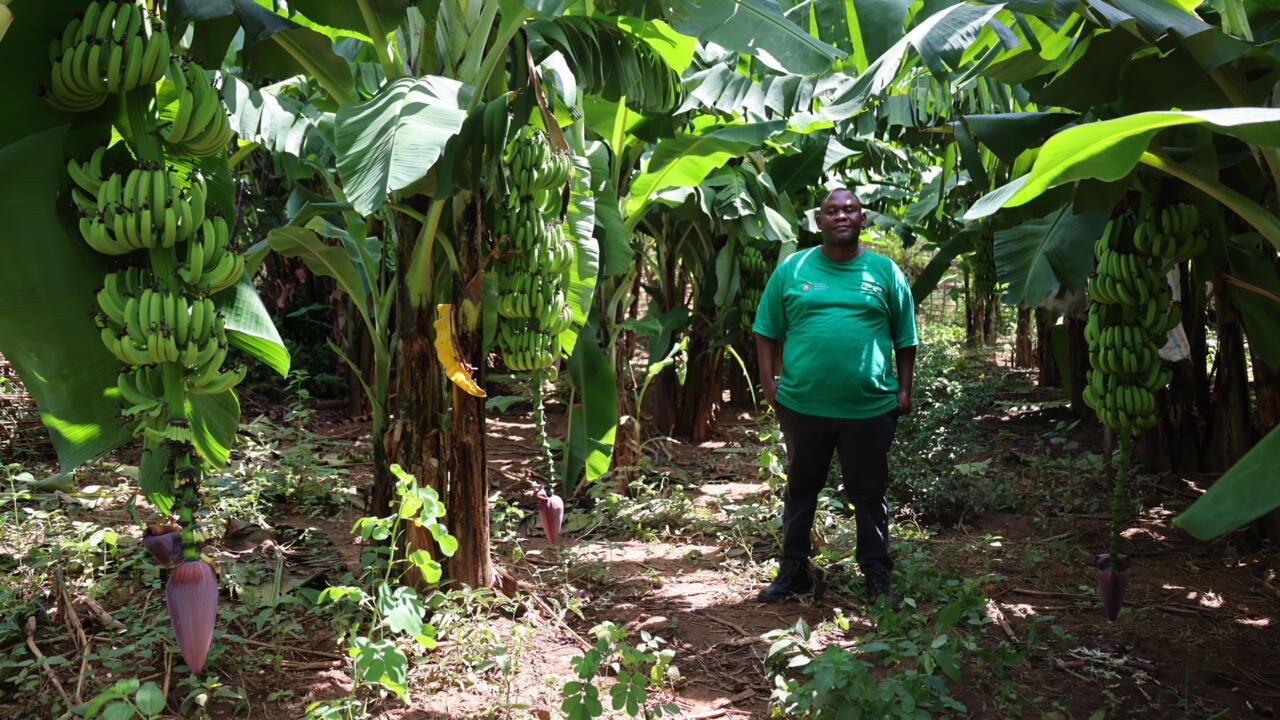
Nsanje, Malawi – When Davie Kampira, 34, a farmer in Nsanje, southern Malawi, received 34 banana suckers in 2024, he did not envisage that the few dozen plants he tried out on a run-down piece of land, previously used for brickmaking, would transform into a small estate. Today, two years later, the land beside the river has produced nine hectares of different banana varieties, along with houses, a shop and a better life for his two children and wife. Issued on: 31/07/2026 - 22:29 3 min Reading time Charles Pensulo in Malawi "Banana farming is much better than maize because I am able to harvest every eight months, and I have been earning more compared with when I was growing maize," said Kampira, who sells a bunch for 25,000 Malawian kwacha (€12.61), while holding a large, mature green banana bunch on his farm in Fatima, Traditional Authority Mlolo, in Nsanje district. The frontline of disaster The district is prone to disaster, partly because of its geographical position. As well as its low-lying altitude, it is also where an outlet of Lake Malawi, the Shire River, is found, and where water from the rest of the country's water bodies ends up. Kampira's farm in Malawi © RFI/Charles Pensulo While the area is known for its high temperatures, most rainy seasons bring floods, damaging land, people and livelihoods. When cyclones have hit the country, including Cyclone Freddy, the damage has been immense. Thousands displaced as flooding devastates wetland crops in Malawi Yet while efforts have mainly focused on minimising damage to people and their livelihoods, far less attention has been paid to soil fertility and to structures that help the land absorb more water. Suckers passed from farmer to farmer To address the problem, a project supported by the Zurich Climate Resilience Alliance and implemented by Concern Worldwide provided 1,064 banana suckers to 100 farmers across 15 communities. Under the scheme, farmers were to pass on ten suckers each to others within ten months, to help expand the farming. Thousands displaced as flooding devastates wetland crops in Malawi "Apart from controlling soil erosion, we are also looking at the issue of food security," Ernest Kambiya, programme officer for monitoring and evaluation at Concern Worldwide, told RFI. "As you are aware, Nsanje and Chikwawa are among the country's disaster hotspots. If it isn't floods, it's sometimes dry spells." Banana plants are considered highly effective at controlling soil erosion, particularly when managed through proper mulching, contour planting and intercropping. According to reports, their thick canopy breaks the force of heavy tropical rain, while their extensive root networks and leaves, used as ground cover, help prevent topsoil from washing away. In Nsanje district, the crop is helping to rebuild soil structures, with a particular focus on downstream areas, to protect against recurrent flooding, according to the charity. The banana suckers' dense root systems help prevent soil erosion, especially on sloped terrain, and protect farmland from degradation during heavy rains. According to Kambiya, banana farming is part of a wider disaster-preparedness project. "Research has shown that we can save more by preparing vulnerable communities in advance, rather than simply responding to disasters," he said. Malawians face food insecurity and soaring unemployment as they head to polls "This is one of the nature-based solutions we are promoting, alongside banana production. We also tried bamboo, but that proved less successful because of the cyclone floods, whereas most of the bananas survived," he added. A natural hedge against the water Agriculture expert Tamani Nkhono-Mvula told RFI that bananas have huge potential for conserving soil and improving food security. "If you plant bananas, they act as a hedge and, in most cases, trap large amounts of water, which helps to conserve the soil. Bananas are deep-rooted crops, just like vetiver grass. In places such as Mulanje and Thyolo, where bananas have been planted, soil erosion has been greatly reduced," he said. Malawi's economic crisis pushes prices beyond the reach of struggling population For Kampira, the benefits of banana farming are not hypothetical but a lived reality. He hopes to expand his farm further and market his fruit across the country. "I have also helped to conserve the environment, because here on the farm, erosion doesn't happen, even when the water comes, despite being so close to the river," he added.
In flood-prone Malawi, bananas become a shield against erosion
Full Article
Original Source
Read the full article at Rfi →KhanList aggregates and links to publicly available news content. We do not host full articles from third-party sources. Always verify important information with original sources.